NALC Continental Youth Gathering: Forming Young Disciples Across North America

Every two years, youth and their leaders from across the North American Lutheran Church (NALC) will  gather for four days of worship, teaching, and service at the Continental Youth Gathering (CYG). What began as a hopeful experiment in 2024 has already grown into a vital tradition where young people encounter Christ, deepen their faith, and discover what it means to live as His disciples in the world.

The first CYG – WE BELONG, was held in Boerne, Texas, in 2024 and brought together youth, adult leaders, and volunteers from across the United States and Canada. The next CYG – REJOICE, will take place July 7–10, 2026, at St. John Lutheran Church in Roanoke, Virginia, where organizers are planning for approximately 400 youth, leaders and volunteers. While the event is hosted by the NALC, its reach and impact extends well beyond. It includes partner agencies and the local community who play significant roles in making it possible.

At its heart, the CYG is not a “conference” or a “camp,” but a gathering built around Word, worship, and witness. Each day centers on Scripture, with teaching that is deeply rooted in the Gospel and the Lutheran confessional tradition, yet accessible and engaging for today’s youth. Large-group sessions combine solid biblical preaching with practical application, helping young people connect Christ’s finished work on the cross to the very real questions and pressures they face in daily life. Bible studies invite youth into smaller communities where they can dig deeper, share their own experiences, and learn to read Scripture not just as a story “back then,” but as God’s living Word for them today. And Worship is part of the daily rhythm, not a side event. Through song, prayer, and proclamation, participants are invited to bring their whole selves to the Lord—joys, doubts, anxieties, and hopes. By celebrating the Lord’s Supper with the wider church, participants are reminded that we belong to something larger than a single local congregation; we belong to the one, holy, catholic, and apostolic Church and that is a reason to rejoice.

A key aspect of the 2026 gathering in Roanoke will be mission projects throughout the local community. Youth will step beyond the walls of the host church to serve alongside local organizations—supporting shelters, food ministries, neighborhood projects, and other community partners.

These mission experiences are not simply “volunteer hours” to be logged. They are framed as an extension of the Chrisitan life: a lived response to the grace participants have received in Christ. Throughout the CYG youth are guided to reflect on why Christians serve, how Christ is present in the margins, and what it means to be a witness in everyday life.

For local agencies and ministries, CYG offers an influx of energetic volunteers and an opportunity to build longer-term relationships with congregations across North America. Many youth will return home eager to continue serving in their own communities, inspired by what they experienced together in Roanoke.

Events like the Continental Youth Gathering do not happen in isolation. They rely on a web of partners—congregations, local ministries, prayer supporters, and agencies that share a commitment to forming lifelong disciples of Jesus.

You can support the CYG in a variety of ways:

  • Pray and give encouragement to youth, leaders, organizers, speakers and those volunteering.
  • If you are a local mission in Roanoke reach out to the Director of Youth and Family Ministries to see how we can partner.
  • Financial support—through designated gifts, sponsorships, or grants—helps keep registration costs accessible, provides scholarships for youth from smaller congregations, and underwrites the local mission projects we are able to offer in Roanoke.
  • Help spread the word so that more congregations can send youth and leaders.

In a world where many young people feel disconnected from church, the CYG offers a hopeful counter-story: a living picture of the Gospel at work, drawing together youth, mentors, and congregations around Christ and His mission.

For more information contact Pastor Teresa Peters at [email protected]

If you would like to register you can do so here: https://thenalc.org/en-us/our-work/equipping-disciples/families/


March for Life and Y4Life Conference in January!

The NALC Life Ministries team is once again preparing for the March for Life in Washington D.C. this January, but our plan is a little different. Instead of holding a life conference, NALC Life has decided to team up with Lutherans for Life (LFL) and participate in their events at the march! Their youth conference, Y4Life, will be held at the Hilton Arlington Landing Hotel (2399 Richmond Highway, Arlington, VA 22202) from Thursday, January 22rd, 2026 through Saturday, January 24th, 2026 and it has over 400 kids already registered – register at https://y4life.org/events/ We encourage all our NALC youth to participate in this free conference.

On Friday, January 23rd we will be once again participating in the March for Life under the NALC banner, and I hope you can join us at 12th and Madison Sts., N.W at noon as we march to the U.S. Capitol.

Before the march there is a prayer service at DAR Constitution Hall 1776 D St. NW (18th and D St.) Washington, DC 20006 starting at 8:30am. The service will be in celebration of America’s 250th birthday, celebrating the Right to Life as recognized in our Declaration of Independence and honoring the memory of Charlie Kirk. The special speaker will be Liche Ariza, who plays the role of Gedera, a Sadducee in Jerusalem and a member of the Sanhedrin in The Chosen.

All our NALC members are invited to attend this service and our clergy are invited to participate (stoles are white). If you have any problems at the march, please contact Pastor Dennis Di Mauro at (703) 568-3346. Pastor Di Mauro can also host you in his home if you would like to stay overnight in DC. We can’t wait to see you in our nation’s capital this January!!


“What We Can All Learn from the ELCA’s Dramatic Decline”

Ever since I became a Lutheran pastor I have been fascinated with denominational statistical trends.  I have especially been interested—and concerned—with trends among Lutheran denominations in general and, starting in 1987, the statistical trends for the ELCA in particular.

The ELCA currently stands out as the Lutheran denomination dealing with the most dramatic rate of institutional decline.  Or perhaps “dealing with” is something of a misnomer.  Why?  Because I see no indication that ELCA leaders even acknowledge their precipitous decline, let alone “deal” with it.

However, as an NALC pastor, I don’t want to only speak to what’s happening in the ELCA.  I also want to address what the NALC—and the LCMC—can learn from the astonishing rate at which the ELCA is losing members.  So bear with me as I share some ELCA statistical realities.

Even attempting to discern the actual rate of decline for the ELCA has, admittedly, been a significant challenge for me.  The reason for this is because, by and large, ELCA leaders have chosen not to publicly acknowledge their staggering losses.  And this has especially been the case since 2010.

The most striking example of the failure of ELCA leadership to address this issue was their lack of response to an article published by Faith-Lead Magazine in September of 2019.  This article was written by Luther Seminary (ELCA) professor Dwight Zscheile, and was entitled, “Will the ELCA Be Gone in 30 Years?”  Needless to say, this title captured my attention.  (And keep in mind that Professor Zscheile was and still is a member of the faculty at Luther, the ELCA’s largest seminary.)  The two most salient points of this article were predictions of the loss in baptized members and regular worship attenders if the internal demographic trends for the ELCA in 2019 continued.  And here were those predictions:

1. The ELCA would only have a total of approximately 67,000 members nationally by 2050.  And…

2. The number of ELCA worshipers—nationally—on a typical Sunday in 2041 will be less than 16,000.

Furthermore, this article made clear that, if these projections turned out to be accurate, the ELCA would no longer be viable as a national church body in 2050.

Given that, back in 2010, the ELCA still claimed on their website that they had “almost” five million members, I was initially skeptical that a denomination of that size could essentially implode by the year 2050.  And I was also not sure how ELCA leaders would respond to this article’s conclusions.  So in 2019 I started monitoring the ELCA’s national magazine, Living Lutheran, to see what their response might be.  I found absolutely no response to or acknowledgment of the 2019 article; or for that matter, any article where an ELCA leader addressed the subject of the ELCA’s institutional decline.

Granted, the ELCA’s national denominational website has, over the last fifteen years been periodically adjusting downward their stated national membership total.  They now (as of late 2025) describe that number as “nearly” 2.7 million members.  This represents a loss of approximately 2.3 million members in fifteen years.  And this translates into a 46% drop in membership in those fifteen years!

My on-going investigation, since 2019, to obtain the full story regarding what’s happening in the ELCA finally “paid off” this last November.  That was when I discovered an internal study by the ELCA’s own Research and Evaluation Team, released in February of 2025.  The title of this document is, “The Future Need for Pastoral Leaders in the Evangelical Lutheran Church in America”.  Now while the staff’s assignment was to address the future need for more ordained pastors, part of this document is a section focused on “the present state of congregations” in the ELCA.  In that section of the report the authors acknowledged that congregational membership figures were typically out-of-date; and that being the case, they instead looked at average worship attendance as the more meaningful statistic.  What did they report when it came to the “present state” of ELCA congregations?  Between 2015 and 2022, congregations with fewer than 50 in average attendance almost doubled.  In 2015, 3 out of 10 congregations reported less than 50 worshipers on an average Sunday.  By 2022, there were nearly 6 out of 10 churches in that size category.  For medium-sized churches (worshiping between 151 and 250) the trend was similar.  Congregations of that size were 12% of ELCA churches in 2015, but only 4% in 2022.  And finally, large congregations (worshiping over 250 in 2015) were 9% of ELCA churches in 2015, but only 2% in 2022.  Here’s a direct quote regarding these “large” ELCA congregations: “To be exact, in 2022, only 167 congregations (nationally) reported an average worship attendance over 250.”  Keep in mind that this is only 167 “large” congregations out of the 8,500 “worshiping communities” the ELCA currently reports on their website!

One more quote from this study: “In summary, the decline in worship attendance in congregations has profoundly reshaped the makeup of the ELCA.  Only a few years ago, the ELCA was composed mostly of small to medium-sized congregations.  Today, it is mostly very small congregations.”  (Emphasis mine)

Now keep in mind that since these statistics were true as of the year 2022, they no doubt are an undercount of the ELCA’s total losses as of 2026, and consequently minimize the current, full extent of the ELCA’s institutional decline.

But How is the ELCA’s Decline Relevant for Congregations in the NALC and LCMC?

I assume that most readers of this article belong to NALC or LCMC congregations.  So let me be clear: The primary reason why the ELCA decline is so dramatic, while both the LCMC and NALC appear to be relatively stable, is because there continues to be an exodus of ELCA congregations through disaffiliation.  And virtually all of these churches leaving the ELCA end up joining either (or both) the LCMC and NALC.  And it’s also important to recognize that movement from the ELCA to the NALC and LCMC does not constitute evangelistic growth.  To use a tired phrase, this is nothing more than a “reshuffling of the saints”.

Furthermore, it is imperative that we recognize that many of the institutional trends in the ELCA—such as plummeting numbers of baptisms and confirmations—and an aging membership, are also trends among many LCMC and NALC churches.  Just one demographic statistic that pertains to our country’s population as a whole: Between 2010 and 2020 the U.S. population of seniors 65 and over grew nearly five times faster than the overall population.  Not surprisingly, this trend has an impact on the overwhelming majority of our congregations.

However, to put it bluntly, I think we need to consider whether we can learn from the dramatic decline of the ELCA.  In other words, we need to ask whether the LCMC and NALC could be facing similar rates of decline in the not-too-distant future.

Now I’m convinced that part of the ELCA’s rate of decline is due to the increased politicization of the ELCA since 2009.  But I also believe that a second cause for this decline is an apparent complete disregard, by most ELCA leaders, of the importance of congregational evangelism.  So consider this a wake-up call for all Lutheran congregations: It’s time to make evangelistic outreach your top ministry priority.  And not just to stem the tide of future institutional decline.  Ultimately this is about our New Testament mandate to share the Good News; to witness to the increasing number of Americans who self-identify as “nones” when asked about their religious affiliation.  It’s about reaching out and connecting—as individuals and congregations—to those who do not yet know Jesus Christ as Savior and Lord.

Just trying to “keep the ship (your congregation) afloat” will no longer suffice.  The challenges we are facing are too significant for us to settle for a passive and/or reactive response.  Instead, we need proactive, congregation-wide strategies for reaching, evangelizing and discipling those in our community who are not a part of a Christian church.  In pursuit of that goal, I encourage you to consider the ministry strategies below.

Congregational Outreach Strategies

The single, overarching principle I advocate for is simply this: Creating new groups and ministries for new people.  And to pursue this principle in a comprehensive way, consider what this principle could entail in four areas of your congregation’s ministry.  (And if you can’t do all four simultaneously, choose one to start with, and try to excel in that one area of ministry.)

1. Small Groups and Bible Studies.  This could be your primary discipling (i.e., disciple-making) effort. It can be the best way to not only help members grow in their faith; it can also be a tremendous witnessing opportunity that will—incrementally—help motivate members to bring friends and acquaintances to your congregation.  Never forget the unfortunate reality with small groups that are only made up of already-committed members: they often become cliques.  However, small groups with a discipling emphasis can become effective ways to reach the unchurched; one person (or two) at a time. For published discipling small-group resources consider Sola Publishing.

2. Worship and Hospitality.  For your worship service to reach and assimilate new people it needs to be both participatory in its content and be characterized—before and after worship—by intentional hospitality.  Here’s the goal: Make your Sunday morning worship life the kind of experience that will motivate and inspire your members to invite and bring their unchurched friends and acquaintances to your service.

3. Community Outreach.  Do this primarily for the sake of those you serve.  But do it, in addition, so your members can use their gifts in such a ministry, and so your congregation will be seen, by your surrounding community, as the church that does far more than simply “take care of its own”.

4. Organizing and/or strengthening your ministries for children and youth; and for their parents.

This can be a huge challenge.  Some congregations are simply too small; and as a result don’t have any children or youth.  However, if you sense any potential at all to build this kind of ministry, be ready to invest the necessary resources to help make this happen.  Remember that for those congregations who end up without any nesting stage, active families, their future, long-term viability as a faith community is at risk.

If you have any questions regarding the details of these congregational outreach strategies, don’t hesitate to contact me directly by email.

Pastor Don Brandt

[email protected]

Director of Lutheran CORE’s Congregations in Transition, and the Congregational Lay-leadership Initiative


The Past, Present, and Future of “Bound Conscience”

Director’s Note: Many thanks to Bob Benne, esteemed NALC theologian and friend of Lutheran CORE, for his review of the history of the whole issue of “Bound Conscience.”

The 2022 ELCA Churchwide Assembly passed two resolutions that called for reconsideration of
the 2009 social statement, “Human Sexuality: Gift and Trust.”

  • Reconsideration #1 called for a review of specific text references in light of the 2015
    Supreme Court ruling regarding same sex marriage and “public acceptance of marriage of
    same-gender and gender-non-conforming couples.”
  • Reconsideration #2 called for a reconsideration of the “church’s current concept of the
    four positions of bound conscience” found on pages 19-21 of “Human Sexuality: Gift and
    Trust.”

The task force that was appointed to work on these reconsiderations had recommendations for
the 2025 Churchwide Assembly regarding Reconsideration # 1. They described these
recommendations as “simply editorial,” even though they amounted to no less than a complete
embrace of every form of sexual orientation and gender identity.

The task force is now working on its recommendations for Reconsideration # 2, which will be
voted on at the 2028 Churchwide Assembly. Given everything that is happening and the
direction in which everything is going, it is hard to imagine that providing a place of dignity,
belonging, and respect for traditional views and those who hold them will survive.

Most Lutherans know of Martin Luther’s famous appeal to “bound conscience” at the Diet of Worms in 1521.  He insisted: “Unless I am convinced by the testimony of the Scriptures or by clear reason… my conscience is captive to the Word of God.”  His appeal to “bound conscience” meant that his theological and inner moral compass were not free but held captive by the authority of Scripture and clear reason.  For Luther, this wasn’t about subjective feeling but about obedience to God’s revealed truth, a profound conviction that led him to refuse to recant his writings, seeing it as right and safe only to follow God’s Word.   

There are no doubt many uses of the phrase in the history of Lutheranism since the 16th century, but the use we want to examine is its use in the midst of a controversy in the ELCA over the nature of marriage and its attendant sexual ethics.  While we will focus on the ELCA since 1989, it is important to note that agitation to change traditional teachings on those subjects was already present in the merging churches—the American Lutheran Church, the Lutheran Church in America, and the Association of Evangelical Lutheran Churches—especially in their youth divisions, as well as in their seminaries.

The Past

In the first Assembly of the ELCA in 1989, I roomed with a Virginia pastor who later became the Bishop of Virginia. He was assigned to attend the newly emerging youth organization. Every evening he would sorrowfully recount to me the ways that the adult leaders were propagandizing the youth into accepting practicing homosexual pastors and homosexual marriage.  We could already see what was to come in the new church.

Soon thereafter there were theological gatherings to resist the revisionism pushed by the new church and its Bishop, especially the Called to Faithfulness Conferences held in Northfield, Minnesota. By the turn of the century the newly organized Word Alone led many congregations out of the ELCA as a protest against its agreement with the Episcopal Church that all ordinations must be in the “apostolic succession,” which generally meant that Lutheran ordinations had to have an Episcopal Bishop among the presiders.  Those churches then became Lutheran Congregations in Mission for Christ.

Word Alone also sponsored the emergence of a protest movement against the moral revisionism of the ELCA.    I was present at its first gathering at St. Olaf College in 2003, which was organized and led by retired ELCA Bishop, Paull Spring.  Soon it took the name of Solid Rock and began organizing resistance to proposed changes in sexual ethics that would come about in the Churchwide Assembly of 2003. Solid Rock morphed into Coalition for Reform (CORE) with Roy Harrisville, Jr., as its executive.  Enough resistance was organized in both 2003 and 2005 that the revisionists did not get their way.  In 2005 a report noted that  “When Christians disagree about an ethical issue of this magnitude, one important category for determining the policy of the church may be the recognition that participants in this debate are disagreeing not out of pride or selfish desires, but because their consciences are bound to particular interpretations of Scripture and tradition. The careful way Luther approached moral dilemmas (e.g., in The Estate of Marriage [Luther’s Works 45: 17-49] or Whether Soldiers, Too, Can Be Saved [Luther’s Works 46: 93-137]) showed a genuine concern for the integrity of disputants.”  This report would become the groundwork for the “bound conscience” clause of 2009.

The Assembly of 2007 was supposed to be a truce concerning these issues, but at the end of the Assembly a Bishop proposed a successful amendment that no discipline should be used against those who were already disobeying church rules on sexual ethics.

After much work by a rather loaded task force on those issues, it proposed a social statement entitled Human Sexuality: Gift and Trust, The statement turned out to be ambiguous about every crucial issue and passed by a single vote at 666.  The Assembly also passed provisions for allowing partnered gay pastors and gay marriage.

Though the task force that drafted Human Sexuality was loaded with revisionists, there was enough resistance that the “bound conscience” provision was inserted as a concession to the traditionalists and as a defensive move to prevent a wholesale rebellion in the ELCA.  It recognized four “conscience-bound” positions that Lutherans could faithfully hold on the matter of same-sex relationships, ranging from full opposition to full affirmation of same-sex marriage and the ordination of LGBTQ+ clergy.

When hearings were held about the provision during the Assembly of 2009, I attended one and posed the question about whether it was simply a sop to traditionalist pastors and congregations at the local level to prevent wholesale losses, but that it would not protect traditionalists in any other facet of the church.  That has turned out to be true.  The upper levels of the church have been purged of recalcitrants.

The provision has been crucial for maintaining a painful compromise within the ELCA amid diverse views on human sexuality at the local level. Though hundreds of congregations left after 2009, those traditionalist pastors and congregations that stayed sheltered under the bound conscience provision. I have taught a number of such pastors at the Lutheran Institute of Theology, but they are worried about the future.  One has already transferred to the NALC.

The Present

What is going on to make such pastors and their congregations apprehensive?  The ELCA has already edited the statement and its rules to allow for same sex marriage language and is contemplating a more systematic application of the diversity, equity, and inclusivity ideology, which would definitely not include those traditionalists who cannot agree with the LGBT gender agenda. They are the oppressors and should be silenced or expelled.  Further, the elite of the ELCA have committed themselves to new fervid anti-racist policies that signal panic about the loss of black members even after decades of affirmative action, including the election of a black man as Presiding Bishop.

Those moves certainly signal that the bound conscience provisions are in grave danger.  Further, the task force that has been organized to examine and propose future policy has a majority of “progressives” that are likely to favor a withdrawal of the bound conscience provision.  But it seems that such a proposal is some distance in the future.  Meanwhile, traditionalist pastors and congregations are in uneasy limbo.

The Future

My hunch is that the bound conscience clause will go. There are certainly many level-headed members of the ELCA who prudentially see what will happen:  lots of losses of pastors and congregation with no gains.  More perceptive folks will see the further accommodation of the ELCA to secular progressive culture, much like sister liberal mainline denominations have done. Such accommodation means continued decline.

However, I think the “commanding heights” of the ELCA will push forward with their agenda, including the abolishment of the bound conscience clause.  The ELCA will continue down the slippery slope of accommodation.  When we in CORE were defeated decisively in 2009, we wagered that the ELCA would be unable to say “no” to anything in the sexual revolution. To confirm that wager, it has even made the grave error of propagandizing for transgenderism for children.

There is a long shot chance that the elite themselves will not push their agenda so quickly, or that synod representatives at the ELCA Assembly of 2028 will rebel and resist. But it is more likely that the Assembly will be managed well by the dominant elite, as it has been in most of them. They will make sure that their agenda will prevail.  And there will be one more step away from the Lutheranism whose teachings on marriage and sexuality are clearly grounded in Scripture and Tradition, to which our bound consciences yet cling.


Right Then and There

“I don’t want to offend anyone or lose my friends.” That was the reason one of my church council members gave as to why she holds back from talking to her close friends about faith.

Her response came from a discussion we were having about the importance of building intentional relationships with friends and neighbors with whom we can talk about what it means to be a follower of Jesus Christ. It’s reasonable to understand her hesitancy. Yet, simultaneously, sadly, this is an excuse many believers fall back on because they don’t know how. Admittedly, I have not been exempt from using it myself, that was until one day, I was moved to change.

I had been invited as a guest to attend an NALC Regional Convocation. During one of the breaks, I had an engaging conversation with four individuals from the same church, who were attending as a group. They had asked me about my seminary experience. Up to that point, I had had difficulties with the ELCA candidacy process and I was contemplating leaving to join the NALC.

Throughout our exchange, I noticed how easy it was to talk to them. Even though I was a fish out of water, so to speak, they never made me feel uncomfortable. Their questions were genuine, not attacking or forceful, all while respectful. As we neared the end of the break, they asked if they could pray for me. As I told them that I would appreciate it if they would, they did something quite unexpected; rather than going on their way, they surrounded me, each placing a hand on my shoulder or arm, and began to pray for me, right then and there. It caught me by surprise because I had never had someone not only offer to pray for me but to do it! Over the next few minutes, each of them took a turn praying over something they had picked up on as they listened in, praying for God to give me the insight I needed to make my decision, whatever it was to be, for strength and guidance to go wherever He called me. As they ended, I opened my eyes to find that there were no longer four people surrounding me; passersby had also stopped to pray, placing their hands on those around me.

That day, I witnessed a group of believers demonstrate what following Jesus looks like, and I saw that conversations about life and faith don’t have to be divisive, inspiring me to do the same.

When our Lord encountered someone who was spiritually and/or physically hurting, he didn’t attack them. He didn’t simply offer to pray for them and then continue on his way. Instead, he stopped and prayed over them at that moment.

In the years since, I have stepped out of my comfort zone and offered to pray for strangers—even even someone who struck up a conversation with me on a flight home from Texas.

The feeling I have after praying for someone is that of joy. Doing so reminds me of Luke’s Gospel, where Jesus sends out his disciples ahead of him. As Christ told his disciples (I’m paraphrasing), “If you meet someone receptive to the Word, have a conversation; if they are not, don’t force it and go on your way.” However, I have never encountered anyone who refused my offer of, ‘Can I pray for you?’

Yet, encouraging her and telling her how to do it—based on scripture—only goes so far. While I have had such a positive experience, I find myself asking how I can help empower my councilwoman to set aside her fear and step out in faith.

Her fear is reminiscent of the disciples when Jesus told them to feed the five thousand. They had no clue how, and they certainly didn’t believe they had what it took to get the job done until their shepherd showed them the way. Their reaction was evident; they needed more time to be equipped and empowered.

After they had spent some time watching and learning how Jesus ministered to others, he released his disciples to try it for themselves. That’s when he instructed them how to minister to those receptive to the Word of God and to those who are not. When they came back to him, they reported incredible joy. As her earthly Shepherd, I can see how God has prepared her to spend time with me to learn how to follow Jesus.


2009 to 2011: My Congregation’s Disaffiliation Journey

Back in the fall of 2009, shortly after the ELCA national assembly actions created so much controversy, my congregational members were already leaning toward disaffiliation.  In fact, my co-pastor and I took a quick Sunday-morning written survey in the fall of that year to confirm our sense that the majority of members disagreed with the new ELCA policies.  Sure enough, two-thirds disagreed with the national assembly’s actions.

However, the leaders of our church knew that two-thirds disagreeing was a “far cry” from eventually convincing more than two-thirds to vote—twice—to leave the ELCA.  Furthermore, we were part of the Oregon Synod, and in our synod only four out of its 110 congregations ended up even pursuing disaffiliation.  And our congregation—Our Savior’s—ended up being one of only two churches to eventually succeed in disaffiliating. 

So as we began a one-year education process on the relevant issues surrounding disaffiliation, the goal was to do everything possible to minimize our losses at our first official vote; which ultimately took place in February of 2011.  Below are the major strategies we pursued on the way to our congregational votes; both of which ended up being over 90% supporting disaffiliation.

The first strategy was to learn from the experience of other congregations that either succeeded, or failed, in their disaffiliation process during the year 2010.  For those who failed we learned the principle of not voting until you know, with a high degree of certainty, that you will have at least 80% of members supporting your exit from the ELCA.  Why 80%?  Because many of those who show up to vote against disaffiliation will in all probability eventually leave your congregation.  And we wanted to minimize the number of people we would lose due to this ELCA-instigated controversy.  Also, we wanted to acknowledge that a pre-vote guesstimate of the vote results on our part might prove to be overly optimistic.

So how did we insure—prior to the vote—that we would have at least 80% of members voting in favor?  By conducting an anonymous, mail-in survey where both members in support and in opposition would be motivated to participate in our survey.  This mail-in survey, conducted in January of 2011, resulted in 84% stating that they would, at a special congregational meeting, vote for Our Savior’s Lutheran to leave the ELCA.

And what did we learn from congregations that failed in their disaffiliation vote?  We learned that the traditional and quaint principle, “don’t count your chickens before they hatch” was applicable to this situation.  A case in point: One of the two Oregon Synod churches which had already failed in their effort in early 2010 had miscalculated in their assumption that an overwhelming percentage of their members were so upset with the ELCA that they were ready to vote for disaffiliation in January of 2010.  But this large congregation ended up—with about 400 members attending their special congregational meeting—just seven votes short of two-thirds!  In other words, the clear majority of the over 400 members voting ended up on the “losing” side!  So for us the lesson learned was the necessity for 1) an extended pre-vote education process, and 2) having a high level of confidence as to the vote outcome based on a thorough, advance mail-in survey.  (Note: for smaller churches, informal face-to-face surveys will usually suffice when it comes to an accurate prediction of your formal-vote outcome.)

A second major strategy related to our one-year education process.  We decided to focus on the centrality of Scripture in the life and teaching of the church, and not as much on LGBTQIA+ issues.  Our primary emphasis was on this fact: there was and is no scriptural support for the actions of the national assembly in the summer of 2009. 

     Our third strategy was emphasizing to our members that the ELCA national assembly actions were taken unilaterally, and without the support of a majority of ELCA congregations.  In fact, the only national survey of ELCA congregations, before the assembly vote, showed that a clear majority of the congregations were in opposition to the recommended policy changes.  And yet ELCA national church leaders went ahead and supported these changes anyway.

Our fourth strategy was—during the one-year pre-vote education process—to give those in opposition to disaffiliation opportunities to publicly share their views.  And we did this both at two annual congregational meetings, and in numerous adult forums.

     And our fifth strategy was to follow the “letter of the law” laid out in the ELCA constitution for those congregations pursuing disaffiliation.  This is especially important in those cases where congregations are putting their property ownership at risk by not carefully following those constitutional requirements.

Our disaffiliation process from 2009 to 2011 was an incredible challenge involving significant prayer—and stress—on members, congregational leaders, staff and pastors.  However, I have never, in the last fifteen years, regretted helping lead Our Savior’s out of the ELCA.

But what about ELCA churches considering disaffiliation in 2025/2026?  My sense is that the challenges of the disaffiliation process today are not quite as daunting as in 2010.  And this is true despite the fact that the current ELCA constitutional requirements for disaffiliation are even stricter than they were fifteen years ago.  Then how can I say that today this process is not as “daunting”?  I say that because of the increasing politicization of the ELCA since the assembly actions of 2009.  This politicization of the ELCA continues to alienate many of their congregations.  And this was, in my opinion, inevitable given that many if not most of the more moderate pastors and members who were part of the ELCA in 2010 have since left.  And where are they today?  Not surprisingly, most of them now belong to either the LCMC (Lutheran Congregations in Mission for Christ) or the NALC (North American Lutheran Church).  Back in the late 80’s and early 90’s I was part of an ELCA synod’s staff, and then eventually the national staff of the ELCA’s Division for Congregational Ministries.  In that capacity my assignment was to travel and eventually work with the synodical evangelism committees of 25 of the ELCA’s 65 synods.  In fact I ultimately worked with pastors and lay leaders from over 500 ELCA congregations.  Back then the ELCA was a national church body comprised primarily of biblical and theological moderates; the great majority of whom understood that Scripture was and should continue to be the very foundation of our national church’s life and mission.  In my humble opinion that understanding of the centrality of God’s Word is no longer an emphasis among those who currently lead the ELCA.


Twenty Years of Faithfulness and Blessing

Note from Lutheran CORE’s Executive Director: We thank God for His faithfulness and blessings as we observe the Twentieth Anniversary of Lutheran CORE.  Many thanks to Mark Chavez, first Executive Director of Lutheran CORE, for his many years of providing inspiration, guidance, and leadership for our ministry.  Pastor Chavez also previously served as Director of the WordAlone Network and NALC General Secretary and now serves Reformation Lutheran Church in Lancaster, Pennsylvania (NALC). 

We also thank him for writing this account of the sequence of events that led to the formation of Lutheran CORE.  As we think of the passion, commitment, and hard work of so many, including Mark Chavez, retired ELCA bishop Paull Spring, and Jaynan Clark, former president of the board of the WordAlone Network, we are reminded of the words of the writer to the Hebrews.  “Therefore, since we are surrounded by so great a cloud of witnesses, let us run with perseverance the race that is set before us, looking to Jesus, the pioneer and perfecter of our faith.” (Hebrews 12: 1-2)

Pr. Mark Chavez

Lutheran CORE formed in November 2005, but the seeds for its formation were planted many years prior. The seeds were sown in 1982 when the Lutheran Church in America, the American Lutheran Church and the Association of Evangelical Lutheran Churches established the Commission for a New Lutheran Church (CNLC). Seventy representatives from the three churches developed the proposal for the new church, now known as the Evangelical Lutheran Church in America (ELCA).

The 70 leaders were almost evenly divided on the authority of Scripture over all matters of faith and life. Some upheld the authority of Scripture and others put themselves in authority over Scripture. The proof of that came in February 1984 when the CNLC met in Minneapolis, MN to work on the draft constitution for the new church. A layman representing the AELC proposed editing the first sentence in the draft Confession of Faith. It read, “On the basis of sacred Scriptures, the Church’s creeds and the Lutheran confessional writings, we confess our faith in the one God, Father, Son and Holy Spirit. . .” He proposed substituting “faith in the triune God” for “faith in the one God, Father, Son and Holy Spirit.” He opposed using masculine language with reference to the persons of the Trinity, thereby rejecting God’s revealed, proper name.

His motion was supported by 30 CNLC members, and opposed by 33. Thus the three churches forming the new church were each internally divided on the authority of Scripture. It was an ominous sign of how deeply divided the ELCA would be at its start in 1988, and in fact the division surfaced quickly.

The ELCA Conference of Bishops issued a pastoral letter in 1989 admonishing ELCA pastors to baptize only “in the name of the Father, and of the Son, and of the Holy Spirit.” The bishops were alarmed that a growing number of pastors, taught by a growing number of seminary professors, were intentionally baptizing using words without masculine references to the Trinity.

The next year the ELCA appointed a sexuality task force with 16 members in favor of sexual relationships well beyond the biblical norm of one man and one woman for life. Only one member, the Rev. Dr. Larry Yoder, supported the biblical norm, and he was a late addition to the task force

The warning signs were so obvious that in 1990 more than 1,000 ELCA members – bishops, pastors, theologians and lay leaders – attended “Call to Faithfulness,” a theological conference sponsored by three independent Lutheran theological journals affiliated with the ELCA at St. Olaf College in MN. Almost all the attendees were concerned that the Word of God was being silenced in the ELCA.

A longer account would provide more details of the fundamental division in the ELCA, and attempts by a number of groups and individuals to call attention to the crisis. For now it is sufficient to note that it was only a matter of time before a reform movement like Lutheran CORE would emerge in the ELCA.

Jumping ahead to 2003, one man, retired ELCA Bishop Paull Spring, planted the seed that would become Lutheran CORE. He was a visitor at the August 2003 ELCA Churchwide Assembly (CWA) in Milwaukee, WI. The leaders of the WordAlone Network were also visitors at the Assembly. Bp. Spring approached Pr. Jaynan Clark, WordAlone President, and asked if the WordAlone Network would be interested in forming a coalition to oppose the ELCA’s sexuality recommendations that would be presented at the 2005 CWA in Orlando, FL.

The ELCA, as it had done in 1990 with the first sexuality task force, stacked the second sexuality task force heavily in favor of approval of sexual relationships beyond the biblical norms in 2002. The task force was charged with making recommendations to the 2005 CWA, so Spring knew the recommendations would oppose the authority of Scripture.

Bp. Spring’s initiative was remarkable because he had been one of the most prominent ELCA leaders in support of the full communion agreement between The Episcopal Church USA (TEC) and the ELCA. WordAlone led the opposition to the full communion agreement, first at the 1997 CWA in Philadelphia, and then the 1999 CWA in Denver, where he and Pr. Clark were on opposite sides.

However Bp. Spring knew that he and WordAlone agreed on the authority of Scripture. He met Pr. Clark in fall 2002 at a Christian sexuality conference hosted by Ruskin Heights Lutheran Church in Kansas City, MO. About 350 people were at the conference. WordAlone members accounted for a third of the attendees. The main concern of the attendees was upholding the authority of Scripture in the ELCA as the norm for sexuality and sexual relationships.

Clark accepted Spring’s offer to form a temporary, single issue coalition that would address only the sexuality recommendations going to the 2005 ELCA assembly. They agreed to invite significant ELCA members to a meeting to see if it were possible to form a coalition across the line of division over ecumenism. Bp. Spring invited the leaders he thought should be there and WordAlone did the same. The people invited were retired bishops, theologians and pastors. They represented all the confessional Lutheran camps in the ELCA, from the high church Evangelical Catholics to the low church charismatic Lutherans.

More than 35 people were invited, 25 of whom attended the meeting at Luther Seminary in St. Paul, MN September 19-20, 2003. Despite their disagreements on some matters (ecumenism, worship style and piety), within 90 minutes there was strong consensus that they could work together to form a coalition that would work only until the conclusion of the ELCA’s 2005 CWA. The coalition was named Solid Rock Lutherans, and the Rev. Dr. Roy Harrisville, III, was chosen to serve as its Director.

Solid Rock was successful in organizing opposition to the sexuality recommendations presented to the 2005 CWA in Orlando, FL. The recommendation to approve of ordained and lay ministers in same-sex relationships was defeated 490 – 503. However, an ambiguous recommendation on the blessing of same-sex unions was approved 670 – 323, which was a strong indication of where the ELCA was headed on the sexuality issues.

Though Solid Rock was focused only on the sexuality issues, as people in the coalition got to know each other, they realized they shared other concerns about the ELCA. One concern was the ELCA’s Renewing Worship project, which also made recommendations at the 2005 assembly.  People in Solid Rock Lutherans called attention to the editing of the Psalms and hymns to avoid using masculine pronouns with reference to the three persons of the Trinity in the Renewing Worship materials. Voting members associated with Solid Rock Lutherans at the 2005 CWA called for a delay of considering the Renewing Worship project until the 2009 CWA. However the CWA overwhelmingly approved moving forward with the project, which eventually led to the new hymnal, Evangelical Lutheran Worship.

Because of the good experience in Solid Rock Lutherans, after the 2005 CWA Bp. Spring asked if the WordAlone Network would be interested in forming a new coalition that was not single issue and not temporary. He proposed a coalition for reform that would address the major biblical and theological errors in the ELCA. WordAlone responded positively, and invited Spring and other leaders in Solid Rock Lutherans to its Fall Theological Conference in Brooklyn Park, MN, November 6-8, 2005.

Prior to that conference, Solid Rock Lutherans held its final meeting at Ruskin Heights Lutheran Church in Kansas City, MO September 27-28, 2005. Spring’s proposal for a new coalition generated much discussion and debate. There was still a fair amount of suspicion and distrust of the WordAlone Network because of the disagreement over the full communion agreement with The Episcopal Church. The conversation was candid and healthy. Working through the disagreement was critical because Spring’s intention was to form a coalition “with and within the WordAlone Network.” (Dec 2005 letter from Lutheran CORE steering committee)

Bp. Spring had gained the trust of all at the meeting, so his leadership was crucial in convincing people to move forward with the new coalition. Spring came to the WordAlone conference in November with a resolution calling for a coalition for reform. His proposal was nearly unanimously endorsed by the attendees, which included WordAlone members and leaders from Solid Rock Lutherans. Lutheran CORE was formed as a coalition of pastors, laypeople, congregations, and reforming movements within the ELCA with the goal to reform the church under the Word of God and according to the Lutheran Confessions.

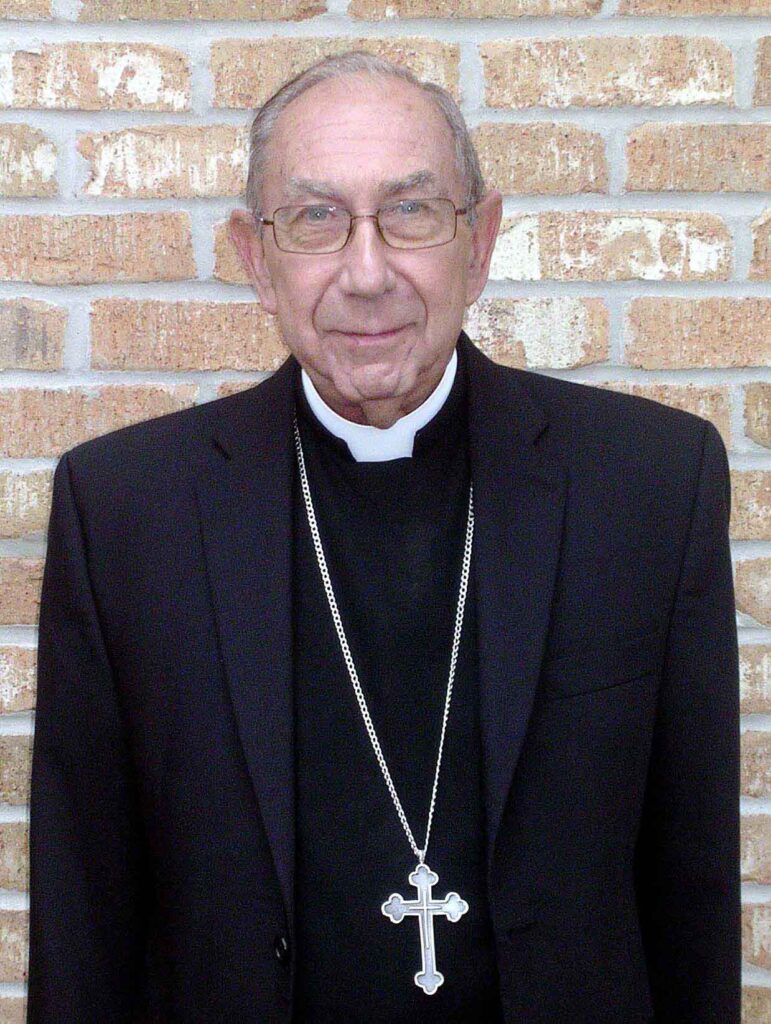
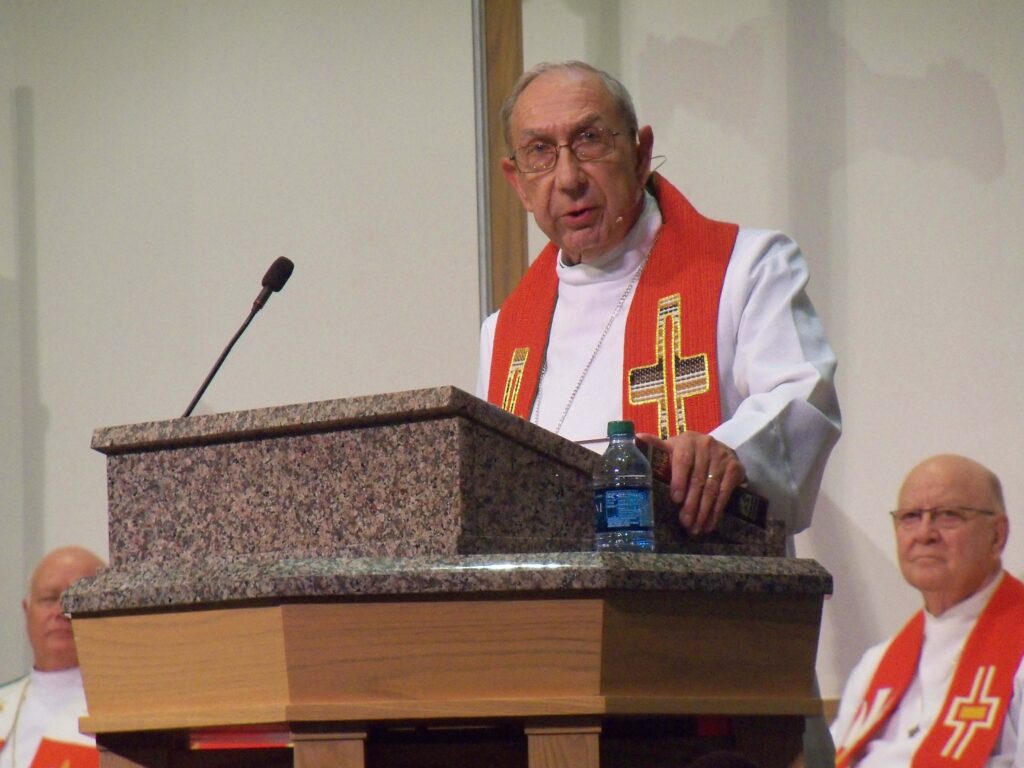
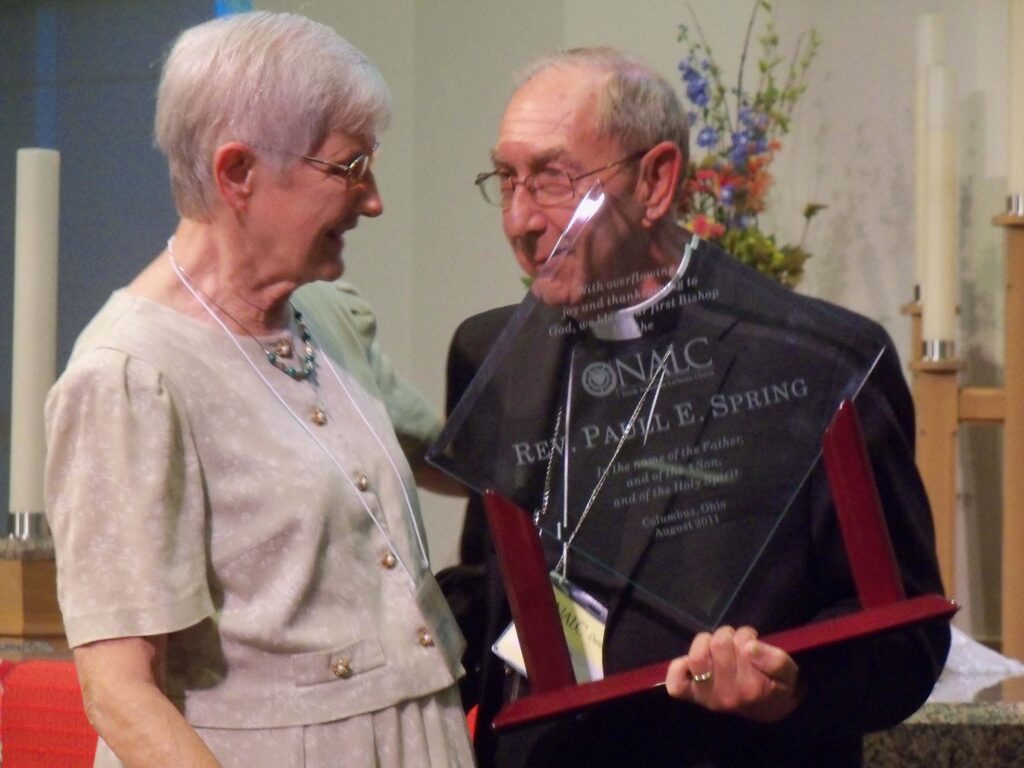
Lutheran CORE or a movement like it might not have emerged without Bp. Spring’s foresight and leadership. His initiative to form Solid Rock Lutherans was critical in bringing together disparate reform groups within the ELCA. Many of the people in those groups had never met the people in the other groups. Solid Rock Lutherans brought them together, creating the trust and good will needed to form Lutheran CORE. Praise the Lord for Bp. Spring’s leadership.


Here We Are, Send Us!

The events that put me at the front line of leading our church out of the ELCA began with an unexpected phone call from our founding pastor. Unbeknownst to him, I was frustrated with our congregation’s direction and the ELCA’s unbiblical stance on various issues.  Pastor wanted to know if I would be interested in being the Council President. Here I was ready to leave the church, and God provided a path to church leadership and fixing the problems that I saw. I agreed to his request, but it wasn’t with the fervor of ‘Here I Am Lord, Send Me!’

I had numerous discussions with the Pastor about leaving the ELCA, how to do that, and its impact.  He was led to believe that he would lose his pension if we left the ELCA. We now know this to be untrue, but it kept us in the ELCA for another decade.

Pastor retired during this period.  By this time, I was all-in on getting the right pastor to lead our church and made that known within the council and general congregational membership.  This led to my interest in serving on our church’s Call Committee. Now I was enthusiastically responding to ‘Here I Am Lord, Send Me!’  I knew that to save our church from the ELCA and lead us on a biblical path, we needed the right pastor.

I was asked to serve on the Call Committee the day after my father passed away. It was a blessing in a time of grief. I was relieved and grateful that I was part of that committee. We went right to work and started developing a questionnaire to ask our congregation what it wanted in a new pastor.

During this process I had an opportunity to attend the Synod Assembly. I left home expecting to be filled with the Holy Spirit while there. I could not have been more wrong. I was fed lectures on white privilege, listened to poems from young black activists about why my whiteness was a problem and why I should ask for forgiveness, The list goes on. Nothing about Christ, nothing about Christianity, nothing except a church manifesting itself as a  political organization and promoting LGBTQ agenda with no regard to sin.

I came back early from the Synod Assembly, reached out to the entire call committee and asked for a special meeting.  “Houston, we have a problem!” echoed in my mind. I put together a synopsis of my trip and all members of the call committee were speechless.  One member said, “Well, I thought I was a liberal but apparently I’m a conservative and didn’t know it.” We contemplated our next steps. Since our congregation asked us to find a pastor, should we go back to them and suggest looking outside of the ELCA?

We felt this was a good course of action but eventually realized that we could not take that path…yet. We focused our search and questions on a path that would lead us to the right pastor…then we prayed…a lot! With God’s help and our listening, we finally found our pastor. But that was the beginning, not the end of our journey. I immediately approached our new pastor (before he was selected) to make sure he was willing to support our plan to leave the ELCA. He said the road would be tough, but we could do it if we wanted. 

When the ELCA announced that it would be a Sanctuary Church, there was a significant amount of publicity that went along with its decision. This worked in our favor because many more members became aware of what the ELCA was doing. Now I didn’t have to find people to talk to and convince them the ELCA was not aligned with our congregation’s beliefs. They started looking for me and saying we need to leave the ELCA.

 I started gathering signatures on a petition. It called for the formation of a Discernment Committee where we could prayerfully determine our church’s path forward. Over 25% of the active congregation members signed it; the council could not refuse our request.

We formed the committee with a mix of members who wanted to stay or leave the ELCA. This was harder than it needed to be because we wanted to hear all voices and concerns.  Pastor led four classes for the congregation which discussed issues within the ELCA and how it had strayed from Luther’s foundational beliefs. These meetings focused on:

  • Justice and Righteousness in Lutheran Theology

  • Social Justice and ELCA Advocacy

  • Faith, Gospel and God language

  • Inter-Religious Discussion and Policy

  • Human Sexuality Gift and Trust

These classes informed our congregation that the ELCA had changed. Our patience and plan worked out. Our first vote was 88% and the second was 89% in affirmation to leave the ELCA and become part of the NALC.


Cancel Culture Strikes Again

Last month there was a discussion in the ELCA Clergy Facebook group where one person mentioned concerns that had been shared by a member of the congregation regarding last summer’s ELCA Youth Gathering in New Orleans. Specifically this member was disturbed over the promotion of LGBTQ ideology and the presence of drag queens. I responded by stating that a video had been shown at the gathering which argued on the basis of the creation account in Genesis for the possibility of more than two genders. I also reported that one of the summary videos for the event showed a group of young people with some drag queens.

Soon afterwards someone posted the question whether I am the Dennis Nelson who works with the NALC. I responded by saying that I am the Dennis Nelson who is the executive director of Lutheran CORE. That did it. Within a few minutes I found that I could no longer access the Facebook group. Several friends who are members of the group telephoned or sent me an email that confirmed that it had been reported by one of the administrators that – for the safety and well-being of the group – I had been removed. One of these informants sent me a screen shot of the announcement of my removal and the ensuing conversation. Some of it was quite nasty.

Here is the email that I then sent to the administrator who announced that I had been removed from the group.

* * * * * * *

Dear –

I was surprised to find out that I had been removed from the ELCA Clergy Facebook group when all I had done was to supply verifiable, publicly available information in response to a discussion regarding last summer’s ELCA youth gathering. I did not initiate the topic. Rather I merely contributed to the discussion by sharing that a video had been shown at the gathering which stated that the creation account in Genesis allows for the possibility of more than two genders and one of the recap videos showed some youth and drag queens.

I am a rostered ELCA pastor (retired) and am a member in good standing of an ELCA congregation where I do not cause disruption but instead contribute to the ministry. I serve as executive director of Lutheran CORE. Contrary to what was said in the conversation thread in the ELCA Clergy Facebook group, Lutheran CORE is not a ministry of the NALC. We are an independent, pan-Lutheran, reform and renewal movement. Our constituency comes from all three Lutheran church bodies – ELCA, LCMC, and NALC. Also contrary to what was said, Lutheran CORE is not the founder of the Lutheran Congregational Support Network. When we learned about that organization the board made it a priority to inform people of their work. We value what they are doing and the tone with which they are doing it.

You stated in the ELCA Clergy Facebook group that Lutheran CORE has “repeatedly demonstrated hostility and abusive behavior towards the ELCA and its clergy.” You said that I have “crossed boundaries targeting and undermining the very clergy this group exists to support.” You accused me of “targeted intolerance.” One member of the group said that it was important that I be identified by name “to prevent additional abusive (sic) from this individual.” Another member accused me of “tearing down ministries and churches.”

I would challenge you to identify any time when I have said anything hostile, abusive, targeting, undermining, intolerant, or tearing down in the ELCA Clergy Facebook group.

I would also challenge you to identify any time when I have been hostile, abusive, targeting, undermining, intolerant, or tearing down in any of my writings for Lutheran CORE. All of my writings are publicly available on Lutheran CORE’s website. Everything I report can be verified through the links I provide to ELCA primary sources. I feel that not I, but the discussion about me in the ELCA Clergy Facebook group has been hostile, abusive, and targeting. The only way that I can interpret the words that were said about me and the action that was taken against me is that you people are so skittish and easily threatened by opinions and information that do not fit with your preferred narrative.

We of Lutheran CORE feel that an important part of our work is alerting pastors, lay leaders, and congregations to what is happening in the ELCA as well as evaluating the significance of those dynamics. Since Lutheran CORE seems to be the only organization that is doing that, we feel that ours is a very valuable ministry. We are very concerned that people know about the possible changes that may be coming because of the work of the Commission for a Renewed Lutheran Church, the DEIA audit which the ELCA had done of its governing documents, and the work of the task force that is reconsidering the human sexuality social statement. What motivates us is love for Jesus, the Gospel, and people, and concern for the ministry of the Church. We are not driven by anger, hatred, and a desire to undermine ELCA clergy and tear down ELCA ministries and churches.

Lutheran CORE’s website shows that we are not a hate group that cares nothing about ministry. Our goal is not to disrupt congregations. Rather we provide many valuable resources for pastors, lay leaders, and congregations, including worship aides, daily devotionals, and weekly lectionary-based Bible studies and children’s messages. We have a support group for seminarians and are one of the sponsors of a program that challenges high schoolers to consider God’s call on their lives. We offer webinars on various topics related to church leadership and provide guidance for congregations in the call process as well as for congregations that are coming to the realization that very likely there will not be an ordained pastor available for them to call. We support cross-country mission trips to help people who have suffered a disaster, as well as local mission trips in the Baltimore area. We have held annual Encuentro events in the Chicago area for congregations that are already involved in as well as congregations considering becoming involved in Spanish language and/or bilingual ministry. The majority of those attending as well as presenting at those events are ELCA. All of the above show that Lutheran CORE provides valuable resources to pastors, lay leaders, and congregations.

I believe that as the administrators and members of the ELCA Clergy Facebook group you need to ask yourselves why you are so threatened by opinions and verifiable, factual information that does not fit with your preferred narrative. Through the things that you have said about me you have shown that you are the ones whose words are hostile and abusive.

In Christ,

Dennis D. Nelson
Retired ELCA Pastor
Executive Director of Lutheran CORE

* * * * * *

Later that day I received a reply from the pastor/administrator. There are several things I would say about his response. I did not reply to him because I did not see the purpose or point of continuing the conversation. But I did want to let you know how he responded and I wanted to show you how fragile, inconsistent, hypocritical, and intolerant they are.

First, he said, “Your work with Lutheran CORE has long been a source of division and pain within the ELCA.”

It is not Lutheran CORE that has caused division and pain within the ELCA. Instead it is the LGBTQIA+ agenda. The election of the ELCA’s first gay bishop in the synod in which I was rostered before I retired caused total conflict and turmoil within the congregation where I had served as pastor for thirty-nine years, and that conflict continued throughout and beyond my final year there. The LGBTQIA+ agenda has caused pain in my life in a way in which I never have caused pain in their lives. Also, before the ELCA changed its policies in 2009 regarding the blessing of same sex relations and the ordination of persons in same sex relations, people who wanted those policies to change disrupted a Churchwide Assembly, defied ELCA standards, and were very blatant and brazen about doing so.

Second, he said, “The organization’s efforts, both direct and indirect, to encourage congregations to leave the ELCA, often under the guise of reform, have left deep wounds.”

Reform is not a “guise” that we hide behind. Instead it is central to our work. Our purpose and mission is not to get congregations to leave the ELCA. Rather it includes alerting persons and congregations that are still in the ELCA to what is happening in and to changes that could be soon coming to the ELCA. We fully realize that for many congregations, leaving the ELCA would not be possible and/or would not be the right or best decision.

Third, he said, “The shaming and mischaracterization of LGBTQIA+ individuals, who are beloved children of God, are especially harmful and stand in opposition to the inclusive love of Christ.”

We do not engage in shaming or mischaracterizing LGBTQIA+ individuals. We agree that they are beloved children of God. We love them and are concerned for them because we believe that they are living a life that is not pleasing to God. We are also deeply concerned as we see that it is only non-binary and LGBTQIA+ ideology that is being promoted at the ELCA youth gatherings. The young people there never hear anything that supports and encourages a traditional view of human sexuality, even though the ELCA still says – in its 2009 human sexuality social statement – that traditional views still have a place of dignity and respect within the ELCA.

Fourth, he said, “When individuals or organizations repeatedly engage in actions that cause division, foster animosity, or promote intolerance – especially towards marginalized communities – it becomes clear that their participation is not aligned with the group’s purpose.”

During the years leading up to the 2009 decisions, during the time when traditional views still prevailed – though always by an ever-decreasing percentage amount – those with traditional views always bent over backwards to make sure that all views – including revisionist views – were treated respectfully and were heard. After revisionist views prevailed in 2009, those with traditional views were not afforded the same kind of courtesy that they had extended for years. It felt like we were being pushed over the cliff. It is not the LGBTQIA+ community that is marginalized. Instead they are a preferred and empowered community. It is those with traditional views that are marginalized. Evidence for this is in the fact that ReconcilingWorks has a voice but no vote position on the ELCA Church Council while the same courtesy is not extended to any group with traditional views.

Fifth, he said, “This decision is not about being ‘threatened’ by different opinions, as you suggest. It is about setting boundaries that foster a supportive, respectful environment for ELCA clergy. Intentionally divisive contributions, no matter how they are framed, detract from that goal.”

Nothing that we say or do is ever “intentionally divisive.” Rather it is motivated by the deepest of love for and commitment to Christ, people, and the mission of the church. For these people any dissent from the “preferred view” is considered disloyal, divisive, and disruptive.

And then he concluded by saying that he has “a deep pastoral responsibility to protect this group as a safe space for clergy who seek encouragement and support rather than conflict.”

In my contribution to the most recent discussion which got me kicked out of the group – as well as in all my other contributions in this Facebook group – I have never said or done anything disruptive, divisive, or conflict producing. Rather I merely pointed out information that would be available to anyone who went to the primary sources.


March for Life and Y4Life Conference in January!

The NALC Life Ministries team is once again preparing for the March for Life in Washington D.C. this January, but our plan is a little different. Instead of holding a life conference, NALC Life has decided to team up with Lutherans for Life (LFL) and participate in their events at the March! Their youth conference, Y4Life, will be held at the Hilton Arlington Landing Hotel (2399 Richmond Highway, Arlington, VA 22202) from Thursday, January 23rd, 2025 through Saturday, January 25th, 2025 and it has over 400 kids already registered (register at https://y4life.org/event/y4life-in-washington-d-c-january-23-25-2025/ ). We encourage all our NALC youth to participate in this free conference.

On Friday, January 24th we will be once again participating in the March for Life under the NALC banner, and I hope you can join us at 12th and Madison Sts., N.W at noon as we march to the U.S. Capitol. Before the march there is a prayer service at DAR Constitution Hall 1776 D St. NW (18th and D St.) Washington, DC 20006 starting at 8:30am. All our NALC members are invited to attend this service and our clergy are invited to participate (stoles are white). If you have any problems at the march, please contact Pastor Dennis Di Mauro at (703) 568-3346. Pastor Di Mauro can also host you in his home if you would like to stay overnight in DC. We can’t wait to see you in our nation’s capital this January!!