November 9, 2025 

Luke 20:27-38 


Script:

Pastor: Good morning boys and girls! Welcome! Let’s say good morning to our friend Sammy. Ready? One, two, three: Good morning, Sammy! 

Sammy: Hey Pastor! What is the special theme this week? 

Pastor: What do you mean, Sammy? 

Sammy: Well, two weeks ago we celebrated Reformation Sunday, and last week we celebrated football Sunday– 

Pastor: No, Sammy. We celebrated All-Saints Day. 

Sammy: That’s what I meant. So we had two big weeks in a row at church. What is the big event or theme this week? 

Pastor: Well, this week we are talking about Resurrection. 

Sammy: Happy Resurrection Day, Pastor! 

Pastor: Not quite, Sammy. It’s not really a feast day or a holiday or a celebration. We are having worship together during ordinary time. 

Sammy: Pastor, these times are anything but ordinary. Have you read the newspaper lately? Watched the news? 

Pastor: Let’s get back to our topic for today: Resurrection. Boys and girls, what does “resurrection” mean? 

[Allow time for responses] 

Sammy: These are great answers.  

Pastor: Jesus did rise from the dead. But we also look forward to our resurrection. 

Sammy: What do you mean, Pastor? 

Pastor: One day, Sammy, after we die, we are going to wait for Jesus to come back. When he comes back, the dead will rise and will see his glory. 

Sammy: Is that going to be a scary day? Like a Halloween day? 

Pastor: No, it’s going to be like Easter Sunday. 

Sammy: Oh I love Easter! We get to sing Alleluia songs to God and there’s an egg hunt and Bartholomew the Bunny comes to worship.  

Pastor: That’s the spirit, Sammy. There’s nothing scary about resurrection. Jesus says, “I am the resurrection and the life. Whoever believes in me will not die, but will have eternal life.” That’s a gift from God. 

Sammy: Yes it is. 

Pastor: Let’s pray. Boys and girls, will you please fold your hands and bow your heads? Dear Jesus, thank you for resurrection. Thank you for your gift of new life. Thank you for your love. Amen. 

Sammy: Bye, everyone! 

Pastor: Bye, Sammy! 


Reformation Sunday Children’s Sermon

John 8:31-36

Pastor: Good morning boys and girls! Welcome! Let’s say good morning to our friend Sammy. Ready? One, two, three: Good morning, Sammy!

Sammy:

Sammy: Good morning, Pastor. Good morning boys and girls. Hey Pastor, why do you look like you are looking for someone.

Pastor: I am expecting a friend come today. I thought he would be here at worship. But I can’t find him.

Sammy: What does he look like? Maybe I can help you find him.

Pastor:  Well, you can’t really miss him. He’s a really big guy. He’s in a strange outfit, and he’s really grumpy. And his name is Martin Luther.

Sammy: Oh, I thought you were talking about Santa Clause for a moment. But he’s not grumpy. You really know how to disappoint someone Pastor.

Pastor: Sorry to disappoint you, Sammy. But Martin  Luther is as fun as Santa Clause.

Sammy: Pastor you really shouldn’t lie in church.

Pastor: No really. He always brings pretzels and cider with him. So that means snacks Sammy.

Sammy: Okay, I think I like him now. But why is he visiting today?

Pastor: Well today is reformation Sunday. It’s a day when we remember Martin nailing the 95 theses on the door of his church. This moment caused a movement to spark reformation within the church.

Sammy: Oh okay. So he was really important. And I just realized something pastor. His name is Luther. Aren’t we part of a Lutheran church?

Pastor: Good job Sammy. We are a Lutheran church. He is the person that wrote a lot of what we teach here at St. Paul’s. His courage is why we are here today. Let us pray now: Dear Jesus, Thank you for reformers like Martin Luther. Thank you for teachers that followed his lead by teaching people the true gospel. In Jesus name we pray. Amen.


Children’s Sermon October 12, 2025

Script:

Luke 17:11-19

Pastor: Good morning boys and girls! Welcome! Let’s say good morning to our friend Sammy. Ready? One, two, three: Good morning, Sammy!

Sammy: Good morning, everyone! Pastor, I just wanted to thank you for doing a great job.

Pastor: Thank you, Sammy.

Sammy: You always listen to me, tell me stories, teach me about the Word of God, and you are a great friend to me.

Pastor: That’s very kind of you, Sammy.

Sammy: I just wanted you to know.

Pastor: You know, Sammy, your thankfulness reminds me of the Gospel reading for today. Jesus healed ten men with a skin disease.

Sammy: A skin disease?

Pastor: Yes—they called out to Jesus and asked him to heal them. He healed them by telling them to go show themselves to the priests. On the way to the priests, they were healed.

Sammy: But why did he tell them to go to the priests? Why not just heal them right away?

Pastor: What do you think, boys and girls? Why did Jesus send the men to go to the priests instead of healing them right away?

[Allow time for responses]

Pastor: These are great answers and ideas. Jesus wanted the men to act in faith. Walking toward the priests meant a commitment of faith for them. And men with a skin disease were considered unclean. They were unable to worship God at the temple if they had a skin disease.

Sammy: So that would be like if we couldn’t go to church?

Pastor: Yes.

Sammy: But they couldn’t help it!

Pastor: That was the rule. In Jesus’s time, there was no cure for this skin disease.

Sammy: That’s horrible. They were forever banned from church. I love church. I want to be here every day.

Pastor: I know, Sammy. But you know, what? Jesus healed all ten of these men, and then they could go to worship God in the temple.

Sammy: And one of them went back to thank him. That man is my favorite. Jesus gave him his life back.

Pastor: Jesus gives each of us a new life in him, and it’s important to thank our God for the many gifts he gives us. In fact, let’s pray and thank him right now. Boys and girls, will you please fold your hands and bow your head? Dear Jesus, we thank you for your healing power. We praise you for directing us to you. Help us to be thankful for everything you give us. Amen.

Sammy: Bye, everyone!

Pastor: Bye, Sammy!


Children’s Sermon October 5

Luke 17:5-10

Script:

Pastor: Good morning boys and girls! Welcome! Let’s say good morning to our friend Sammy. Ready? One, two, three: Good morning, Sammy!

Sammy: Good morning, everyone! Pastor, I made it to church on time this morning.

Pastor: That’s great, Sammy.

Sammy: I do a good job of showing up almost every week. Sometimes I get sick and I have to stay home. Or sometimes I go to the beach on vacation.

Pastor: I am proud of you for coming to church, Sammy.

Sammy: I also pray, and I sing, and I talk to the kids here about God.

Pastor: Yes, you do.

Sammy: And I take the time to help you out, Pastor. That’s a lot of work. I found your keys, invited myself to your house for dinner…

Pastor: Where are you going with this, Sammy?

Sammy: Well, none of it is good enough, is it, Pastor?

Pastor: What do you mean?

Sammy: I was reflecting on the Gospel reading for today, and I was just thinking that all the things I do and all the effort I put into church and my family isn’t good enough.

Pastor: That’s right, Sammy. We will never be good enough. Jesus talks in the reading today about how if we live a holy and righteous life, that is what we are supposed to do. If we show up to church every week, if we sing in the choir, feed the hungry, help each other, serve each other, and love each other, we have done the minimum and we haven’t added anything to the Kingdom of Heaven.

Sammy: So I have to be a good Christian and it’s still not good enough.

Pastor: That’s correct. We sin every day, and doing our best to live a holy life is all we can do. We have to rely on Jesus to do the rest.

Sammy: What do you mean?

Pastor: Boys and girls, what did Jesus do for us?

[Allow time for responses]

Pastor: Jesus died on the cross for our sins. He took all of the sin and shame that we have and he covered us with his grace. He forgives us when we ask him to forgive us because of his great love for us.

Sammy: That’s beautiful.

Pastor: Yes it is. One thing you should know, Sammy, is that when we come to the Kingdom of Heaven, we go empty handed. We don’t bring anything with us, just our sin and our shame. Even as a pastor, I will approach Jesus with my hands bearing my shame. There is nothing I can do or say that will make me good enough in his eyes.

Sammy: That’s why we cling to the cross of Jesus.

Pastor: Yes, that is why we cling to the cross.

Sammy: Whew. That’s a relief.

Pastor: What do you mean?

Sammy: I have a lot of peace now. I was going to make a spreadsheet of all the things I do for Jesus around here. But like we talked about, I am supposed to do all the things I do. And I’ll cling to the cross of Jesus forever.

Pastor: Me too. Let’s pray. Can you all please fold your hands and bow your heads? Dear Jesus, help us to realize we aren’t good enough. Help us to know you are the only one who adds to the Kingdom of Heaven. Thank you for letting us join you in Heaven. We love you. Amen.

Sammy: Bye, everyone!

Pastor: Bye, Sammy!


The Five Solas and the ELCA’s Proposed Constitutional Changes: A Call for Faithful Reformation

Rose Luther. Illustration of theology and confession of faith in the atoning sacrifice of the Lord and Savior Jesus Christ.

As the Evangelical Lutheran Church in America (ELCA) considers sweeping constitutional amendments in 2025, it is crucial to revisit the foundational principles of the Lutheran Reformation—the Five Solas—and assess the implications of these changes for our confessional identity and mission. The Five Solas—Sola Scriptura (Scripture alone), Sola Fide (faith alone), Sola Gratia (grace alone), Solus Christus (Christ alone), and Soli Deo Gloria (to God alone be the glory)—are not merely historical slogans but enduring guideposts for Lutheran faith and practice. Recent proposals within the ELCA threaten to compromise these pillars at a time when clarity and fidelity are most needed.

Sola Scriptura and the Authority of God’s Word

The move toward gender-neutral and nonbinary language in ELCA governing documents, as proposed in the November 2024 Church Council actions, raises significant concerns about Sola Scriptura. While inclusivity is a worthy goal, altering biblical terms such as “brothers and sisters” risks detaching the church from the clear witness of Scripture, which affirms humanity as “male and female” (Genesis 1:27, Matthew 19:4). The authority of Scripture, upheld by the Lutheran Confessions, must remain the foundation for doctrine and practice. When church language is shaped more by cultural trends than by God’s revealed Word, we risk undermining the very principle that sparked the Reformation: that “God’s Word shall establish articles of faith” (Luther).

Solus Christus and the Marks of the Church

Another critical issue is the proposed expansion of voting rights to synod assemblies for non-congregational ministries—such as camps and nonprofits—that do not regularly offer Word and Sacrament ministry. The Augsburg Confession defines the Church as the assembly where the Gospel is purely taught, and the sacraments rightly administered. To broaden the definition of “church” to include organizations whose primary mission is not the proclamation of the Gospel or the administration of the sacraments risks severing the church from its Christological center. Solus Christus reminds us that Christ alone is the head of the Church, and it is His presence in Word and Sacrament that constitutes the true church—not organizational structure or social activism.

Soli Deo Gloria and Church Governance

The Commission for a Renewed Lutheran Church (CRLC) has proposed streamlining the constitutional amendment process by eliminating the second Assembly vote, thereby centralizing authority and reducing congregational input. Such a move contradicts both the spirit of the Augsburg Confession and the principle of Soli Deo Gloria, which insists that all church governance must ultimately glorify God, not merely serve institutional efficiency. Furthermore, the lack of proactive communication about these amendments undermines transparency and trust, violating the church’s commitment to open dialogue and discernment.

Sola Fide, Sola Gratia, and the Marginalization of Confessional Voices

Perhaps most troubling is the increasing marginalization of confessional and conservative voices within the ELCA. Sola Fide and Sola Gratia teach that all are justified by faith and saved by grace alone—not by ideological conformity or prevailing cultural opinions. When traditional perspectives are dismissed or excluded from meaningful dialogue, the church risks replacing genuine unity with superficial consensus, undermining the mutual respect and forbearance to which we are called (Romans 14:1, Ephesians 4:3). True inclusion, rooted in the grace of Christ, embraces the full spectrum of faithful Lutheran convictions.

A Call to Faithful Reformation

The proposed constitutional changes present a pivotal moment for the ELCA. To remain faithful to our Reformation heritage, the church must:

  • Ensure all amendments are publicized directly to congregations, upholding Sola Scriptura.
  • Reject fast-tracking governance changes that bypass congregational discernment, preserving Soli Deo Gloria.
  • Host open forums to discuss amendments through the lens of the Five Solas, especially Solus Christus.
  • Appoint confessional leaders committed to upholding Reformation theology.

The ELCA cannot credibly champion inclusion while sidelining conservative voices and obscuring governance changes. Only by realigning with the Five Solas can the church preserve its confessional integrity and witness to the Gospel of Jesus Christ.

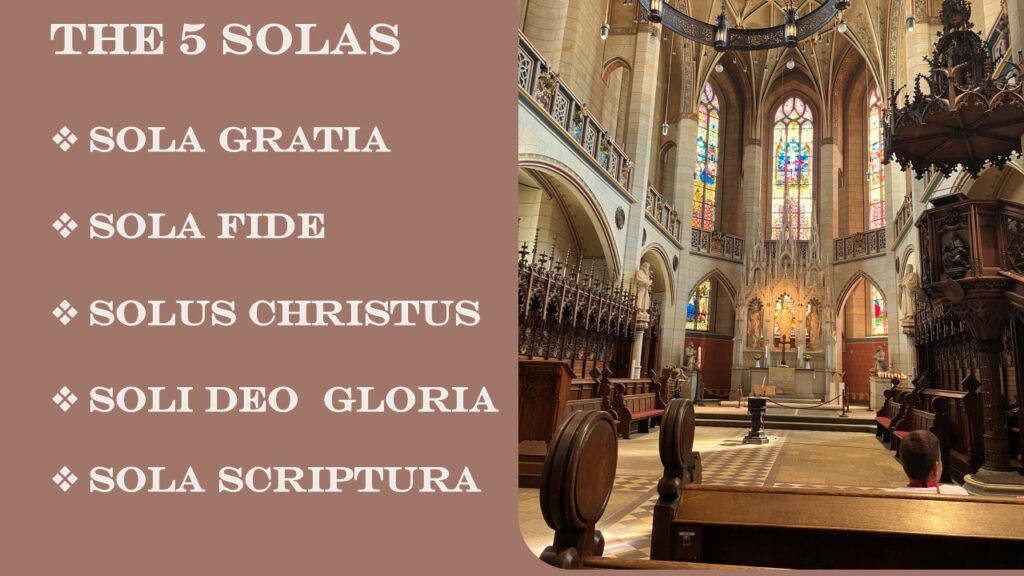
Sola slide with list of solas and German church, courtesy of Paul Fleming.


Leaving the ELCA: Communion, Confession, and Constitutions

It started with Holy Communion.  When people ask me to share my experience with leaving the ELCA, the story begins where questions of church fellowship must always begin: the altar.

Following the churchwide votes of 2009, people started using “impaired communion” more frequently to describe the ELCA’s situation.  I particularly recall David Yeago using it to good effect.  To commune is to share something in common, and what the Church shares is Christ.  Not only the 2009 votes, but also the long trajectory of the ELCA’s doctrinal development, made it clear that differing Christs were confessed in the ELCA.

I remember a dedicated revisionist agreeing with me, already in 2003.  “Yes,” he said, “that would be the classical Lutheran understanding of our situation.”  Communion could not proceed as usual.  I realize that many people, including many conservatives, might disagree with that diagnosis.  But that’s where my experience began: the simple recognition that “impaired communion” impairs Communion.  It is there, at the altar, that impaired communion is either repaired, or it is not.

Our first bishop under this new circumstance didn’t like our perspective, especially when we informed him that we would no longer host the Supper at conference or synodical events, but he did not press us to change.  The second bishop was far less sympathetic.  Here I should pause and note that we’ve already encountered two key points about leaving the ELCA.  Having led two congregations out of the ELCA, and counseled and accompanied several others, I’ve seen these points prove valuable time and again.

First, start by asking what your dissatisfaction with the ELCA has to do with doctrine, if anything at all—determine if you disagree on the fundamental question of “Who do you say that I am?”—and distinguish those concerns from other, lesser ones (like, “We’re willing to bet we can get a pastor faster and cheaper somehow else” [unfavorable odds, honestly]).  Then, if you have a doctrinal disagreement, ask yourself how Jesus repairs that sort of thing.  Is it at the conference table, debating constitutions, or at His table, communing or not communing? 

At the very least, that sort of reflection will help clarify your thought.  Constitutions are works; Communion is grace.  Are your problems with the ELCA work problems or grace problems?  If grace is being misunderstood, then the place to begin the remedy (and, potentially, to begin changes in fellowship) is where grace is clarified.  Trying to address a grace problem through a works solution (i.e., trusting a constitutional rearrangement alone) won’t get at it, ever, because the problem is not disagreement about your works, but about the Lord’s gifts. 

Fumbling this distinction continues to hound the various departure movements, I would suggest.   Holy Communion is where Jesus forgives sins.  So, if we now disagree over what sins He forgives, how He forgives them, or who He even is, then we also disagree about what He does at His altar.  Burying that simple problem under layers of constitutional finesse will not clarify the situation to you or to the people whom you serve—and when I say, “the people whom you serve,” I include representatives of your synod, which brings me to the second point.

One bishop is not like another.  Like you and me, each is his or her own little bundle of insecurities, aspirations, and ideas half finished.  If you think it’s hard to be you, being you as an ELCA bishop would be ten times worse for everyone.  I don’t say so out of any animus towards those who hold the office.  We should sympathize with them.  The office as presently constituted is a nightmare, as if someone had found the corpse of a thirteenth-century bishop of Bangor and used an electrical storm to try combining it with Grok, only to find too much personality remained.  The point is: the bishops need your help.

The bishops and their representatives belong to a much larger organization that tries to solve grace problems with work solutions.  “Synod means walking together,” apparently, and each churchwide assembly tries to lock the step, but the differences only widen because they’re trying to heal a flesh wound with a welding torch.  Still, that’s the solution they have, and so the bishops and their representatives will come to you by way of constitution, not Communion.  If your beef is a grace problem, you will need to help them face it, not for the sake of justice or something like it (you’re a Christian, so there’s no room for revenge here), but for the sake of their own souls.  

They will not appreciate this idea.  It won’t be easy.  I call it “playing catch with someone who won’t throw back.”  Here’s how it went for me:

Bishop: “Well, Steve, thank very much for meeting with us today.  I appreciate that your time is valuable.  Why don’t we begin with you explaining to me what your concerns are?” [this starting point can be a trap, but that’s another article]

Me: [Explains my concerns.]

Bishop: [silence]

Me: [shrugs eyebrows]

Bishop: I’m not going to engage you on that topic right now.

Different words could be used. Sometimes no words would be used. There would simply be a long stare, followed by a deep breath and a change of subject.  At other times, there may be honeyed expressions of sympathy followed by continued denials: “That is not the problem.”  Or as one bishop put it to me, “I don’t accept what you’re saying, because I never learned that.”  He said so years ago, and it’s not a horrible answer in some instances.  But it is rather like being asked to play catch, and in good faith tossing the first pitch, only to watch the other person catch the ball, drop it in a bucket, and look back at you.

They won’t engage you on theology.  They don’t think it’s a grace problem.

So if you have a confessional point you want to make, you will need both to confess the truth and to create a situation in which they slow down long enough to a) hear it and b) consider their own confession in light of it.  At its best, the process of leaving the ELCA is an opportunity for everyone to walk away knowing more clearly who they are and why.  There are some synodical leaders who understand this, and if you should encounter some, you’ll feel the difference and be thankful for it.  Either way, remember that what you’re doing is for their sake, not yours, since you are a Christian.  The goal isn’t for you to win, nor is it only for the congregation to leave, but also for the bishop and their representatives to grow in the faith.  They will not necessarily look at it that way—to many of them, you are the problem, and you will be fixed constitutionally—and so you must help them see it.

You’ll do so by starting with Communion, not the constitution.

With all that said, there is one particular way that the ELCA constitutions perform a strangely gracious function, though I’ve rarely heard anyone acknowledge it.  By including in its governing documents a method for leaving the ELCA, the ELCA acknowledges that leaving its fellowship is both permissible and potentially good.  Constitutions are works and seek to govern works.  By including among their works the ability to leave the ELCA, the ELCA constitutions confess that it’s a potentially good work to do so.  If you are part of a congregation considering leaving the ELCA, please make that point to your congregation: the ELCA believes it’s okay to do this.

You’d be forgiven for not realizing it.  I do know one bishop who acknowledged that leaving can be a good work, and she didn’t even mean it in a passive aggressive way.  The acknowledgement is rare!  But no matter.  It’s there in print, and no church should pass into law something it thinks is inherently sinful.  If it is—if a church thinks that leaving is inherently wrong—then it needs to take the process right off the page.  But if it stays on the page, and so far it has, then every congregation needs to know that even the ELCA thinks this process is a totally okay thing.  Sure, you’ll sin along the way—watch for it; repent of it—but so it goes for every good work.  Abusus non tollit usum: the abuse of a thing does not nullify its use.

Don’t look at the process as your enemy.  It’s a friend if you make it so.  “To the pure all things are pure” (Titus 1:15).  You agreed to that process by virtue of being in the ELCA, so follow it.  That’s part of love.  At the same time, you can always read the process closely.   To create a circumstance where you may press the confessional point and help everyone clarify who they are in the light of grace, you may find unexpected, entirely permissible ways to fulfill and participate in the process outlined.  These unexpected ways will surprise others, but just so, they may create, for the Gospel, a forum. 

The cool kids are now calling that sort of thing “interruptive,” and they make it part of their mission statements.  I’d suggest that you just call it “all in day’s work” and not think very much about it.  It can be done politely and kindly enough, even joyfully, the way you’d perform a Baptism or eat soup at a soup supper (yes, Baptisms are very different from soup-eating, but you doing the Baptism, and you sitting with your congregation and eating the soup, are not).  Other, cooler kids will have even more important things for you to consider than what I’ve written here, but this is what I’ve got: start (and end) with Communion, be prepared to play one-sided catch, work hard to create a situation where they at least catch it, and know that the ELCA totally thinks this is an okay thing to do.

Otherwise, it wouldn’t be on the page. 


Orthodox Repentance

If your church is following the three year lectionary, Lent begins on Ash Wednesday with 2 Corinthians 5:20b-6:10.  Officially, the pericope begins, “We implore you on behalf of Christ, be reconciled to God. For our sake he made him to be sin who knew no sin, so that in him we might become the righteousness of God.” (2 Cor 5:20b–5:21, ESV) In light of the fact that he is addressing established Christians, what Paul is obviously driving at here is the ongoing need for even the most committed Christians to realign their lives with the will of God.  “Be reconciled” implies that these already-converted Christian believers are not in a conciliar state with God; in fact, Paul is addressing them for a third time precisely because while claiming Christian identity, they are behaving in ways inimical to God.

At a recent gathering of primarily conservative clergy, I got some hostility but engendered much more fantastic conversation when I brought up the danger of Christianity being coopted by conservative politics. In the end, everyone agreed that Christians need to be on God’s agenda first, offering critique as well as necessarily-conditional support to any ideology, political party or strategy. This is what it means to be “the light of the world” and the “salt of the earth.”

A wise mentor once told me that people’s politics are always influencing their theology, but that the great conversation that is the inner life of the church over time corrects—and when necessary, excises—the errors that people of any given time and place incorporate.  Because of the fractured nature of the Church’s communion and witness, amplified by social media, there is a real danger of these much-needed course corrections being significantly delayed or not even engaged in.

The solution to this is to heed Paul’s words to “be reconciled to God,” which is of course, what the season of Lent is all about. The difference between the orthodox Christian construal of these words and the progressive Christian one is that for the orthodox Christian, the Bible provides the content of what being reconciled to God looks like—a detailed road map for discerning where one’s life is out of sync with the life of the triune God.  Conversely, for the progressive Christian, the Bible provides abstract theological principles, but the content comes from elsewhere, sources deemed more relevant because they are more contemporary, scientific, progressive, or whatever.

The outcome of these two approaches is what yields at least some of the divisions observable in contemporary Christianity, where people united by confessional traditions like Lutheran, Methodist, Catholic, etc. have radically different ideas of what makes for faithful Christian living.  While both agree for the need to reconcile ourselves to God, one group sees God as telling us what would constitute alignment with God, the other believes that God is “just” or “forgiving” or “love,” but asserts that what those words mean is not what Christians have traditionally thought they mean, based on the witness of Scripture.

What this means in practice is that the progressive Christian lacks any tool whereby to critique their own politically-influenced positions, for they have no data by which to evaluate them.  As long as the principles they have gleaned from Scripture seem to be met by the ideologies and morays acceptable within their own narrow cultural conditioning, they are living as God intends and no reconciliation is necessary. Conversely, for the orthodox Christian, while perceiving one’s own biases is always notoriously hard, the Scriptures provide actual canons against which to measure cultural assumptions and political prescriptions… and the exhortation to do so.

Paul goes on, “Working together with him, then, we appeal to you not to receive the grace of God in vain.” It is important that we not consign the persistent warnings of the New Testament about spiritual disqualification to the dustbin based on our theological principles, no matter how venerable or new. We can receive the grace of God in vain, and only the lifetime of persistent Christian repentance (realignment) that Luther called for in the first article of the 95 Theses can stave off that terrifying reality. So, since we cannot hope to be perfected in theology, holiness, or piety, let us be perfected in repentance, and let the Scriptures dictate to us what that should look like… furthermore, let us start today. “For [God] says, ‘In a favorable time I listened to you, and in a day of salvation I have helped you.’ Behold, now is the favorable time; behold, now is the day of salvation.” (2 Cor 6:1–2, ESV)


Approaching the Throne of Grace With Boldness

Every year Lent is a time when we give thanks to God for His great love and amazing grace.  How much we need that love and grace.  Every year on the First Sunday in Lent the Gospel reading is the account in one of the synoptics of the temptation of Jesus.  This year the reading is from Luke 4.  The Gospel writers tell us that Jesus resisted the tempter and how He did so.  The author of the letter to the Hebrews expresses so beautifully and powerfully what that can mean to us.  “We do not have a high priest who is unable to sympathize with our weaknesses, but we have one who in every respect has been tested as we are, yet without sin.” (Hebrews 4: 15). 

We have a God who can empathize with us.  But more than that, we have a God who paid the penalty for and broke the power of sin and who won the victory over death and the devil.  Therefore, we can “approach the throne of grace with boldness” for it is there that we will “receive mercy and find grace to help in time of need.” (Hebrews 4: 16)  Do you see the throne of God as a throne of grace?  Do you know that you can approach it with boldness?  Have you found at the throne of God mercy and grace to help in time of need?

What I would like to do is to go through Luke’s account of the temptation as found in Luke 4: 1-13.  As we do so, we will see what makes God’s throne a throne of grace and why it is possible for us to approach that throne with boldness.

Luke 4: 1-2 tell us that after His baptism “Jesus, full of the Holy Spirit, returned from the Jordan and was led by the Spirit in the wilderness, where for forty days he was tempted by the devil.”  Matthew and Mark say it a little bit differently.  According to Matthew 4: 1, “Jesus was led up by the Spirit into the wilderness to be tempted by the devil.”  Mark 1: 12 says, “The Spirit immediately drove him out into the wilderness.”  When have you felt that the Spirit led you while you were in the wilderness?  When have you felt that the Spirit actually led you into the wilderness?  When have you even felt that the Spirit drove you into the wilderness?     

Luke 4: 2 continues, “He ate nothing at all during those days, and when they were over, he was famished.”  Note:  The devil attacked Jesus at a point of weakness – at a time of great vulnerability.  Remember: The devil also knows your points of weakness – your times of greatest vulnerability.  And that is exactly where the devil will attack you.    

We find the First Temptation in Luke 4: 3.  “The devil said to him, ‘If you are the Son of God, command this stone to become a loaf of bread.’”  Just a few verses before, in Luke 3: 22, at His baptism, the Father had said to Him, “You are my Son, the Beloved; with you I am well pleased.” 

I can see two possible things going on here.  First, Satan could be saying, “If you truly are who you think you are, then you should be able to turn these stones into loaves of bread.”  But Jesus knew that if He were to do that in order to have the strength to resist the devil, then He would be drawing on a power that would not also be available to us.  A second possibility is that here we see the devil attacking Jesus at His sense of self-identity.  He wanted to get Jesus to question whether He truly is the Son of God.  In the same way the devil will try to get you to question whether you are a child of God.  The devil is jealous of your identity as a child of God, so he will attack you there.  The devil will attack your self-identity, your self-image, your self-confidence. 

We find the Second Temptation in Luke 4: 5-7.  “Then the devil led him up and showed him in an instant all the kingdoms of the world.  And the devil said to him, ‘To you I will give their glory and all this authority; for it has been given over to me, and I give it to anyone I please.  If you, then, will worship me, it will all be yours.’” 

The truth is that the devil has no more right to lay claim to all the kingdoms of the world than I would have the right to try to sell you the Brooklyn Bridge.  The devil could claim that right only as a usurper – a thief.  The devil was also tempting Jesus to choose the easy, less painful way, and to avoid the way of the cross.  When has the devil tempted you to choose the easy, less painful way?  What was the result?  Would the easy, less painful way have worked? 

We find the Third Temptation in Luke 4: 9-11.  “Then the devil took him to Jerusalem, and placed him on the pinnacle of the temple, saying to him, ‘If you are the Son of God, throw yourself down from here,  for it is written, “He will command his angels concerning you, to protect you,” and “On their hands they will bear you up, so that you will not dash your foot against a stone.”’” 

Again, the devil attacks Jesus by trying to get Him to question His identity as the Son of God.  Here we see that the devil knows the Bible (in this case, Psalm 91: 11-12), though he will misquote and misuse the Bible.  If the devil knows the Bible (and he has had many more centuries than any of us have had to learn the Bible), then we had better get to know the Bible too, so that we will not be led astray. 

Luke concludes his account with these words.  “When the devil had finished every test, he departed from him until an opportune time.” (Luke 4: 13)  The devil is like the Terminator, who said, “I’ll be back.”

Again, I can see two things going on here.  First, the devil had finished every test.  The devil has thrown everything he has against Jesus and none of it knocked Him over.  Jesus experienced the full onslaught of evil and none of it worked against Him.  The devil does not need to throw everything he has against us, for we fall early in the process.  Jesus experienced the full severity of temptation in a way that we do not know because the devil does not need to use it all against us.

Second, we can ask the question, When was that “opportune time”?  I believe in the Garden of Gethsemane, where again the devil tried to tempt Jesus to go the easier, less painful way and avoid the way of the cross.

In Luke’s account of the agony in the garden after Jesus prayed, “Father if you are willing, remove this cup from me; yet not my will but yours be done,” it says that “an angel from heaven appeared to him and gave him strength.”  (Luke 22: 42-43).  Mark’s much more succinct account says, “He was in the wilderness forty days, tempted by Satan . . . and the angels waited on him.” (Mark 1: 13)

When have you experienced the ministry of angels after a particularly difficult time in your life, including a time of severe temptation?  When have you offered encouraging and strengthening ministry to someone else after a particularly difficult time in that person’s life, including a time of severe temptation?   My prayer for you during this Lenten season is that you will experience the throne of God as a throne of grace, that you will know that you can approach that throne with boldness, and that coming into God’s presence you will receive mercy and find grace to help in time of need. 


LETTER FROM THE DIRECTOR – OCTOBER 2024

“MY GRACE IS SUFFICIENT FOR YOU”

The first time I began to really understand and value Paul’s second letter to the Corinthians was during my second year of seminary. It was a particularly difficult year for me – one of my most difficult – and I found Paul’s letter speaking to my heart and giving me hope, strength, and encouragement.

I knew that Paul had a particularly difficult relationship with the Corinthians, especially after his first letter to them. But in 2 Corinthians he also addresses what he had been experiencing in Ephesus. You read Luke’s account in Acts 19 and it sounds like everything is wonderful and going great. The value of the books that were burned by those who had practiced magic but then turned to Christ was fifty thousand denarii (verse 19). “The word of the Lord grew mightily and prevailed” (verse 20). So many people were becoming followers of Jesus that the silversmiths who made images of Artemis were in danger of going out of business (verse 24-27). And even some of the officials of the province were friendly to Paul and wanted to protect him from the screaming crowd in the theater (verse 31). But then you read a couple statements that Paul made in his letters and you find out how tough that time had actually been for him. He writes in his first letter, “I fought with wild animals at Ephesus” (1 Corinthians 15: 32). And then he adds in his second letter, “We do not want you to be unaware of the affliction we experienced in Asia; we were so utterly, unbearably crushed that we despaired of life itself” (2 Corinthians 1: 8).

One of the keynote speakers at the recent LCMC (Lutheran Congregations in Mission for Christ) gathering, Dr. Stephen Witmer, led us in a study of 2 Corinthians. Dr. Witmer is a pastor in Massachusetts and adjunct professor of New Testament at Gordon-Conwell Theological Seminary. He spoke of how the apostle was very open and honest in revealing his struggles and weaknesses. In chapter 1 Paul tells of how he is now able to console others in their afflictions with the consolation which he himself received from God in his afflictions. Dr. Witmer pointed out that this is far more than Paul’s merely saying that he is now more empathetic towards others in their suffering because of his own suffering. Rather Paul is saying that he is able to pass on to others nothing less than the divine consolation that he himself received from God (2 Corinthians 1: 4). And his afflictions have led him to rely not on himself but on “God who raises the dead” (2 Corinthians 1: 9). Any God who can raise the dead can also take care of all my other problems as well.

As Dr. Witmer continued to speak, I was reminded of how – during my second year of seminary when I for the first time began to really understand and value this letter – God also spoke to me through the eleventh and twelfth chapters of the letter. In chapter eleven Paul lists several of the severe trials that he has gone through. I especially remember reading in verse 25 “three times I was shipwrecked.” And the shipwreck on the way to Rome, recorded in Acts 27, has not happened yet. I know that for me, if I have already been involved in three shipwrecks, I would have a hard time getting back into a boat.

And then in chapter twelve Paul talks about his thorn in the flesh and how he had pleaded with God three times to remove it (verses 7-8). I remember how at that time in my life there were some things in my life that I really would have liked to have changed. But God’s response to Paul was, “No, I am going to let you keep it – that thorn, weakness, limitation, or struggle – because of what you will learn through it and because of how you will grow and be changed because of it.” God said to Paul what I also needed to hear. “My grace is sufficient for you” (verse 9). Paul learned that God’s power is made perfect in our weakness (verse 9) and that as we have to deal with our own weaknesses, we more and more realize that we are totally dependent upon God’s strength (verse 10).

Dr. Stephen Witmer addressed powerfully the whole issue of weakness, as did the other keynote speaker, Dr. Kyle Fever. Kyle Fever is pastor of Good Shepherd Lutheran Church in Adair, Iowa (LCMC) and director of academic formation at the Master’s Institute. While Stephen’s presentation was more of a Bible study, Kyle gave a personal testimony where he shared about the pain, struggles, and severe testing of faith that he and his wife endured after their oldest child suffered a severe brain injury from a bad automobile accident. Kyle shared openly and honestly as he spoke to our hearts and lives. Their suffering was great, their pain was overwhelming, but God’s grace saw them through. When Kyle showed a picture of his family on the day that his daughter enrolled in college, everyone erupted into applause. We were all encouraged, blessed, and strengthened.

What an inspiration it was to attend a gathering where the keynote presenters spoke to the real issues of life and strengthened us and helped us prepare for the next chapter of life and ministry. What a contrast to the ELCA’s Rostered Leaders Gathering in July 2023, where I feel that only one speaker expressed care and concern for how we as rostered leaders are doing personally. Everyone else focused on recruiting us for and getting us on board with the ELCA’s agenda.

After flying back to Phoenix and picking up my car at the airport, I started my vehicle. The first song that played on Sirius XM was “Faithfully” by TobyMac. In that song the contemporary Christian artist tells of his struggles after the death of his twenty-one-year-old son Truett from an accidental overdose of fentanyl and amphetamines. He writes –

“But when my world broke into pieces, You were there faithfully.
When I cried out to You, Jesus, You made a way for me.
I may never be the same man,
But I’m a man who still believes.
When I cried out to You, Jesus, You were there faithfully.”

Stephen Witmer, Kyle Fever, TobyMac, and the apostle Paul all encouraged us and helped us by telling us of how they have cried out to Jesus and how they still believe even when their world broke into pieces.

* * * * * * *

BEWARE OF THE LATEST
FROM THE ELCA’S COMMISSION FOR A RENEWED LUTHERAN CHURCH

As promised, we continue to monitor the work of the ELCA’s Commission for a Renewed Lutheran Church (CRLC). That Commission was formed in response to action taken by the ELCA’s 2022 Churchwide Assembly, which directed the Church Council to establish a Commission that shall “reconsider the statements of purpose for each of the expressions of this church, the principles of its organizational structure, and all matters pertaining thereunto.” The Commission was instructed to be “particularly attentive to our shared commitment to dismantle racism” and to “present its findings and recommendations to the 2025 Churchwide Assembly in preparation for a possible reconstituting convention.”

A written summary of the Commission’s seventh meeting – held from August 8-10 – can now be found on their website. A link to that website can be found HERECommission for a Renewed Lutheran Church – Evangelical Lutheran Church in America (elca.org). There are several items in that written summary that I believe should cause great concern.

Fourth bullet point under August 8 –
The CRLC received updates from the Church Council and a subcommittee on the progress of the DEIA (Diversity, Equity, Inclusion, and Accessibility) audit.

The ELCA continues full speed ahead with the DEIA audit. Please see my article, “A Warning of What Is Coming,” in the March 2024 issue of our newsletter, where I list several of the expectations of congregations from that audit. A link to that article can be found HEREA Warning of What is Coming – Lutheran Coalition for Renewal (CORE) (lutherancore.website).  In that article I raised the question of whether and how congregations will be penalized if they are not DEIA compliant. I also asked pastors and church leaders to consider how the ministry and mission priorities of their congregation will be derailed and the energy of their congregation will be consumed by efforts to become DEIA compliant. If you do not believe what I said in the article, just look at the Minimum DEIA Standards for Congregations and the changes in the Model Constitution for Congregations as recommended by the law firm that did the audit. A link to that report can be found HEREDEIA_Report_Part_2.pdf (elca.org).

Some people have said that they see DEIA as very compatible with the Gospel. My response is that it is the exact opposite of the Gospel. DEIA is legalism at its worst and pure Marxism. Its demands are insatiable, it can never offer forgiveness, and it cannot provide deliverance. No matter how much you repent of and grovel because of your own oppressive behavior as well as the oppressive behavior of your ancestors and others of your race, it is never enough. You cannot do enough. You will always fall short. You cannot be forgiven, because if you are forgiven, then those who claim that you are oppressing them lose their power over you. And it cannot provide deliverance. If you are white, male, straight, and/or a member of any of the other privileged, oppressive people groups, then you cannot not be an oppressor. Rather the systems that privilege and empower you must be dismantled.

Third bullet point under August 9 –
The Who We Are Committee led the CRLC in a discussion about constitutional language updates.

Nothing specific – which raises the question, Why is there nothing specific? The natural concern is that the new constitutional language will make the ELCA more hierarchical and reduce congregational autonomy. If that is not the case, why are the Commission and ELCA leadership doing nothing to recognize and alleviate those concerns?

Fourth bullet point under August 9 –
The How Are We Governed Committee . . . began discussion . . . of matters relating to accountability, autonomy versus uniformity, and the need for structural flexibility.

Again, nothing specific. And again, congregations have every reason to fear that they will lose autonomy and be forced into greater uniformity. And congregations with traditional views are certainly not going to be the ones who will be blessed with structural flexibility.

Second bullet point under August 10 –
The How Are We Governed Committee presented draft proposals of possible changes to governance structures.

Again, nothing specific. And again, congregations have every reason to fear that the changes to governance structures will increase and further empower hierarchy and decrease and further disempower congregational autonomy.

The written summary does say under the fourth bullet point under August 10 –
The Communications Committee . . . presented an update on how the final CRLC report can be shared with the wider ELCA community.

Again, nothing specific. It does not say when or at what point in the process the final report will be revealed, but pastors, lay leaders, and congregations with traditional views have every reason to fear that by then it will be too late. And if the net result of the work of the commission, the DEIA audit, and the reconsideration of bound conscience in the human sexuality social statement is not to tighten the squeeze on those with traditional views, then why is the ELCA not acknowledging and not showing any concern whatsoever for the fears and concerns of those with traditional views?

We will keep you posted.

* * * * * * *

VIDEO MINISTRIES

“JOINING JESUS ON HIS MISSION” BY GREG FINKE

Many thanks to Aaron Heilman for his review of “Joining Jesus on His Mission” by Greg Finke. Aaron is currently serving as worship leader at Pointe of Hope Lutheran Church (LCMS) while pursuing a BA in Christian Ministry at Spurgeon College. A link to Aaron’s video book review can be found HERE. A link to our YouTube channel, which contains over fifty reviews of books and videos on topics of interest and importance, can be found HERE.

Mission. Outreach. Evangelism. As a Lutheran, do you feel a twinge of anxiety when you hear these words? These are big and scary concepts to the average churchgoer. The past few decades, we have struggled with these concepts and the fruit, or lack thereof, is painfully evident. Thankfully, God has provided a resource to help us get comfortable with the thought of engaging in mission, outreach, and evangelism.

Greg Finke has blessed us with a great book, “Joining Jesus on His Mission: How to Be an Everyday Missionary.” There are many books written on these topics but many of them are overly process based and seemingly complicated, to the point where they become overwhelming. Greg Finke has recognized this and provided an approach that works for anyone at any comfort level with mission, outreach, and evangelism.

With a down-to-earth, common sense attitude, Finke will make you feel like you can, in fact, join Jesus on His mission in this world. The book reads well with a conversational tone. Each chapter has questions for reflection and discussion which makes this great for small groups. This book is highly recommended and commended.

* * * * * * *

As we once again give thanks to God for His working powerfully through the lives and efforts of His people to bring about the Reformation, let us recommit ourselves to preserving and sharing a faith that is based on the authority of Scripture and the Gospel of salvation by grace through faith. And let us recommit ourselves to fulfilling the Great Commission and living according to the Great Commandment.

Blessings in Christ,

Dennis D. Nelson
Executive Director of Lutheran CORE


Children’s Sermon, July 7, 2024, Seventh Sunday of Pentecost, Lectionary Year B

Scripture 

Mark 6:1-13 

Script 

Props: You will need a duffle bag or suitcase filled with items for the beach or for a vacation to the beach. Suggestions: beach toys, sunglasses, a towel, a book, clothes, a swimsuit, snacks) 

Pastor: Good morning boys and girls! Welcome! Let’s say good morning to our friend Sammy and see if she is there. Ready? One, two, three: Good morning, Sammy! 

Sammy: Good morning, everyone! Pastor, I am going on a trip.  

Pastor: Where are you going, Sammy?  

Sammy: It’s summer, and I am going to the beach!  

Pastor: Have you ever been to the beach before, Sammy?  

Sammy: Nope! It’s my first time going to the beach. I am looking forward to traveling and relaxing.  

Pastor: Sammy, I think you should talk to the boys and girls about the beach. There’s some things that you need to know about it. Boys and girls, what can you tell Sammy about the beach? 

[Allow time for responses]  

Sammy: The beach sounds great! I cannot wait to go.  

Pastor: Sammy, did you pack a bag for the beach?  

Sammy: I did! I left it on the floor in the front of the church.  

Pastor: Boys and girls, do you see Sammy’s bag?  

[Allow the children to retrieve and open the bag]  

Pastor: Sammy, this bag is big—you must have a lot of items packed for the beach. How many days are you going to stay at the beach? 

Sammy: Just two days. 

Pastor: Let’s see what Sammy packed. [Have the children help unpack Sammy’s bag. Name the items as they come out.] There’s a lot of stuff in here, Sammy.  

Sammy: Baa-haha. I have to be prepared, Pastor.  

Pastor: You know, Sammy, I know a lot about being prepared and making sure you have what you need, but a lot of this stuff isn’t important or necessary for the beach.  

Sammy: Oh?  

Pastor: You know, in our gospel reading for today, Jesus sent out his disciples on a trip. He told them not to take anything with them.  

Sammy: What?!  

Pastor: They were only to take a staff and the clothes they were wearing.   

Sammy: And their wallets so they could buy whatever they needed.   

Pastor: No, Jesus told them not to take any money with them.  

Sammy: Okay, so then they packed a lot of snacks.  

Pastor: No snacks.  

Sammy: . . . Baahahaha.  

Pastor: Really, Sammy. No snacks.  

Sammy: But how did they survive? What did they eat? What did they wear?  

Pastor: That’s the whole point, Sammy. Jesus wanted them to trust that God would always provide for them, no matter what. The disciples did incredible miracles in the name of Jesus and God took care of them every step of the way.  

Sammy: You know, Pastor, I think that you can take that bag with you. I’ll trust God to provide for me on my trip to the beach.   

Pastor: That’s the spirit, Sammy. Boys and girls, can we please fold our hands and bow our heads? Dear Jesus, thank you for calling us to trust you. Thank you for sending us into the world to serve. Thank you for providing for us. Amen.  

Sammy: Bye, everyone!  

Pastor: Bye, Sammy!