She Just Does Not Get It

After reading two recent communications from ELCA Presiding Bishop Elizabeth Eaton, the only conclusion I can come to is this.  She just does not get it.

The first communication is dated September 3, 2021 and is entitled, “We Are the Body of Christ.”  A link to that communication can be found here. In that letter Bishop Eaton writes about the great, long-standing animosity between Jews and Gentiles, and about how in the early church, these two groups of people were able to be brought together.  She refers to the council in Jerusalem in Acts 15 as well as to the second chapter of Paul’s letter to the Ephesians, and to how “the dispute between the two groups was healed.”  She said that this healing “went to the very core of what it meant to be part of the church.”  She then said, “They were one body.  We are one body. . . . Yes, we have significant disagreement about very important issues, but our cultural and political differences cannot dissolve this bond.”  I was absolutely floored by what she wrote next.  “We can take heart from the example of the early church.  If, by the Spirit’s power, they could set aside their differences – which were far greater than any of ours – then we, too, by the power of the Sprit, can live into the unity that already exists in Christ.”

She just does not get it.  The differences between confessional Lutherans today who hold to the authority of the Bible and who believe that the Lutheran Confessions are a reliable interpretation of the Bible and those who would call themselves the “progressives” are not far less than, instead they are far greater than the differences between Jews and Gentiles in the early church.  For example –

No one in the early church led the young people of that church in denouncing the views of the more traditional folks as a lie from Satan that needs to be renounced – unlike what happened at the 2018 ELCA youth gathering. 

The apostles did not ignore, dismiss, minimize, or marginalize the Hellenists when they expressed their concern that their widows were being neglected (Acts 6).  Instead, they appointed seven deacons to resolve the matter.  In contrast, those with traditional views are usually totally ignored when they express their concerns to those in positions of power.    

Heresies in the early church were dealt with (for example, see Colossians 2) rather than just accepted or even celebrated as culturally sensitive ways to contextualize the Gospel.

After the early church made their decision in Acts 15 as to how uncircumcised Gentiles could be a part of the church, they did not then a few years later claim to have decided something else.  Their honesty and integrity in holding to what they had decided stands in sharp contrast with the way in which the ELCA has expanded and re-interpreted what was actually voted on and approved in 2009 so that they are now able to embrace the full LGBTQIA+ agenda. 

The apostles did not break promises and ignore commitments as the ELCA has done by its not giving a place of honor and respect to traditional views and those who hold them.  I have heard of white male seminarians with traditional views being told to put tape over their mouths and not speak.  I also know of people whose ordination candidacy process was cancelled or who were denied entrance into the candidacy process because of their traditional views.   

Yes, Bishop Eaton just does not get it.  The differences between confessional Lutherans and those who would call themselves the “progressives” are not far less than, instead they are far greater than the differences between Jews and Gentiles in the early church.

Even more out of touch with reality is what Bishop Eaton wrote in the second communication, which is dated October 20, 2021, and is entitled, “A pastoral letter from the ELCA presiding bishop regarding the actions of the Reformed Church in America General Synod 2021.”  A link to that communication can be found here.  In that letter she told about one of the ELCA’s full communion partners, which had recently met in General Synod.  The final Vision 2020 Report was presented to the assembly, with its recommendations for the future of the denomination “with regard to staying together . . . and grace-filled separation.”  Bishop Eaton commended that church body for “adopting regulations to provide an unobstructed pathway for those local churches that will depart the denomination.”  She praised their actions, which she says “reflect the RCA’s commitment to walking together, respecting differences, and affirming common mission and ministry.”  She described the spirit of the synod as “conciliatory and hope-filled, as delegates shared their disagreements in the bond of peace.” 

What she then says in the next paragraph is totally out of touch with reality.  She talked about how the ELCA has “traveled this same road.”  She uses language from the 2009 social statement, “Human Sexuality: Gift and Trust,” when she says, “It is possible, by the grace of God, to be a church that makes an active choice to live with the disagreement among us, and ‘to accompany one another in study, prayer, discernment, pastoral care, and respect.”  How out of touch can you get?  There may have been those who – back in 2009 – were deceived into buying that line so that they were willing to vote in favor of the human sexuality social statement and the changes in ministry policies.  But I do not know anyone today who continues to believe that the ELCA has any plans to “honor bound conscience.”

I know that there are ELCA bishops and synod councils who have been gracious in their dealings with congregations who were voting to disaffiliate from the ELCA.   But I have also heard many stories of bullying, intimidating, threats to take property, and efforts to get as many dollars as possible from congregations who wish to leave.  I know of retired ELCA pastors who were told by their synods that they would be removed from the ELCA clergy roster if they did not leave a congregation that has voted to disaffiliate from the ELCA.  I know of a seminarian who was no longer welcome at an ELCA seminary once the congregation that she was affiliated with began the process of leaving the ELCA. 

Too many ELCA congregations have not experienced a “grace-filled separation.”  Too many ELCA congregations did not find “an unobstructed pathway” when they began the process of voting to leave the ELCA. I am certain that what Bishop Eaton wrote in her October 20 communication is something that she wishes were true and that she desires to be true.  But why does she not know that it is not true?  Does she really think that people will believe what she wrote?   


November 2021 Newsletter


Concerns Over a Confession

On September 27 the ELCA released a “Declaration of the ELCA to American Indian and Alaska Native People.”  The document contains a full page of confessions to the American Indian and Alaska Native communities of the ELCA and in the U. S. as well as to non-Indigenous communities of the ELCA.  A link to that document can be found here.

There is no doubt – there is absolutely no question – but that when settlers from Europe came to America, there were already people living here.  There is no doubt – there is absolutely no question – but that treaties were broken, promises were not kept, and people – including children who were forcibly enrolled in boarding schools – were mistreated and abused.  There is much that we need to repent of.  We also know that all of our homes and all of our churches – and even the ELCA office building on Higgins Road – are all built on land that once belonged to someone else.    

I am reminded of the account in 2 Samuel 21, when “there was a famine in the days of David for three years, year after year” (verse 1).  David inquired of the Lord and asked why.  The Lord replied, “There is bloodguilt on Saul and on his house, because he put the Gibeonites to death.” The Israelites had made a treaty with the Gibeonites when they first entered into the Promised Land (Joshua 9).  Even though the Gibeonites had tricked the Israelites into making that treaty, Joshua knew that they still needed to keep their promises.  But several generations later – during the time of King Saul – those promises were broken.  Israel needed to deal with the fact that they had not kept their word.  They had to face what they had done.  It was only after they had done so that God would again bless them.  2 Samuel 21: 14 tells us that after Israel made things right, “God heeded supplications for the land.”  It makes you wonder if part of the reason for all of the problems within our country – as well as within the ELCA – is because of promises that have been broken.

But there are a couple sentences within that declaration/confession that make me deeply troubled.  In the first paragraph it says, “We have devalued Indigenous religions and lifeways.”  In the second paragraph it says, “We confess that we are complicit in the annihilation of Native peoples and your cultures, languages, and religions.”  I completely agree that it is severely wrong to devalue other people and their lifeways.  It is absolutely wrong to annihilate other peoples and their cultures and languages.  What I want to address is the ELCA’s confessing its devaluing indigenous religions.  I read that statement in the light of the “Declaration of Inter-Religious Commitment,” which the ELCA Churchwide Assembly overwhelmingly approved in 2019.  A link to that document can be found here

What concerns me about the ELCA’s Declaration of Inter-Religious Commitment is the section entitled, “Limits on our knowing.”  In that section it says, “We must be careful about claiming to know God’s judgments regarding another religion.”  Instead it says that “all we know, and all we need to know, is that our neighbors are made in God’s image and that we are called to love and serve them.”  Certainly our neighbors are made in God’s image.  Certainly we are called to love and serve them.  But since it is a fact that people who are not followers of Jesus also love and serve their neighbors, then the ELCA is saying that the church of Jesus has nothing unique, valuable, and important to offer to other people.

If the church of Jesus has nothing unique, valuable, and important to offer to other people, then I could see why we might feel the need to confess devaluing other religions.  But if the church of Jesus does have something unique, valuable, and important to offer to other people, then it is not that we devalue other religions.  Rather it is that we value people.  We love people, and we want people to know and love Jesus and to know that Jesus loves them.  We would not be loving and serving our neighbors if we did not tell them about Jesus.  

Are the only options either devaluing other religions or feeling that as followers of Jesus we have nothing unique, valuable, and important to offer?  The account of the apostle Paul in Athens in Acts 17 says that there is another option.  Please notice five things from this account.

First, verse 16 says that Paul was “deeply distressed to see that the city (of Athens) was full of idols.”  Are we deeply distressed over the ways in which people place so many other things before and above God?

Second, in verse 22 Paul began his message in front of the Areopagus on a very positive note.  He did not blast the people for all of their idols.  Instead he said, “Athenians, I see how extremely religious you are in every way.”  In our relating to people who do not know Jesus, do we begin on a positive note and do we maintain a positive spirit? 

Third, we see in verse 23 that Paul had taken the time and had put forth the effort to become familiar with their culture and the objects of their worship.  He said, “As I went through the city and looked carefully at the objects of your worship.”  Do we do the same?  

Fourth, he found a connecting point.  As Paul looked carefully at the objects of the Athenians’ worship, he came across an altar with the inscription, “To an unknown god.” (verse 23)  Do we look until we can find a connecting point?  Can we identify the aspects of our culture that reveal the spiritual yearnings and longings of people?

Fifth, he was able to relate to the people by quoting from their poets, who had said, “In him we live and move and have our being” and “We too are his offspring.” (verse 28)  Are we able to relate to and connect with people today by quoting from the sources that give expression to their feelings, needs, and longings?

So either devaluing other religions or feeling that as followers of Jesus we have nothing unique, valuable, and important to offer are not the only options.  Like the apostle Paul, we need to recognize the spiritual yearnings and longings of people, and then we need to find ways to connect with them.  We do this, not because we devalue their religions, but instead because we value people.  We love people, and we want people to know and love Jesus and to know that Jesus loves them. 


Seminary Devastated

Greetings in the Name of our Lord Jesus Christ.

The Ethiopia Evangelical Church Mekane Yesus (EECMY) no longer receives support from the ELCA due to the 2009 ELCA churchwide assembly.  Prior to that point, the ELCA had been among the greatest supporters of the EECMY.  The EECMY is now the largest Lutheran body in the world, growing by over 60,000 per month.

On August 17th, 2021, an unprecedented flash flood on the campus of the their main seminary destroyed 96 dormitory rooms as well as the homes of 21 families including 5 missionary families.  Damage is in the millions of dollars.  Eight lives were lost from the seminary community.  Here is a link to a video showing damage.  We grieve the loss of our brothers and sisters, yet not as the world grieves (1 Thes. 4:13ff).

The future of their main seminary is now at risk.  Much of the campus needs to be rebuilt.  Students and faculty no longer have places to stay.  Serious steps are being taken to guarantee such flooding does not take place in the future.

In the words of Bishop Dan Selbo in the September NALC newsletter, “We will also be inviting ‘every pastor, congregation and member to enter into intentional and intensive prayer for Ethiopia’”.  The story needs to be told and retold, as the EECMY has no other full-communion relationship with other bodies in North America.  The NALC has only 500 congregations.

You can help.  Tax-deductible disaster relief contributions are being received by the NALC.  

It is likely that short-term relief efforts will still not adequately rebuild the campus.  Thus, if you feel called to support the seminary in their efforts to recover and achieve long-term self-sustainability, a noteworthy building project on higher ground, untouched by the flooding, has been underway in partnership with Lutheran Bible Translators.  This project provides much needed assistance as well as creating an ongoing revenue stream of $225,000 per year to the seminary.  (Details and how to give are included in a separate handout, “God is on the move in Ethiopia!”)  If 250 congregations, or one from their membership, respond with a $4,000 donation, that project will be completed, generating revenue starting early in 2022.

Both of these opportunities provide much needed assistance to Mekane Yesus Seminary at this critical point in time. 

With a heavy heart for our brothers and sisters in Ethiopia,

John Conrad,

Chair, Mekane Yesus Seminary Advancement Team

Pastor, First Evangelical Lutheran Church, Floresville, TX

[email protected]

Mobile: 830-534-3139


Letter From the Director – October 2021

WHAT WILL IT BE NEXT?

There are two things we know for sure about the ELCA.  First, they will always give us plenty to write about.  And second, they will always leave us wondering what will it be next.  Such was the case during the past couple months.

On August 23 the Religious News Service released the story that Nadia Bolz-Weber, the ELCA’s most famous pastor, has been installed as pastor of public witness by the Rocky Mountain Synod.  This is the Nadia Bolz-Weber who was one of the keynote speakers at the 2018 ELCA youth gathering.  She led 31,000 young people in a chant rejecting traditional views of human sexuality as a lie.  (See CORE Voice July 2018).  This is the Nadia Bolz-Weber who is known for her profanity and her bragging about the sex she is having outside of marriage.  I assume it was to accommodate Nadia Bolz-Weber that the ELCA Conference of Bishops recommended and the ELCA Church Council approved a wording in the recently revised document, “Definitions and Guidelines for Discipline,” which no longer describes abstinence from sexual intercourse until marriage as an expectation and requirement for pastors and other rostered leaders, but instead only as “the aspirational teaching of this church.”

In the past, when I have expressed concern about the pagan goddess worship at Ebenezer HerChurch in San Francisco, I was told that they do not represent the ELCA.  When I wrote to ELCA Presiding Bishop Elizabeth Eaton regarding the “We Are Naked and Unashamed” movement, which wants to eliminate the requirement that pastors be married (by any definition) in order to be sexually active, I was told by her that they are outside of the teachings of “this church” and she does not want to give them attention and credence by commenting on them.

The news story said that the entire Conference of Bishops had to sign off on at least the creation of that position, if not also choosing Nadia Bolz-Weber for that position.  In addition, she was called to that position by the Rocky Mountain Synod and installed in that position by the bishop of that synod, Jim Gonia.  All that tells me that there is no way that the ELCA can say that this is action that does not represent and reflect on the ELCA.

Well, if that is what happened in August, what happened in September?  The ELCA again made the news.  That must be one of their greatest goals – to make the news.  This time they made the news by installing Protestantism’s first transgender bishop, Meghan Rohrer of the Sierra Pacific Synod.  There is much to be said about that action.

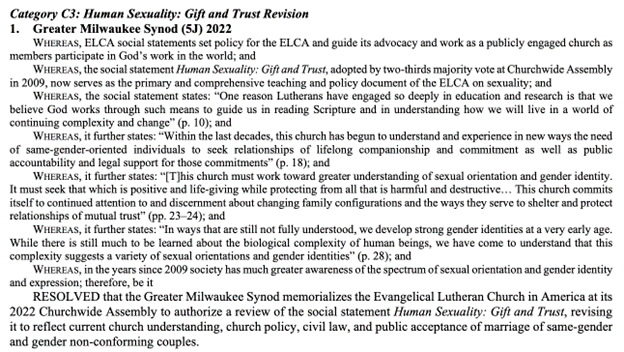
Of course there is much that could be said about the ELCA’s even having a transgender pastor who could be elected bishop.  The ELCA fully embraces the LGBTQIA+ agenda, even though the ELCA has never officially taken action to approve the BTQIA+ portion of LGBTQIA+.  (Transgender is the “T” portion of LGBTQIA+.)  The actions taken by the 2009 churchwide assembly only approved the ordination of a certain group of L and G persons – those that are in (PALMS) publicly accountable, lifelong, monogamous same sex relationships.  Even the recently approved document, “Definitions and Guidelines for Discipline,” which I have referenced above, affirms that “this church’s understanding of human sexuality is stated in its authorized social teachings” – the most recent of which is the 2009 “Social Statement on Human Sexuality: Gift and Trust.”       

Not too long ago I received an email from an ELCA synodical staff person, who is now an ELCA synodical bishop.  She agreed that in 2009 the ELCA did not act to approve the ordination of BTQIA+ persons.  She also said that if the ordination of BTQIA+ persons had been part of the vote, it probably would not have been approved at that time.  But, she said, the Holy Spirit has revealed new things to the church.  What good timing on the part of the Holy Spirit!  To reveal new things to the church after and only after enough traditionally minded people have left that church so that these new things will not only be accepted, but welcomed and embraced.

But there is much more that can be said about the installation service for Bishop Rohrer.  I will start with the wording of the invocation given by ELCA Presiding Bishop Elizabeth Eaton.  The news story said that “congregants were invited to stand as clergy gathered around the orchid-festooned baptismal font, giving thanks as decanters poured water from the Sacramento and Garcia Rivers, Lake Tahoe and the San Francisco Bay as acolytes waved blue streamers overhead.”  And then Bishop Eaton said, “You, oh God: Parent, Child, and Holy Breath.  You are the water we crave. . . .  You, oh God: Rain, Estuary, and Sea.  You are life for us all, now and forever.  Amen.”

I assume all this is intended to be some kind of creative reference to baptism, but what is it actually?  Idolatry.  Notice the parallel sentence structure.  The first “You, oh God:” is followed by five words that identify God – “Parent, Child, and Holy Breath.”  Not Father, Son, and Holy Spirit, as per the ecumenical creeds and the Lutheran Confessions.  (Interestingly enough, at the ELCA service of ordination for a minister of word and sacrament – the new term for pastor – the candidate is asked, “Will you therefore preach and teach in accordance with the holy scriptures and these creeds and confessions?”  At the ELCA service of installation of a bishop, the bishop is asked, “Will you carry out this ministry in accordance with the holy scriptures and with the confessions of the Lutheran church?”  But why would we expect the ELCA to expect one of its own pastors and/or bishops to actually do what they said they would do?)

The first “You, oh God:” is followed by five words that identify that God – “Parent, Child, and Holy Breath.”  So we should be able to assume that the words that follow the second “You, oh God:” also identify God.  And what are those words?  “Rain, Estuary, and Sea.”  What is this?  Idolatry.  Invoking God as Rain, Estuary and Sea, and invoking Rain, Estuary, and Sea as God.  Worshipping the creation rather than the Creator.

And who is this said by?  No one less than the Presiding Bishop of the ELCA.  The ELCA could argue that Ebenezer HerChurch does not represent the ELCA, and the agenda and goals of “We Are Naked and Unashamed” are outside the teachings of “this church,” but I assume that what the Presiding Bishop says represents the ELCA and is within the teachings of “this church.”  Does Bishop Eaton actually believe that God is “Rain, Estuary, and Sea” and “Rain, Estuary, and Sea” are God, or is she so careless about saying what she is handed to say at the service for the installation of a synodical bishop? 

What if the prophets of Baal were right and Elijah was wrong and the gods are merely forces of nature?  Certainly rain is a gift, and water is essential for life.  I live in Arizona.  I give thanks for the monsoon rains which fell this past July and August.  The danger of fires is now listed as low or moderate, rather than extreme, and most of Arizona is no longer suffering from extreme or exceptional drought.  But if God were only the forces of nature, and the forces of nature were God, then what do I do about the fact that the forces that can make life possible can also destroy?  If God were only the forces of nature – Rain, Estuary, and Sea – then I would know nothing of a God who loves me as well as created me and who went to great lengths and paid a high price to save me.

Yes, it does matter what we believe.  It does matter how we witness.  It does matter what we say within the context of a worship service – especially one that is so publicly visible.

The final thing that I would want to comment on from the installation service for Bishop Rohrer is the way in which the service began with a “land acknowledgement” – a declaration that “the land where we live and worship in this place is stolen land.”  Participants in the ceremony, which was held in Grace Cathedral – in a historically wealthy neighborhood in San Francisco – were encouraged to “find concrete ways to make reparations to the original stewards of these places and their descendants.”

It is interesting.  For the ELCA the worst of sins are the ones that they are proud that they are not guilty of – white supremacy, racism, male dominance, and sexism.  They feel free to blast and criticize those awful white settlers who stole the land from indigenous persons, not realizing that they are doing the very same thing when they send in “woke” pastors who decimate congregations.  These congregations then close, their buildings are sold, and from the proceeds synods and ELCA churchwide finance their agenda. 

For example, I wrote in my June letter from the director about the online synod assembly for the ELCA synod in which I was rostered before I retired.   The proposed spending plan for the 2022-2023 fiscal year included income of $899,000, but expenses of over $1.2 million.  The assembly rejected the budget, not because it was not balanced, but instead because it did not provide funding for all of the favored ministries.  The attitude of the assembly was, We need to sell more buildings from closed congregations, and we need to use more of the dollars already obtained from already selling buildings from closed congregations.

The hypocrisy is amazing.  Encouraging the participants in the installation service of an ELCA synodical bishop to “find concrete ways to make reparations to the original stewards of these places and their descendants” while showing neither respect, consideration, appreciation, nor regard for the people who built and paid for the buildings which they are now selling in order to fund their agendas, values, and priorities.  

* * * * * * *

IN SHARP CONTRAST

In sharp contrast was the LCMC gathering in early October, which I had the privilege of attending on behalf of Lutheran CORE.  In the second reading for October 10 – in Hebrews 4:14 – the author of this letter urges his readers, “Let us hold fast to our confession.”  The people at this gathering were not afraid to hold fast to their confession.  They were not afraid to call God Father, believe in the authority of the Bible, see the Lutheran Confessions as an accurate statement of Scriptural teachings and relevant for us today (even though they were written by white males), and view the mission of the Church as proclaiming Christ and helping people grow as disciples of Christ.

* * * * * *

VIDEO BOOK REVIEW – “WE WILL NOT BE SILENCED”

Lutheran CORE continues to provide monthly video reviews of books of interest and importance.  Many thanks to Bill Decker for giving us a review of Erwin Lutzer’s book, We Will Not Be Silenced: Responding Courageously to Our Culture’s Assault on Christianity.  This is a book for all who are concerned about how they can and will live out their Christian convictions against a growing tide of hostility in our contemporary culture.  Picking up on the words of Jesus to the church in Sardis in Revelation 3: 2 to “strengthen what remains,” this book is written with the ardent hope that the U. S. church will wake up and “strengthen what remains.” 

Mr. Decker is an ELCA rostered lay leader who has done editorial and grant writing work for the ELCA.  Erwin Lutzer is a student of Martin Luther and pastor emeritus of Moody Church in Chicago. 

This review, as well as ten others, have been posted on our YouTube channel.  A link to the channel can be found here.

Dennis D. Nelson

Executive Director of Lutheran CORE


Newly Updated Statement on Scripture

Several weeks ago there was considerable discussion in Lutheran CORE’s Facebook group in response to a person who questioned whether it is appropriate to call the Bible the Word of God. 

As part of that process, we posted our Statement on Scripture, which was written in 2007.

Because that statement was responding specifically to comments made by former ELCA presiding bishop Mark Hansen and to the ELCA’s Book of Faith initiative, we felt that the document should be updated to reflect our current situation and without reference to that initiative.

We are very grateful to NALC pastor Ken Kimball, who, along with Bishop Paull Spring, wrote the original statement.  Pastor Kimball graciously accepted our request to update the statement.  We are also very grateful to Dr. Mark Mattes of Grand View University for reviewing the statement. 

At its most recent meeting the board of Lutheran CORE unanimously voted to approve the statement.  You can find the full text of that document here

As we said in the July 2021 issue of CORE Voice, the real issue behind the issue is more often than not the authority of Scripture.  Refusing to call God Father, rejecting evangelism as part of the mission of the church, seeing faith in Christ as only one out of many ways to God, and embracing the full, radical LGBTQIA+ agenda all result from rejecting the inspiration, reliability, and authority of the Bible.  Therefore, we are glad to be able to share with you this newly updated Statement on Scripture.    

In the words of a hymn that has been set to the tune of “A Mighty Fortress” –

“God’s Word is our great heritage and shall be ours forever.

To spread its light from age to age shall be our chief endeavor.

Through life it guides our way; in death it is our stay.

Lord, grant while time shall last your Church may hold it fast

Throughout all generations.”


An Unanticipated Agreement

I find that usually I can anticipate fairly accurately with whom I will agree or disagree.  However, there are times when I am caught by surprise.  Such was the case with a public letter written by a member of the board of Extraordinary Lutheran Ministries (ELM).  

On its website this organization describes its mission in this way: “Extraordinary Lutheran Ministries organizes queer seminarians and rostered ministers, confronts barriers and systemic oppression, and activates queer ideas and movements within the Lutheran Church.”

This is not the kind of organization that I would expect myself to find something to agree on with.  So how did that come about?

A few months ago in celebration of Pride Month (June) the ELCA posted a link to the document, A Lutheran Introduction to SOGIE by ReconcilingWorks.  SOGIE stands for Sexual Orientation, Gender Identity, and Gender Expression.

Pastor Suzannah Porter, an ELCA pastor and member of the board of Extraordinary Lutheran Ministries, responded by commenting with concern that the ELCA was giving the impression that the whole church body is LGBTQ+ affirming, when in fact it is not, since there are congregations which hold to traditional sexual ethics with the church’s sanction.  Pastor Porter supported her statement by quoting the Bound Conscience policy which is a prominent part of the 2009 social statement, Human Sexuality: Gift and Trust.  That document described four different positions regarding same gender relationships, which it acknowledged that people within “this church” hold “with conviction and integrity.”  On the basis of “the bound conscience,” it said, “We . . . believe that this church . . . will include these different understandings and practices within its life as it seeks to live out its mission and ministry in the world.”  In other words, traditional views of human sexuality have the full endorsement and sanction of a social statement that was approved by no less an authority than an ELCA Churchwide Assembly. 

What happened after Pastor Porter sought to expose the ELCA’s dishonesty by revealing that the ELCA actually sanctions traditional views when it tries to give the impression that it is LGBTQ+ affirming?  Several things.

First, others replied to Pastor Porter’s comment with stories of lack of LGBTQ+ acceptance at various ELCA congregations.

Second, the ELCA deleted Pastor Porter’s comment – the only one, to her knowledge, that cited the Bound Conscience policy.  

Third, Pastor Porter responded in an angry public letter condemning the ELCA’s action.  She said, “It is Pride 2021 month, and I cannot be deleted today.” 

Here is more of what she said:

“ELCA, get back here and answer for yourself. On the post listing Reconciling Works SOGI resources (found herehttp://bit.ly/elcasogipost) you deleted my comment clearly stating that projecting the image that the ELCA is welcoming and affirming of queer people without clearly stating that it is also our policy that the church can call queer people to repentance and refuse to recognize same sex marriage is misrepresentation.

“After now hundreds of people think the whole denomination is affirming, you deleted the only comment that clarified your policy. And erased the testimony of the replies of people who labored to tell their stories. But you seem to keep the reattempt when I stated my position on the board and council. This leads me to believe that misrepresentation was not just an accident, it was the goal.”

What is going on here?  A lot.

First, the ELCA sought to silence a leader in the LGBTQ+ community, in the name of being LGBTQ+ affirming.

Second, Lutheran CORE and ELM agree that honesty, integrity, and transparency are important.  What is actually done in the church needs to match what public statements say will be done and what official policy says should be done.

Third, the ELCA’s misrepresentation, as Pastor Porter calls it, is dishonest and unhelpful both to people seeking LGBTQ+ affirming communities and to those who hold to traditional sexual ethics.  It would be far better for the ELCA to be truthful and honest and consistent all across the board. 

Now, to be sure, Lutheran CORE and Extraordinary Lutheran Ministries would have totally opposite purposes for raising these issues.

Extraordinary Lutheran Ministries would want the ELCA to eliminate language that sanctions traditional views, while Lutheran CORE would want the ELCA to keep its promise and live up to its commitment to also honor and provide a place for traditional views. 

Nevertheless, Pastor Porter’s point stands, and we agree.  The ELCA’s actions were dishonest and unhelpful.    

Click here to read the ELCA’s original post.

Click here to read Pastor Porter’s original post.


If Not CRT, Then What?

Here’s a true story, related to me by someone who witnessed it.  A small church, considering departure from the ELCA, solicited questions from the congregation.  One question surprised people, but it was, apparently, asked in earnest: If we leave the ELCA, will we go back to being a church that bans people of color?

Wait—what?  “Go back”?  “Ban”?  Some questions require their own hour to answer.  Did the questioner believe that her congregation had once banned persons of color?  Why?  Also, had the questioner never heard that the ELCA is “the whitest denomination in America,” as one of its own pastors has called it (not that other Lutherans are far behind)?  What string of pastors had neglected to teach, not only Lutheran failures in racial reconciliation, but also the Lutheran church’s rich contribution to civil rights, refugee resettlement, and the fair treatment of all people in congregation, school, and institutions of care? 

I don’t know how the congregation’s leaders ultimately addressed that question, but it proves that the question of race is on people’s mind.  Lutherans want to know where it resides in their faith and church’s life.

You know this.  You can’t breathe in America and not know it.  It has dominated the news, and one particular development has especially captured recent attention: critical race theory (CRT).  In general, conservatives have balked at CRT, criticizing instances of “CRT training” that seem to demean and unfairly condemn people of European descent.  States have begun passing resolutions banning its use in government and public education.

That criticism has echoed in the church’s halls as confessing Lutherans of various stripes point out where CRT differs from the Gospel’s more liberating message of “neither Jew nor Greek, neither slave nor free, nor male and female, for you are all one in Christ Jesus” (Galatians 3:28).  Yet a question lingers: if not CRT, then what?

How shall denominations, congregations, and believers critique the biases that linger within their own hearts and minds?  Are there aspects of Lutheran church culture that have made it one of the whitest denominations in America, and how might the Gospel overcome that culture?

Real Forgiveness for Real Sins

I don’t pretend to have hard and fast answers.  But as I’ve reflected on the question—and if you haven’t reflected on the question, it’s time to start, for the sake of the church you love—a few thoughts have struck me as worth sharing.  You probably already know them, but it doesn’t hurt to see them in print.  As St. Paul told the Philippians: repetition doesn’t hurt the author, and it’s good for everyone else (Philippians 3:1). 

It would all seem to start with real forgiveness for real sins.  It’s one thing to say, “We don’t rely on CRT; we preach the Gospel” (and that statement is fair and true enough), but it’s another thing so to preach that Gospel that it forgives a real sin brought to light.  Where have you, your congregation, and your denomination been blind to persons of color?  How have you or your church harmed them or rebuffed them, even if unintentionally? 

These questions are safe for you to ask (that is, they may hurt, but they are ultimately secure and good), because you know the One in whose presence you ask them: Jesus, who has carried the sins of the world.  You may let them have their way with you, critiquing, judging, and enlightening you, because you know that the more real the sin is, the more real the forgiveness that comes in Jesus’ name.  So let the sins take shape, in even startling contour, and then let the grace of Christ clothe them in a brilliant mercy that overcomes them.

The church has its own language for this kind of preaching, distinct from the vocabulary of secular justice warriors.  The Bible may not speak of racism and inequality or inequity, but it does speak of old-fashioned, rotten things like enmity, strife, jealousy, fits of anger, pride, divisions, envy, greed, and the like.  How do these works of the flesh, unearthed for us by the Spirit, illumine our problems with race, and what is Christ’s forgiving word for them? 

Preach it, and expect that preaching to change things, including you.

“You Do Not Have Because You Do Not Ask”

St. James has his moments. The second verse of his fourth chapter might be one of the better ones: have you tried asking?  Once God has spoken to us in our sin, we speak to Him by His generous grace. Only by His Word do we have words to speak, and when His Word calls out our sins and tells us, “These sins are forgiven; there is a limit to their power; you need not live under their bondage,” then we know what to ask.  Ask Him for what He desires; ask Him for the sin to be overcome and healed; ask for your soul, your congregation, and your church to welcome the people of every nation.

There’s really not too much more to say about this call to prayer, I don’t think, except do it.  Pray daily for the Gospel that we preach and the doctrine we confess to be the means by which the Lord draws all nations to Himself.  Maybe you pray from a place where God’s answer to that prayer won’t change how your congregation or life looks very much—congregations reflect their neighborhoods, after all, and so not every congregation has to be a microcosm of “The Church,” somehow ideally diverse, and thinking that it does actually denies the catholic nature of Christ’s body—but you’re not praying for only parochial concerns.  You’re praying for the whole Church, and for the Fisherman’s net to be cast across the world.

Pray, and say the amen in the confidence of God’s faithfulness. 

The Grass Isn’t Always Greener

This last suggestion (I know: there are lots more things to be said; what we have here is just a smattering) runs afoul of certain strands of church critique.  I call it (fairly, I think) the anti-institutional critique, which insists that buildings and polity and such things are irrelevant to faithfulness in mission, if not harmful to it.  To be sure, the faithfulness of a church is never measured by its stuff.  But stuff is no more irrelevant to the conduct of the ministry than our bodies are. 

What checks the sins of enmity, pride, greed, and rivalry more than for those with the most to take a weekly pilgrimage to gather with those who have the least?

God will raise our bodies, and so He calls us to steward this flesh in a certain way.  So also will He liberate creation from its bondage to decay, and so we steward creation in a certain way.  In particular, the Lutheran church should probably start paying more attention to where it lays its foundations, as in, its literal foundations. 

The church has always needed buildings for its mission.  The fact that the church first met in homes wasn’t a rejection of public buildings as much as it was the commandeering of private buildings for public use.  Throughout the church’s history, wherever missionaries spread the Gospel, they quickly built a shelter for its public proclamation, and they chose the placement of those shelters wisely.  It was an incarnational move, seeking to proclaim by the place wherein the Body gathers who and what the Body is. 

How our churches continue this ethic today may be key to understanding our problem with race.  That is, looking at our buildings and where we put them may be one way both to identify our real racial sin and to welcome God’s gracious balm for it.  For how we build has everything to do with how we use our money and why, and those economics may be the deeper root of Lutheran racial woes.

A case in point (another true story, and one repeated other places): a church in a mid-sized city had a beautiful neo-Gothic church in a busy, even crowded downtown.  Because that downtown had grown so busy, and so few of the people at the church lived there any longer, they decided to sell that building in favor of building a new house of worship far on the city’s margins, surrounded by a lush, green campus—it’s fair to say, not too different from a country club.  I knew this church a few years ago and just recently drove through its city.  I decided to check on it, and what did I find?

I found the downtown church, still a bit crumbly but nevertheless standing and beautiful,  purchased by another congregation with a more evangelical thrust and looking very well visited by a variety of people. As for the new Lutheran church—well, I almost didn’t find it.  Surrounded by beautiful green trees and a busy, suburban commercial center, it was easy to miss.  It would take effort, in fact, to find.  It would also require a car to attend, and it would take some personal courage, I imagine, to drive up to such a very nice church with anything less than a very nice car.


So in the city where this church stands, where white people comprise the Very Nice Car classes and blacks and Latinos fill cheaper housing downtown near the bus lines, which of these churches will have a better start to overcoming racial barriers?  In order to overcome such barriers, the church must be present as its Lord is present—and how present is a church hidden behind well-manicured trees?

I’m not saying, “Build it, and they will come.”  We’ve seen that approach fail so many times.  There’s no gimmick here, and the soul-work of preaching and prayer is more than everything else.  I’m also not suggesting that persons of color are always poor or whites always rich.  But I am saying, as many others have said, that racial divisions may find their deeper roots in class divisions, and the Lutheran church’s recent architectural history may illustrate the truth of it (as does the fact that that our churches appear to lack poor and working class whites as much as they lack persons of color!).  The church must be present to those whom it seeks.  It must bring the font and Bible and altar to them, clothed in their own neighborhood. 

Taking up that calling will mean that those already in the church may have to dedicate their resources and wealth for local ministries and houses of worship either not in service of themselves or at a distance from their own homes, requiring them who are more equipped to travel to do so.  Why not?  What checks the sins of enmity, pride, greed, and rivalry more than for those with the most to take up a weekly pilgrimage to gather with those who have the least?  Wouldn’t such a pilgrimage confess, “These sins are forgiven, and therefore, they no longer set the limits and conduct of our devotion”?

Yes, I know that persons of color are guilty of their own sins of enmity, pride, greed, and the like.  I also know that they aren’t the ones most likely reading this article, and I know it because most of you are Lutherans, and Lutherans are one of the whitest Christian traditions in America.  It needs some new and more Biblical attention.  CRT is not the way, and so what is?  Preaching, praying, and showing up to be present, all of it concrete and real and down-to-earth, seems to be the way I know, the way that I’ve been given to confess.  What are some other parts of that way?  I imagine you know, or that God will show it to you if you ask.


ELCA Support for the Equality Act: What Does it Mean?

Earlier this year, I noticed that ELCA Advocacy had given the Equality Act its full and unqualified endorsement.   It also encouraged members of the ELCA to write their Senators, calling upon them to support the legislation.  In doing so, the ELCA made reference to the social statement Human Sexuality: Gift and Trust (HSGT). 

I wrote to Presiding Bishop Eaton, saying:

The ELCA has declared its support of the Equality Act.  It is also urging its members to write to their Senators in support of the Equality Act. What I am wondering is whether the ELCA has given any thought to how the Equality Act will affect those congregations who choose not to call partnered homosexual pastors, or who choose not to perform same-sex weddings.  

As you know, there is debate about whether the act will remove religious freedom protections from congregations and pastors.  Has the ELCA considered this question?  Is the ELCA prepared to defend the right of its congregations and pastors to act in accordance with their “bound consciences” as was promised in 2009

The response came not from Presiding Bishop Eaton, but from Rev. Amy Reumann, Senior Director, Witnessing in Society, ELCA.  She assured me that the ELCA is aware of the “implications with respect to the Religious Freedom Restoration Act.”  She further stated that the ELCA is “reviewing that language in consultation with a number of our full communion partners and ELCA legal staff.”  Finally, she said that the ELCA hopes “to work with these Senate offices in discerning legislative language that achieves a bi-partisan and fair bill for protecting equal rights and religious integrity.”

I was very pleased to hear this and I had only two requests.  I asked if the ELCA would be willing to reiterate what Rev. Reumann told me in a public statement to ELCA congregations and whether I could share her reply.  She said yes to the latter.  In regard to the former, she asked what kind of public message would be helpful in my context.

It is at this point that our conversation began to go awry.  I gave her a fairly detailed response, clearly stating what I would like the ELCA to reaffirm.  Essentially, I asked that the ELCA publicly restate that choosing not to call a partnered homosexual and not to perform same sex weddings, and teaching in accord with positions 1, 2, or 3 of HSGT are still permitted and encouraged by this church.  Secondly, I asked that the ELCA publicly state its opposition to any language in the Equality Act that would or might punish ELCA congregations for these approved practices.

From that point forward, I received several replies reiterating ELCA policy, along with historical documents that detailed the Ministry Policy Resolutions adopted in 2009.  However, the question about whether the ELCA would publicly reiterate its commitment to those documents and to religious freedom protections for its congregations was not answered.  Finally, after a full week and another e-mail to Presiding Bishop Eaton, I received an e-mail telling me that my concerns would be addressed in ELCA Advocacy materials that would come out in April.

In April, ELCA Advocacy did in fact include the following words in its message:

Some U.S Senators support the intent of the Equality Act but have broader concerns about religious exemptions. There may be amendments proposed responding to these concerns.

As in the Senate, in the ELCA there is a diversity of beliefs and debates about possible impacts of this legislation on religious exemptions.

In an April 13 “guest blog” on ELCA Advocacy Blog, ELCA General Counsel, Thomas Cunniff, wrote:

We urge the adoption of legislation that ensures the full rights of LGBTQ+ persons without infringing on religious liberty or permitting improper government interference in the ecclesiastical activities of religious organizations. Blanket exemptions for anyone claiming a religious motive are too broad and would eviscerate necessary civil rights protections for historically marginalized groups. Not providing space in which dissenting religious groups can practice their beliefs free from government interference, however, would gravely damage freedom of conscience. Moreover, fully exempting statutes from RFRA sets a dangerous precedent of permitting the government to forcibly impose the views of the majority on minority religions, a precedent which could easily be weaponized by a future Congress and President. For these reasons, the ELCA is committed to continue working with others, including full communion partners, to find a solution that fully protects the civil rights of our LGBTQ+ siblings while at the same time protecting the free exercise and conscience rights of religious objectors.

That was not the last word on the matter, however.  On April 16, ELCA Advocacy sent an Action Alert with the following apology:

Issuance of the Action Alert related to the Equality Act on April 13 elicited strong reaction communicated through social media and other channels. Anger, deception, confusion, and contribution to a deepening of harm already part of the lives of many LGBTQIA+ members and other siblings surfaced, along with questioning advocacy process and accountability in the ELCA. For presenting a lack of care on these deep-felt issues, we apologize.  [alert]

It further stated that:

The blog post, “Equal Rights and Religious Freedom,” remains public on our ELCA advocacy blog not for prescriptive purposes but as background on “a false choice between equal rights and religious freedom.” Anticipated is a guest blog post that will provide further perspectives.

This seems to indicate that Mr. Cunniff’s blog post does not express the opinion of the ELCA and in no way indicates how the ELCA will proceed in relation to the Equality Act.  So we are left with a deeply ambiguous and equivocal statement of ELCA policy regarding “bound conscience” and religious freedom.  

Sadly, this leaves us where we began.  Any congregation with a commitment to traditional views on marriage and ordination is left uncertain about the future.


Mountain Lion Cubs Do Not Stay Mountain Lion Cubs

Not too far from our home – in the Sonoran Desert outside Phoenix – is the Southwest Wildlife Conservation Center.  This wonderful facility cares for many desert animals that have been injured or orphaned.  The goal is always to be able to return them to the wild.  But that is not always possible, so for some animals this place becomes their permanent home.  Some animals are brought there by people who naively thought that a mountain lion cub would make a great pet.  But mountain lion cubs always grow up, and people come to realize that something they thought would be safe has become a threat.

I thought of people who mistakenly believe that they could tame a mountain lion cub when I read the April 16 letter from ELCA Presiding Bishop Elizabeth Eaton addressing racial justice.  A link to her letter can be found here.  In her call for reform to “any institutionally racist system” she essentially endorses Black Lives Matter.  She encourages people to join Campaign Zero, which she describes as “a 10-point policy platform created by the #BlackLivesMatter movement to address and improve relationships between local law enforcement and the communities in which they serve.”  She also urges people to learn more about ELCA resources at elca.org/blacklivesmatter. 

I was relieved to read on the ELCA website that “the ELCA churchwide organization does not provide financial support to this chapter-based organization.”  I have been deeply disturbed to read about some other organizations and businesses that do contribute financially to Black Lives Matter.  It also seemed very reasonable to read on the ELCA website, “This movement does not seek to elevate Black lives above others.  Rather, the movement seeks to help people recognize that Black lives matter no less than other lives.”

The ELCA website is correct when it says, “Scripture tells us that each person is created in the image of God. . . . All of us have integrity and value.”  There is absolutely no question.  Racism does exist, and racism is wrong.  The First Readings for Easter Sunday and May 9 have both come from the account in Acts 10 when God clearly directed Peter to go to the house of Cornelius.  In the First Reading for Easter Peter said, “I truly understand that God shows no partiality.” (verse 34) In the First Reading for May 9 “the circumcised believers who had come with Peter were astounded that the gift of the Holy Spirit had been poured out even on the Gentiles.” (verse 45) Peter said, “Can anyone withhold the water for baptizing these people who have received the Holy Spirit just as we have?” (verse 47) If God has included them, how could we exclude them?

But for at least three reasons the ELCA’s endorsing and embracing the Black Lives Matter movement reminds me of people who think that a mountain lion cub would be safe.

First, the page on the ELCA website does not address the fact that at least two of the three original founders of Black Lives Matter are self-avowed, trained Marxist organizers.  Marxism has led to political systems that have enslaved people and that have been severely hostile to the Christian faith.

Second, while the full embrace of the LGBTQIA+ agenda is very strong within the ELCA, I am not aware of any official action taken by the ELCA to affirm that full agenda.  A document recently approved by the ELCA Church Council, “Definitions and Guidelines for Discipline,” includes the sentence, “This church’s understanding of human sexuality is stated in its authorized social teachings.” (page 8) The most recent of these social teachings is the social statement, “Human Sexuality: Gift and Trust,” which was approved by the 2009 Churchwide Assembly.  Actions taken by that assembly provided for the blessing of and ordination of persons in publicly accountable, lifelong, monogamous, same sex relationships.  They did not embrace the full LGBTQIA+ agenda.  In contrast, Black Lives Matter has said, “We foster a queer-affirming network.  When we gather, we do so with the intention of freeing ourselves from the tight grip of heteronormative thinking.”  It is interesting that the page that contains that wording from Black Lives Matter appears to no longer exist.

Third, what Black Lives Matter used to call its “Full Manifesto” also is on a page that appears to no longer exist.  One of the most disturbing sentences in the “Full Manifesto” reads as follows – “We disrupt the western-prescribed nuclear family structure requirement by supporting each other as extended families and ‘villages’ that collectively care for one another, especially our children.”  Every orthodox Christian parent should be horrified over a statement like that, which advocates for the state’s taking over the raising of children.  Every Christian parent needs to do everything they can to keep from losing the ability to influence the faith formation of their children.  To me it is interesting – and I believe significant – that some of the statements from Black Lives Matter that have caused the greatest alarm are on website pages that appear to no longer exist.  If you can find them, please let me know.  Has the Black Lives Matter movement modified and/or softened its position?  I doubt it.  I believe they are just downplaying it.  They want people like the ELCA to believe that there is nothing to fear.  What Black Lives Matter advocates for, every reasonable person should be in favor of.  Mountain lion cubs will stay mountain lion cubs