How Your Congregation Can Identify, Enlist and Train Part-time Lay Ministers

Note:  “This is a ministry resource article for churches that might be interested in the new upcoming CORE ministry called the Congregational Lay-leadership Initiative (CLI). The article below offers a preview of this new ministry.”  

The current shortage of available pastors in the LCMC and NALC presents a difficult challenge for a great many call committees.  This is especially true for smaller churches when their search process has extended beyond 18 to 24 months without success.  In fact, such a scenario can result in nothing less than an existential crisis for their congregations.  In these situations we are looking not only at burned out and disheartened call committees; we are talking about congregations where their members are beginning to lose hope for their future as a faith community.

Thirty years ago call committees of smaller churches could reasonably take comfort in the conviction that it would “only be a matter of time” before they would be able to “call and install” their next pastor.  However, in 2023 this is not a reasonable expectation.  Why?  Because with retiring Boomer pastors—and far fewer seminary graduates—our clergy supply crisis is only growing more dire.

Here is the stark, unvarnished truth: A great many of our smaller vacant churches will never, until the last Boomer pastor retires in 2029 (or shortly thereafter), have much hope of finding a pastor.  For these churches there needs to be a “reality check”: As long as they assume their only hope to survive as a congregation is to find that new pastor, it’s only a matter of time before they will have given up on their search process.   At that point discussions will probably begin regarding the possibility of having to close their doors and disband as a faith community.

However, there is an alternative to this scenario; a way to continue ministering to their members and their surrounding community without a resident, full-time pastor to lead them.  This alternative is to intentionally transition to a long-term lay-led ministry.  And this transition would not just be a temporary “stop-gap” plan until they find a pastor to call, but a ministry strategy to continue, as long  as necessary, as a vibrant and thriving lay-led congregation.

There is now outside assistance available for smaller churches willing to transition from a clergy-dependent ministry model to one built on a foundation of lay leadership.  But first, a disclaimer: If your congregation’s in-person worship attendance averages less than 25, and/or you no longer have  members who are active retired or younger, this assistance might be “too little too late”.  Why?  Because this ministry model depends on one, two or three members willing and able to step forward and serve your congregation as part-time lay ministers.

However, if you still have congregational leaders who are active retirees or younger, I encourage you to consider the Congregational Lay-leadership Initiative as a way of preparing for an immediate future where your congregation will not only survive, but thrive.

Below are the steps involved if you decide to transition to a lay-led congregational ministry modelAnd keep in mind that your “outside” assistance in this process would be a retired Lutheran pastor mentoring and encouraging your part-time lay ministers—at a distance—as they serve your congregation.

1. Identifying the right member (or members) to ask to become a part-time lay minister.

The conversation regarding the “right” person will most often begin within your church council.  (And note: The right person might already be serving on your council.)  The ideal candidate for this new ministry role should already be recognized, by your members, as a congregational leader; and as a person characterized by both a strong faith and personal integrity.  He or she should be someone who comes to mind in the context of your council’s prayers for guidance, and also when considering biblical texts such as Romans 12:1-8.  And this needs to be someone whom the Council ultimately chooses  unanimously, not just based on a majority vote.

2. Enlisting your lay minister (or lay ministers).  This step needs to be done with great care, and while Council members are praying for this person to accept this ministry opportunity.  Also, recruitment needs to happen face to face, not over the phone.  Ideally, two Council members should present “the ask”, rather than just one.  In addition, this individual should be asked to pray about this opportunity over the next few days rather than give an immediate “yes” or “no”.  (Of course if you receive an immediate and enthusiastic “Yes!”, don’t argue!)  Do not, at this point, get into such details as the average number of hours expected per week, or compensation, or the specific start date.  Instead, make clear that if she/he agrees to say yes to this ministry, the Council will simply “make it work” for your new lay minister.  In other words, the details of this position will be negotiated based on what is workable for this person.  This includes the details of the final “job description”; which will be based on this person’s gifts, abilities and preferences.  The overall theme in this enlistment conversation is: “Why we consider you to be uniquely qualified for this important ministry role in the life of our congregation.” 

3. Hiring your part-time lay minister(s).  To impress upon your lay minister the importance of this position I suggest a formal job contract.  This contract will be worked out with your new employee’s input.  Some suggestions for your contract: Either this person or the Council can end this agreement with a 30-day notice; and the “average” number of hours per week would be flexible and again determined with your lay minister’s input.  (I suggest somewhere between 10 and 20 hours per week.)  Make clear that this person will be supervised by and answer to the Council.  Your written job description, then, will be written in collaboration with your new employee.  When determining the overall structure of this job contract you can find resources online; resources that you will obviously adapt to your specific situation.  

4. Commissioning/Installing your lay minister(s).  It is extremely important your members participate—during a worship service—in this commissioning.  Make a “big deal” out of this occasion. Celebrate this event as a congregation.  Have a potluck immediately following the service.  And have a laying on of hands as part of the commissioning.

5. Training your lay minister(s).  The good news here is that your lay minister probably already has the gifts to perform most of the responsibilities you negotiated in determining the job description. However, there will undoubtedly be some ministry responsibilities he/she might not feel entirely comfortable with.  For example, what if one of the responsibilities is preaching?  There are resources available to become more confident in this aspect of ministry.  (For example, an online 6-week preaching course.)  Contact me or an LCMC staff person for information regarding such resources.

Any costs involved in such resources should be covered by your congregation.

6. Mentoring for your lay minister(s).  The Congregational Lay-leadership Initiative is designed with the goal of every congregation having a retired Lutheran pastor to mentor its lay minister(s).  This mentor would be volunteering for this role and would provide encouragement and counsel for your lay minister(s) by means of a monthly online meeting and/or by phone.  In rare cases this mentor might be within driving distance of your church; in which case the monthly meeting could be in-person.  If needed, I can assist you in recruiting a mentor who is on the LCMC or NALC rosters.

7.  The matter of pulpit supply.  This is of course a huge issue in the worship life of your congregation.  Because of this fact it would be ideal if one or more of your lay ministers was comfortable in a preaching (or teaching) role.  This is especially important if you do not have local (most likely retired) pastors available for pulpit supply.  Here is my rule of thumb: You want to avoid, when possible, having lay ministers and other members reading someone else’s sermons.  This might be okay on an occasional basis, but should not be a regular, most-Sundays practice.  Why?  It’s not easy to be invested and engaged emotionally while reading something that you did not write.  Again, I suggest one of your lay leaders take an online seminary preaching course as one way to address this matter.

8. Maintaining your eucharistic ministry.  If you will not typically have an ordained visiting pastor participating in your worship service, be aware that the LCMC allows for designated congregational lay members to preside over the celebration of communion. 

Finally, I believe two or three lay ministers, if available, would be preferable to just one; for four reasons:

First, a team of lay ministers means each person is able to offer encouragement and support to the others on the team.

Second, there is the Biblical concept of “different people, different gifts”.  In other words, with more than one you are more likely to have a lay minister with the appropriate gift for each major ministry responsibility.

Third, I think mentoring sessions can be even more helpful when the mentor is having online sessions (e.g., via Zoom) with a group of two or three lay ministers as opposed to an extended phone conversation with just one.

Fourth, a team of lay ministers provides a level of accountability that comes with fellow co-workers. 

If you have any questions, you may contact me directly.  My email is…                    [email protected]


You Do-I Watch: A Hard Lesson in Fully Releasing the Next Generation into Mission

Editor’s note: River’s Edge Ministry (REM), located in Mt. Airy, MD, traveled to Pine Island, FL in January as part of Cross Country Mission (CCM) 2023. Pine Island was devastated by Hurricane Ian in late September 2022. Mary Bates, NALC Disaster Response Coordinator, did the necessary groundwork to find the work sites that matched our team’s skillsets. Lutheran CORE’s board provided funding that enabled REM to reduce the cost of the trip for the crew. Previous articles about Cross Country Mission and City Mission include The Potency of Missional Engagement, Igniting Renewal Through Mission and How City Mission Was Born, Part 1: Katrina, the Unwelcomed Reformer.

As a pastor-mission developer who has served for many decades, I believe we—those who are part of a so-called ‘mainline’ denominational church body—are facing a hard (and potentially devastating) reality: Who will be leading our churches, especially as a significantly large percentage of clergy retire and many others ‘step down’ because of discouragement and sheer exhaustion? AND, where is the ‘next generation’ of pastors and leaders? The intent of this article is not to answer these questions but to simply acknowledge and remember that we, as pastors and leaders of Christ’s Church, are called to grapple with such realities and then present hope in the midst of it all. These times press us to consider other, more general questions: “Lord, what are You saying to us?” and “Lord, how should we respond?” I desire to offer at least a glimmer of hope by sharing a hard lesson in fully ‘releasing’ the next generation into leadership.

This ‘hard lesson’ involved laying aside my leadership, unconditionally, and literally watching from afar as the next generation took the reins and completely oversaw a very challenging disaster relief mission which we had been planning for months through Mary Bates, Coordinator of NALC Disaster Response. Though they did all of the work and I watched from 1100 miles away, it was an unexpected blessing to behold and one from which we, I, learned a great deal. In a nutshell, I was sidelined and could not lead this effort called Cross Country Mission: Pine Island, FL because I developed shingles in my right eye. Just days before the scheduled departure from MD on January 29th, I was still resolved to be part of this effort. But then my ophthalmologist informed me that if I didn’t stay home and rest, I might lose my eyesight. I listened. I suppose we could’ve cancelled but, instead, we recalibrated our strategy and the next generation stepped fully and willingly into the task before them. Not only did I keep my eyesight but I gained a greater vision of how important it is to equip and mobilize the next generation by fully releasing them into leadership roles.

In this article, I’d like to share a bit, as both father and pastor-mission developer, of how the Lord made a way and used a difficult circumstance for the greater good (cf. Romans 8:28). It’s encouraging to know that there’s well-grounded precedence for such a happening: “Behold, I am doing a new thing; now it springs forth, do you not perceive it? I will make a way in the wilderness and rivers in the desert.” (Isaiah 43:19)

One of the greatest joys in my life has been parenting. As a father for nearly 34 years, it seems that I am still learning the fundamentals of child-rearing. One of them is transitioning from the demanding commitment of rearing and raising little ones to, perhaps, the greater challenge of releasing them into a world beyond the familiarity and comfort of home. It seems that there’s not much difference between our pastoral/shepherding role in ministry and our parenting role. As parents, we are called to eventually release our children into their full potential, giftedness, calling/vocation, and God-ordained destiny, etc. Is ministry any different? As a priest, pastor, shepherd, father/mother of the faith, are we not to release and mobilize our congregants, disciples, etc. into the work of the ministry for the sake of the Kingdom? As I shared in the opening paragraphs of this article, I just experienced this reality, face-to-face, in a very real and practical way, both as a parent and as a pastor; especially in terms of more effectively moving a child (or disciple) from a preparatory season of rearing-raising (or equipping) into a fruitful season of releasing (or mobilizing).  

A while back, I attended a conference regarding what it means to build a discipling culture—an environment to communicate and pass on the faith—within the local church setting. During that time, a clear and concise model was presented on how to create such a culture. It is one that you may be familiar with and is especially apropos to our present conversation. I believe it’s especially helpful and a simple but highly-effective pedagogical tool in raising up the next generation of leaders. For the sake of clarity, we’ll simply refer to this model as a teaching square.

Teaching Square where P represents parenting

The “P” in our teaching square represents parenting. Our “progression” in teaching our children is essential as we move from P1 to P4, especially knowing that they are—whether we’re aware of it or not—watching and learning from our words and actions. Again, we can bring out the very best in our kids and release them with a self-assured independence, or we can choose not to take the time to parent our children thoughtfully and wait for a different outcome. We could just as easily replace the ‘P’ with a ‘D’ with the emphasis being discipling not parenting. But the teaching square is easier said than done. As pastors and leaders within the Church, one of our great privileges is leading our parishioners into a deeper relationship with Jesus Christ while simultaneously equipping and mobilizing them for the work of the ministry … and the Church’s mission. My great confession in this article is that it’s been difficult for me—both as a parent and a pastor—to move around the square fluidly. I find myself stumbling around P4 (or D4), YOU DO—I WATCH! But I know it’s absolutely essential, especially in raising up and fully releasing the next generation. 

I believe you could share a similar story and make a similar confession, but for me it took ‘shingles in the eye’ for my soul to awaken to the gravity of what’s at stake—If our children, the next generation AND/OR our parishioners-disciples are not fully and unconditionally released as missional disciples, then the future of the Church is greatly at risk. Fully releasing means trusting, accepting and expecting that the Lord’s already gone before us, making our paths straight and the rough roads smooth (Psalm 5:8), and causing the necessary infrastructure to be built with new (and different) resources, ideas and relationships, etc. It means that we faithfully lead around the teaching square, but then pause (before we stumble) at P4-D4, take a deep breath … and then completely and unconditionally relinquish our own need to lead and pass the baton into the more-than-competent hands of those we’ve been faithfully shepherding and discipling, especially the next generation! We should then be able to take a seat, rest, rejoice, and then cheer them on with a loud cry, YOU DO-I WATCH! Indeed, it was a joy to watch two of my sons, Jacob and Caleb, and two other young adults enthusiastically take the reins of leadership for Cross Country Mission: Pine Island, FL.

Paralleling many of my own thoughts about leadership in his provocative article, How Your Congregation Can Identify, Enlist and Train Part-time Ministers, Pastor Don Brandt writes, “The current shortage of available pastors in the LCMC and NALC presents a difficult challenge for a great many call committees … In fact, such a scenario can result in nothing less than an existential crisis for their congregations.” This article is very helpful in at least stimulating a much-needed conversation in which all leaders and pastors of every congregation should engage. Though well-intended, addressing such important concerns should not be reserved for just another hierarchically-appointed task force or national staff person. Again, ALL of us should be intensely involved in the discourse because, after all, what happens if we’re not able (or are unwilling) to enlist others to lead when finding or calling an ordained pastor becomes nigh impossible? This question ties in with my opening questions: Who will be leading our churches, especially as a significantly large percentage of clergy retire and many others ‘step down’ because of discouragement and sheer exhaustion? AND, where is the ‘next generation’ of pastors and leaders?

Thank you for taking the time to at least consider how we might more effectively release our parishioners, especially the next generation, into the mission field. Because I wasn’t able to be part of Cross Country Mission: Pine Island, FL, Kim Smith, a missional partner with River’s Edge Ministries and one who did participate, will tell at least part of the rest of the story of how the work of ministry unfolded. Enjoy her article, (Per)Mission to Lead, also published in Lutheran CORE’s  March newsletter. You’ll read about how the team stepped up as she and the other 24 co-laborers from many different churches did the work of the ministry. I stood back and watched … And it was way more than good!

All photographs used in this article were provided by various crew members.


Global Lutheran House of Studies

Rev. Dr. Richard Blue, Jr.

As the Directors of the Global Lutheran House of Studies at United Theological Seminary (UTS) in Dayton, Ohio (established in 1871), we are honored to announce the launch of a new program for pastoral ministry formation in the Lutheran Tradition that is deeply committed to The Historic Faith and Church Renewal. At UTS, we are motivated by the belief that the church is essential to the renewal of the world and the development of disciples of Jesus Christ. We are dedicated to empowering faithful and fruitful Christian leaders to fulfill this mission. Visit https://united.edu/global-lutheran-house-of-study/ for the most current information on The Global Lutheran House of Study at United Theological Seminary.

One way we aim to honor the legacy of Martin Luther is by emphasizing confessional Lutheran teachings and the importance of upholding and declaring the Lutheran Confessions. We believe that the church has a responsibility to remain true to its Lutheran distinctives and to pass on the rich heritage of the Lutheran tradition to future generations. This includes offering classes on the Lutheran Confessions and their relevance for practical ministry, as well as opportunities for students to learn from and connect with scholars and leaders from various Lutheran traditions.

The Global Lutheran House of Studies (GLHS) also supports its vision and goal by emphasizing education in global ministry, theology, and global Lutheran traditions. We believe that the church has a duty to confront the challenges and opportunities of a rapidly changing world, and we are dedicated to providing our students with the skills and knowledge they need to serve as church leaders worldwide. This includes classes on cross-cultural mission, global theology, and the unique Lutheran perspective on ecumenism, as well as opportunities for students to participate in international contextualization trips, mission trips, and internships as required by the programs we offer through UTS.

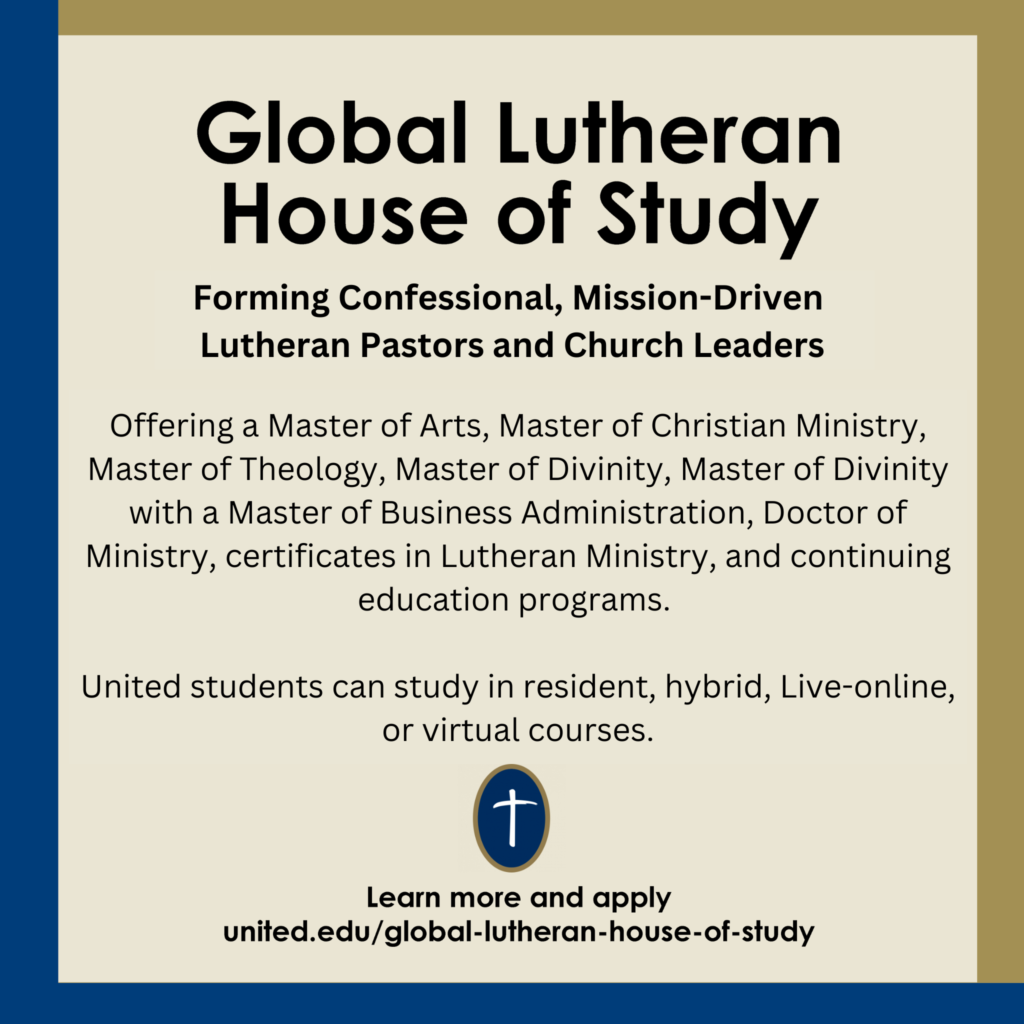
In addition to our emphasis on confessional Lutheran teachings and global mission, we are also committed to academic excellence and providing our students with a high-quality education. The Association of Theological Schools accredits United Theological Seminary, which includes The Global Lutheran House of Studies, and we are dedicated to helping our students achieve academic and professional success. We offer a range of educational programs and resources, including master’s degrees (M.A., Masters in Christian Ministry, Masters of Theology, MDiv, MDIV/MBA), doctorate (DMin), certificates (Lutheran Ministry and others), and continuing education programs. United students can study in resident, hybrid, Live-online, or virtual courses.

As Directors of the Global Lutheran House of Studies, we are dedicated to our students’ success and helping them fulfill God’s mission to create disciples of Jesus Christ and renew the church. We will work closely with them to provide the support and resources they need to succeed in their academics and their current and future vocations, and we encourage them to participate in school life and take advantage of UTS’s numerous activities, events, and training opportunities.

Overall, we are excited about the impact that the Global Lutheran House of Studies will have on the lives of our students and the church at large, and we are committed to carrying out this vital work in the coming years. We believe that our school is uniquely qualified to help confessional Lutheran students develop their faith and prepare for mission-driven leadership in the Church. For more information, visit https://united.edu/global-lutheran-house-of-study/. The first twelve admitted MDiv students receive 50% off tuition, with additional scholarships available for other programs, including the DMin.

The Directors of the Global Lutheran House of Studies at United Theological Seminary in Dayton, Ohio, are Reverend Dr. Thomas Thorstad STS, Reverend Daniel Landin, and Reverend Dr. Richard Blue, Jr. The faculty and staff serve this house of study, who are all Lutheran pastors within various Lutheran denominations, have been approved and remain in good standing with ongoing approvals as of January 1, 2023.. The faculty and staff include Reverend Dr. Douglas Schoelles, Reverend Dr. Wesley Teixeira, Reverend Dr. Rod Ford, Reverend Dr. Thomas Thorstad STS, Reverend Daniel Landin, and Reverend Dr. Richard Blue, Jr.

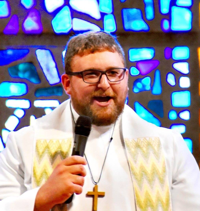
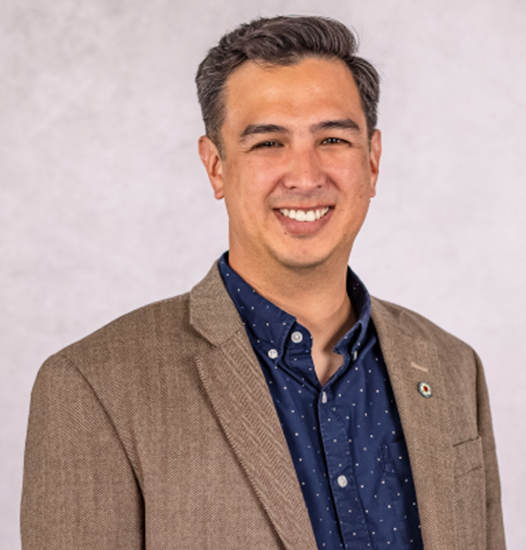
Image in page header (left to right): Rev. Richard Blue, Rev. Thomas Thorstad, Rev. Daniel Landin


The Potency of Missional Engagement

Dear Friends—

A most happy and blessed New Year to you and yours.

No doubt, many of us reading this article can readily receive such a greeting; but, for some, these words may be welcomed but not so easily received or even believed. This may include an individual who just discovered they have a very difficult illness to contend with or maybe it’s a husband who lost a beloved wife of 35 years or one trapped in overwhelming bondage to an addiction or perhaps it’s a family who experienced a natural catastrophe and lost everything. The list goes on. When facing such a reality, it can be much more difficult to receive a word of blessing, while happiness is illusive at best. This is precisely when the Community of Faith, the Body of Christ, is called to rise up and consider the potency of missional engagement. It is helpful for us, as brothers and sisters who are bound up in Christ, to be aware of those who are struggling and then allow the Great Commandment to settle deeply into that place of compassion: “‘ … and you shall love the Lord your God with all your heart, and with all your soul, and with all your mind, and with all your strength.’ The second is this, ‘You shall love your neighbor as yourself.’” (Mark 12:30, 31) This will necessarily push us towards mission which can quickly and graciously re-prioritize the living out of these most challenging days. 

In 1 Corinthians 12, St. Paul paints a beautiful and profound picture of what it means to be a community of faith and concludes with these striking, life-altering words: “If one member suffers, all suffer together; if one member is honored, all rejoice together.” (v. 26) The writer of Hebrews says it a bit differently in 12:12, “ … lift your drooping hands and strengthen your weak knees, and make straight paths for your feet, so that what is lame may not be put out of joint but rather be healed.” Again, we can see our ‘calling’ to come alongside and help lift up and literally be the hands and feet of Jesus, especially for those whose hands are failing and knees and feet weak. This is what it means to be fully engaged in mission.

This brief article is an invitation for you to join us in an upcoming missional event or better yet, and more practically speaking, connect with a local church body and engage in mission … in your own backyard! Prayerfully consider engaging—Not only will it help bring restorative healing to any given situation but you will experience restoration and healing as well. Just engage.

Last year, I wrote an article for the July CORE Voice Newsletter (click here) regarding the power and potency of such missional engagement. It is there that I describe a particular outreach called City Mission (CM) which was birthed out of Cross Country Mission (CCM). Dennis (Nelson) asked that I write this article to share just a bit about our upcoming CCM. Again, though I’m inviting you to participate in this event, more so I’m inviting you to simply participate in mission at some level, somewhere.

On January 30th through February 4th (link for more details @ https://www.riversedgeministries.org/ ), River’s Edge Ministries will be headed to Pine Island, Florida, for our eleventh disaster relief/rebuild effort. We are a multi-generational group of ordinary people coming together from many denominations to be His Church. Our fervent hope is to be a Christ-centered family on mission and avail ourselves to the needs of those who were severely impacted by Hurricane Ian, causing over 150 fatalities in Cuba, Florida, North Carolina, and Virginia; but most of the deaths were in Florida. Ian also caused catastrophic damage with losses estimated to be more than $50 billion. The cities of Fort Myers Beach and Naples were particularly hard hit. Millions were left without power in the storm’s wake, and numerous inhabitants were forced to take refuge on their roofs. Sanibel Island and Pine Island were hardest hit by the storm surge. Clearly, thousands are still in the recovery phase and are only now rebuilding their future. It will be our sacred honor to be part of that rebuilding.

Please note that we are currently working with Mary Bates (NALC Disaster Relief) who has established our base of operation, housing, missional work, etc. (Thank you, Mary, for all of your extraordinary work for the Kingdom of God, especially as it manifests itself in the midst of utter chaos and ruin.) Our plan is to arrive to First Baptist Church on Pine Island by the evening of January 30th. Upon arrival, we’ll set up our base camp on the church grounds in their building and outside in the parking lot, etc. We will work from 9:00 until 3:00 on January 31st, February 1st and 2nd, and then depart on February 3rd and arrive back home to MD by February 4th.  We will travel just over 1000 miles by car, van, and truck with the hope of bringing a small caravan of hurricane clean-up-rebuilding workers and prayer warriors. Some are even flying in. As alluded to before (cf. Mark 12), our hope is to minister to heart, soul, mind, and strength. There will be a broad range of work tasks, including ongoing clean-up, framing, electrical, drywalling, roofing, meal prep, and on-the-ground intercessory prayer. We are praying for many skilled and unskilled co-laborers, but mostly willing hearts! At the present time, nearly 20 have committed to this event; but, it seems that we’ll have closer to 30 brothers and sisters participating in Cross Country Mission: Pine Island, FL; again, from 16 to 70+ years of age and at least 7-8 different denominations. And to think that we, a church of the NALC, get to sponsor this event—What an honor and joy!

If by chance you become interested in participating in this effort or have an interest in hosting a similar event in the future, please register here or contact me directly. But the gentle invitation and challenge from this article remains: Simply engage in mission somewhere … it’s right in front of you. I’d like to thank CORE and many individuals for supporting this missional endeavor with resources and encouragement. 

Do take care, stay the course, and keep your eyes on Jesus, the Pioneer and Perfecter of our faith.

K. Craig Moorman

River’s Edge Ministries, Mt. Airy, MD

(Images in this post: Flickr)


Better Call Saul: Discernment at Damascus

Pr. Jeff Morlock

Ananias (not Sapphira’s husband, but the other Ananias) is an obscure figure in the New Testament. He appears only twice, for a total of eight verses. Yet Ananias is much more than the answer to a Bible trivia question. The Lord used this ordinary man to change the world in unfathomable ways. His story teaches us to listen for God’s call, discern our next assignment, and discover the astounding impact that obedience can have.

So what did Ananias hear God say? “Rise and go to the street called Straight, and at the house of Judas look for a man of Tarsus named Saul, for behold, he is praying, and he has seen in a vision a man named Ananias come in and lay his hands on him so that he might regain his sight.” (Acts 9:11b-12 ESV). The obedience that the Lord asks of us is often counterintuitive. It is rarely easy, but it ends up being one thread in the glorious tapestry He is weaving. We may or may not get to glimpse the finished project, but if God is calling you, then the role you play in God’s plan will be important.

Yet not every thought and idea is from the Lord. So how will you know? Ananias had to discern his call. To discern means to perceive, recognize, or distinguish. Although filled with fear and apprehension, Ananias sought clarity regarding God’s will. Discernment is faith seeking understanding; not stalling indefinitely but listening for further direction and confirmation. So, Ananias asks, “Ugh, Lord, isn’t Saul dangerous?” And the Lord revealed His plan: “Go, for he is a chosen instrument of mine to carry my name before the Gentiles and kings and the children of Israel. For I will show him how much he must suffer for the sake of my name.”  (Acts 9:15b-16 ESV).

That sounds consistent with the witness of the Scriptures, which is another aspect of discernment. Beginning with Abraham, God gave His name to Israel in order to bless the nations of the world. And Jesus himself not only suffered for the sake of God’s mission, but declared, Whoever does not bear his own cross and come after me cannot be my disciple ” (Luke 14:27). Biblically, to bless others and to suffer for the gospel are part of every disciple’s calling.

God is always calling you to join him in his work. To discern a particular course of action, then, means asking certain questions. Does it take me out of my comfort zone? Does it require sacrifice? Is it consistent with Scripture? Does it sound like Jesus? If the answers are “yes,” then it’s likely from the Lord.

But there’s one more question. What do other believers think about it? Ananias stepped out in faith and discovered that Saul was indeed at the home of Christian disciples who had taken him in and cared for his needs. With this confirmation, Ananias laid his trembling hands upon Saul, who had been blinded days earlier when he encountered Jesus on the road to Damascus.

In that moment, God used Ananias to heal Saul, who regained his sight and was filled with the Holy Spirit. Presumably, it was also Ananias who then had the privilege of baptizing the man who would go on to write two thirds of the New Testament! And Saul, who discerned his call to preach the Gospel, became Paul, the chief apostle and church planter for the non-Jewish world!

Although it was God who called Saul, He used Ananias to be part of it. After this brief episode in Acts, we never hear from Ananias again in the Bible. But where would we be without him? Where would Saul be without Ananias? Where would the Church be without Paul? Clearly, not everyone can be Paul. But everyone can absolutely be Ananias, who learned to discern, and who helped a brother do the same.

If this passage seems detached from present day reality, let me assure you that, in recently discerning my own call to the North American Lutheran Seminary, God used a number of “Ananias’s” to remove scales  from my eyes when I was blind to God’s plan, and how it fit perfectly with my gifts and passions.  Part of my role now is to daily be an Ananias for others who are discerning a call to ordained ministry.  

Recently, I spoke with a mid-career disciple named John, who had been praying about pursuing theological education. He told me how God used a stranger to confirm that this was indeed the Lord’s plan. John was traveling and when he arrived at the airport, he presented his boarding pass to the airline attendant, who repeated John’s full name and exclaimed, “With a name like that, you ought to be a pastor!” As I write this, John is completing his seminary application.

The fact is that God can and will use you as he used the people in my life, that airline attendant in John’s life, Saul who became Paul, and Ananias himself. My prayer is that all of us will learn to consistently ask, “God, is there someone you would have me speak with today? Is there somewhere you would have me go? Is there something you would have me do?” Be listening. Be available. Be ready. You never know what difference you will make.

Pastor Jeff Morlock is Director of Vocational Discernment at the North American Lutheran Seminary.


The Need for More Lay-led Lutheran Congregations

It has, for decades, been an incredibly unfair reality faced by smaller rural and inner-city congregations.  In a denomination that has traditionally insisted that viable, healthy congregations must be led by a resident, ordained pastor, the number of pastors willing to serve in these settings have often been “few and far between.”  Even back when there were an abundant number of seminary graduates, the majority of those graduates often showed little or no interest in serving churches located in such communities.  And this unfortunate attitude was not limited to graduating seminary students looking for a first call; it was also common among already ordained, serving pastors looking for their next call.

So what did these rural and inner-city congregations do when even new seminary grads had little interest in their calls?  They waited.  And they knew that eventually—if they waited long enough—their bishop or district president would find them a new graduate whom they could “take under their wing” and train.  Unfortunately, as soon as these first-call pastors were “trained” they would usually move on, within two or three years, to a larger church in a suburban setting.  Then the congregation’s pastoral search process would begin once more.

It used to be true—decades ago—that there was still an abundant supply of seminary graduates coming through the “pipeline.”  As a result, the national Lutheran church bodies could continue to insist—or at least imply—that healthy and viable congregations were, by definition, led by an ordained pastor.  But here we are in 2023.  And unlike decades back, there are far fewer seminary graduates; Boomer pastors have already or soon will be retiring; and smaller rural congregations are more often than not located in declining communities.  (Communities where the median age of their residents—and the congregation’s members—is in the late 50’s or 60’s.)  As a result, that traditional Lutheran ministry model—that the only viable congregation is one that can find and call an ordained pastor—simply has to change.  Unfortunately many of these congregations have been taught the false dichotomy that unless they can find and call an ordained pastor they might as well close their doors.

And that false dichotomy is not consistent with either the New Testament understanding of the church, nor with Martin Luther’s teaching regarding the priesthood of all believers. 

Tragically most Lutheran church bodies have failed to adequately model or advocate for intentional, long-term lay-led congregational ministries when there is no reasonable expectation that a resident pastor will ever be “called and installed.”  These congregations need a third option; not just the choice between an unending pastoral search process or closing their doors.  That “third option” is to become a truly lay-led congregation; a priesthood of believers not just in theory, but in terms of ministry practice.

Here is the stark truth of what is happening “out there” among many of our smaller congregations: They have been looking for a pastor for years.  In fact, some of them have gone three, four or more years without a resident pastor.  The longer they assume that such a pastor is “their only hope,” the more likely they will not survive as an organized faith community.  And they need to know that at least until the last Boomer pastor retires in the 2030’s, the number of pastoral vacancies will only grow, and grow dramatically.

Finally, these churches need to know that the work of the Holy Spirit in congregational life and ministry is not dependent on the leadership and presence of a resident, ordained seminary graduate.  This was true in the time of the early Apostolic church almost 2,000 years ago, and it is still true today.

“As you come to him, the living Stone—rejected by men but chosen by God and precious to him—you also, like living stones, are being built into a spiritual house to be a holy priesthood, offering spiritual sacrifices acceptable to God through Jesus Christ” 1st Peter 2:4-5 (NIV).


Video Ministry – January 2023

Here is a link to our You Tube channel.  In the top row you will find both our Video Book Reviews as well as our CORE Convictions Videos on various topics related to Biblical teaching, Lutheran theology, and Christian living.  You will find these videos in the order in which they were posted, beginning with the most recent.  In the second row you will find links to the Playlists for both sets of videos.  This month we want to feature a CORE Convictions video by NALC pastor Tim Hubert.

“INTERIM MINISTRY” BY PASTOR TIMOTHY HUBERT

Many thanks to NALC pastor Tim Hubert for his very wise and insightful video on interim ministry.  A link to his video can be found here.

Pastor Hubert has been ordained for forty years.  For twenty-five years he served in regular calls; for fifteen years he has served various interim assignments.  He has seen and experienced both kinds of situations – when a very beloved pastor leaves as well as when a pastor in a very troubled situation leaves.

Tim describes three questions that congregations will have regarding the new interim pastor –

  1. Can we trust the interim pastor?  Including, Can we trust the interim pastor to love us in the way our former pastor loved us?
  2. Will the interim pastor stay long enough – until we are ready to call a new pastor?  Church councils want a seamless transition in ministry.
  3. Will the congregation allow itself to love the interim pastor, knowing that the interim pastor will be with them only for a short time?

He also lists three expectations that interim pastors have –

  1.  To be treated fairly and honorably.  The congregation needs to remember that the interim pastor did not cause the former pastor to leave.
  2. To be paid a fair and honorable salary.  While some congregations will try to save money at the expense of the interim pastor, Pastor Hubert believes that the interim should be paid the same as the previous pastor.  Otherwise, the congregation could be in for a real shock when they learn that they may need to pay their next pastor more than they had paid the previous pastor.   
  3. That the congregation will trust the process.

Losing a pastor is a grief process – both when the former pastor was loved and when it was a troubled situation.  All change creates pain.  Even good grief can take up to two years to heal.

Tim recommends that a congregation have an interim for one to two years.  In situations where there has been significant conflict, it can take longer to begin the process of healing.  It is a good sign of healing when members are returning to worship and are becoming involved once again.

Tim’s closing advice is –

Pray for interim pastors – there are fewer and fewer of them.

Thank the Lord when He provides you with an interim pastor.

Thank the Lord that He already knows and has chosen your next pastor.

Remember that the Lord is in charge.  As Jesus said in Luke 12: 32, “Fear not, little flock; it is your Father’s good pleasure to give you the Kingdom.”


Introducing Faith GreenHouse

Pr. Dave Wollan

More than an internship, a community for leadership formation!

Faith Lutheran Church, in Hutchinson, MN, is excited to be launching a new initiative to address the need for future leaders of the Lutheran church.  Because our old leadership-training institutions can no longer be trusted, and because many of the new online institutions are not as ideal for young interested leaders, Faith Lutheran is cultivating an environment and community for learning and formation. 

I have a gifted daughter who is about to graduate from college and is interested in pursuing a Master of Divinity degree.  But where can she go to get that degree?  Our old Lutheran institutions are no longer truly Lutheran, and while the new online seminaries are great, she hardly wants to get her M-Div. while living in her parent’s basement! 

We need to cultivate quality learning environments, opportunities, and communities that will attract and accommodate young seminary students and other young adults interested in congregational ministry.  Our friend, Pastor Nathan Hoff, has one such intern community at Trinity Lutheran in San Pedro, CA, and Faith Lutheran is now creating another in big-town rural Minnesota.

Faith Lutheran began to aggressively pursue this vision in the summer of 2021.  We challenged the congregation to give towards the initiative and received $75,000!  Then, after a Sunday morning update on the vision, a member was so inspired that he and his wife donated $100,000 to help secure housing.  The Lord continued to move this last summer, when an old home a block-and-a-half away from the church came up for sale.  We presented our vision to the sellers and were able to purchase the house for $20,000 less than the list price!  We have named the house “The Ansgar House,” after the Apostle to the North and the patron saint of Denmark.  Recently, a group of young adults have started gathering there every Thursday night for food, fun, Bible study, and worship.

Inside Faith GreenHouse

We have a house.*  We have a young adult community.  And we have a plethora of opportunities for aspiring young adult leaders to plug into!  Now we are praying for the Lord to call some interns!  

Faith Greenhouse is an intentional intern community.  An opportunity for young adults to enjoy intentional Christian community with one another, plug into a thriving confessional Lutheran congregation with a large variety of ministries, and explore how they are gifted for ministry.  Interns receive free housing for 20-25 hours/week of church engagement.  Interns will be mentored in theology and ministry, and will gain valuable experience and guidance in pastoral, children’s, youth, seniors, and worship ministry plus much more.  The internship is designed to run September through May, with a summer option.

Are you, or someone you know, interested or do you have questions?  Please contact me at [email protected].  You can also support this ministry financially by sending gifts to Faith Lutheran Church, 335 Main St S, Hutchinson, Mn, 55350.

*The house with the green roof above is a stock photo.


Does Doctrine Matter?

Does doctrine matter?  That is a question that has been asked again and again in the Church.  Sometimes, the question is asked because doctrine seems so dry and boring.  It seems so much like academic hair splitting.   A second reason is because doctrine divides.   During the 17th Century, central Europe endured the 30 Years War, leading to the death of up to one-third of the population of Germany.  That war was driven by doctrinal differences between Catholics, Lutherans, and the Reformed. 

When the war was over, a movement arose called Pietism.  Many saw it as a Second Reformation.  Pietism emphasized many things that have become part of our common heritage as Christians.  The man considered the founder of Pietism, Philip Jacob Spener, made six proposals to improve the life of the Church.  One of them was this:

We must beware how we conduct ourselves in religious controversies.

Being at war with one another, either literally or verbally, does little to spread the Gospel.  Non-believers are turned away from the Church when they see how divided we are.  In particular, when they perceive that Christians are lacking in love for one another, they wonder about the truth of the Gospel.  After all, didn’t Jesus teach that the greatest commandment was to love God and one another?

That is all true, but it’s not so easy to dismiss doctrine.  In the Lutheran Church of the 17th Century there was another movement that emphasized doctrine.  It is known today as Lutheran Orthodoxy.  They spent a great amount of time disputing with Catholics and the Reformed over proper theology.  At its best, Orthodoxy was not obsessed with doctrine for its own sake, as if one is saved by having the right answers to abstract theological questions.  Rather, Orthodoxy understood that the purpose of doctrine is to preserve the pure preaching of God’s Word and the proper administration of the Sacraments. 

Why does this matter?  Because it is through the Word and the Sacraments that God gives us forgiveness, life and salvation.  For instance, there is the question, “Is the Bible the Word of God?”  You might be surprised to hear that question.  Both the Pietists and the Orthodox held the Bible in high regard.  In fact, Jacob Spener’s complaint was that there wasn’t enough Bible reading in the Church, particularly among the laity.  Meanwhile, Catholics, the Reformed, and Lutherans all agreed that the Bible was the Word of God.  They only disagreed on how it should be interpreted.

That is not the case today.  In the past year, I have heard an ELCA pastor declare that the Bible is not the Word of God.  Instead, he said that Jesus is the only Word of God.  The Bible, he said, is a Word about God, but it is not the Word of God.  The reason he did this is that he finds parts of the Bible to be offensive, outmoded, and oppressive. Rather than turning to the Bible on questions of faith and life, he would prefer that we ask ourselves what we think the “real Jesus” would do.  In doing this, he drives a wedge between the Jesus of the Bible and the Jesus that we supposedly “know in our hearts.”

What does Lutheran doctrine teach?  It certainly does teach that Jesus is the Incarnate Word of God.  However, it also teaches that the Bible is the inspired Word of God.  It is in and through the Written Word that we encounter the Incarnate Word.  In fact, Lutheran doctrine teaches that the Word of God comes to us in three forms:  1) the Incarnate Word, 2) the Written Word, and finally 3) the Preached and Sacramental Word. 

This is where doctrine becomes practical, and not only practical, but a matter of life and death.  Think of the question of the forgiveness of sins.  If your sins are forgiven, you have life and salvation.  If your sins are not forgiven, you will be condemned eternally.  So, how do you know your sins are forgiven?   How can you be sure?  The answer that Lutheran doctrine gives is that you will know for sure when a Preacher announces to you, “Your sins are forgiven.”  You will also know for sure when you are Baptized and when you receive the Body and Blood of Christ in Holy Communion. 

“But wait a second,” you might say, “how do I know that Preaching, Baptism and Communion do these things?”  The answer is very important.  You know because it says so in the Bible.  Can a human preacher really announce the forgiveness of my sins?  Yes! Go read John 20: 22-23 and Matthew 16:18.   Does Baptism really save me?  Yes!  Go read Mark 16:16 and 1 Peter 3:21.  Do I really receive forgiveness, life and salvation in Holy Communion?  Yes!  Go read Matthew 26:27-28. 

It all depends on what we believe about the Bible.  If it is God’s Word, then we can be comforted with the knowledge that our sins are forgiven for Jesus’ sake.  If it is only a human word, we are left to figure it out for ourselves.  Lutheran doctrine tells you that you can be confident that the Bible is GOD’S WORD.  As the beloved children’s songs says:

Jesus loves me, this I know, for the BIBLE tells me so.

May God give all of us the childlike faith to believe those simple words.

In Christ,

Pastor David Charlton


Every Samuel Needs an Eli

“What do you want to be when you grow up?” It’s a question that youth have been asked since they graduated kindergarten. But in high school, the question becomes a much more pressing issue. In a culture obsessed with both success and control, students are encouraged at earlier and earlier ages to have their futures and career paths completely mapped out. And much of the decision making in this regard revolves around interests, skills, money, and the expectations of others. At the intersection of “What am I interested in, what am I good at, what will my loved ones approve of, and how much money can I make doing it?” is the decision to follow one career path over all the others.

What is too often excluded from this equation is the biblical reality of God’s call. We are called into being, called into relationship with the Lord and His Church, called to serve, and called into a yet unknown future by One who knows us better than we know ourselves, and who loves us beyond measure. For Christians, then, the primary question that needs to be answered is not, “What do I want to be when I grow up?” but rather, “What is God’s call on my life?”

Every kid in Sunday School has heard the story of young Samuel (I Samuel 3), to whom the Lord spoke in the middle of the night. Like many of us, Samuel struggled to recognize the voice of the Lord. In fact, it was Samuel’s older and wiser mentor, Eli, who helped Samuel recognize God’s voice and call on his life.

Although he failed to recognize God’s calling at first, Samuel was open to the Lord’s leading. After learning that it was God who was calling, he responded by saying, “Speak, LORD, for your servant is listening.” Are you listening for God’s call on your life? Are you open to His leading? You might hear God’s call during times of study or silent prayer. You may hear God’s call through the proclamation of His Word in a sermon or Bible study, through a petition in the Prayers of the Church, or through the lyrics of a hymn. Or even more likely, you may hear God’s call through family, friends, or church members who might say, “You would make a good pastor. Have you ever considered pursuing ordained ministry?”

One of Martin Luther’s gifts to the Church was his insistence that all callings are holy. Whether one is gifted and called by God to be a pastor, butcher, baker, or candlestick maker, each calling is equally holy and necessary for human flourishing, and for the building up of the Lord’s people. So how does one “hear God’s call?”

The first step is to recognize the Holy Spirit’s movement in your life. The older and more experienced Eli recognized that the Spirit was speaking to Samuel, and he encouraged Samuel to reply, “Speak Lord, for your servant is listening.” Only then could Samuel recognize the Spirit’s leading and respond in obedience to the call.

The truth is that most of us need an “Eli” at one time or another in our lives. And most, if not all of us, are also called to be an Eli for others. Being an Eli simply means keeping our eyes open to recognize the gifts of others and staying present to them — listening, talking, praying, and sharing with them. Finding an answer to every question is not always as necessary as just being a companion as they search and discern.

Jesus had compassion on the crowds he encountered because “they were harassed and helpless, like sheep without a shepherd” (Mark 9:36). Today there is a critical shortage of shepherds in God’s Church. Many congregations are without a called and trained pastor to preach His Word and administer the sacraments. How to explain this shortage? Has God gone silent? Is the Lord no longer speaking?

No. In fact, somewhere in our congregations right now is an infant who will be baptized this Sunday, who has a call to ordained ministry. Somewhere in our congregations right now is a fourth grader who has a call to ordained ministry, and who is also the absolute terror of Mrs. So-And-So’s Sunday School Class. Somewhere in our congregations right now is an eighth grader who has a call to ordained ministry. They are about to be confirmed, and they wish their parents would allow them to sleep in on Sundays, because “Church is boring.” Somewhere in our congregations right now is a high school sophomore who is preparing to attend the retreat that will change their life and confirm their call to ordained ministry. And somewhere in our congregations is a college student or career person who is running from God’s call to ordained ministry or has postponed it to pursue an alternative career path. I know this because each of these people was me at different points in my life.

Thankfully, the Lord strategically placed Eli’s in my life. My youth minister, Duane. My Sunday School teacher, Ruth. And my pastor, Reuben. Each of them, and many others, too, played the role of Eli in my life to help me recognize my spiritual gifts, to encourage my discernment of God’s call, to listen to my concerns, questions, and objections, and ultimately to walk with me to the “yes” that finally came when I filled out my seminary application.

Friends, there are many, many Samuel’s out there today who are called to serve and speak the Word of God, but instead of filling out a seminary application, they are pursuing a path that is more expedient or lucrative. They are pursuing a path that is more in line with the expectations of those around them.

So let me ask you to find your place in this biblical story. Are you a Samuel, knowing that there is a voice speaking to you and calling you to a purpose bigger than your own dreams and desires? Or are you an Eli, called to pay attention to the gifts of those with whom you worship? Called to encourage and walk with those who are or should be discerning God’s call to Word and Sacrament ministry? Either way, you are the answer to the crisis we face today in the Church of Jesus, where sheep without a shepherd are “harassed and helpless.” Every Samuel needs an Eli. And every Eli can recognize a Samuel with God’s help.

Pastor Jeff Morlock is Director of Vocational Discernment at the North American Lutheran Seminary. He may be reached at [email protected].