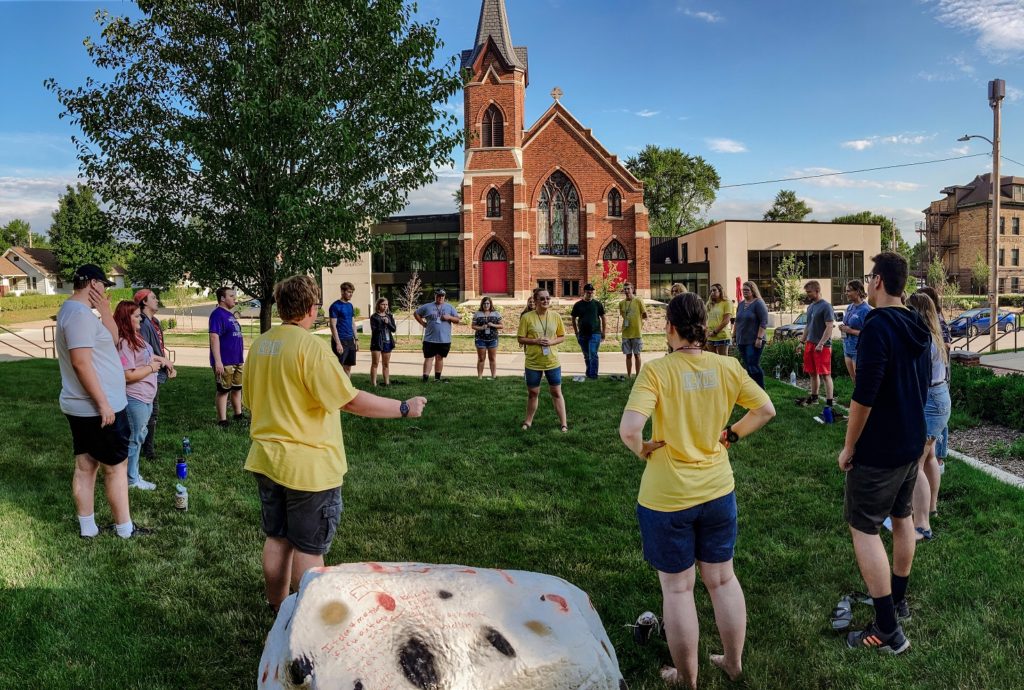
A Note from a College Missionary in Italy

“Ciao! I’m Jackson. I’m from the United States. What’s your name?”

This is the gist of how I started conversations during my time in Italy this past May and June. It was usually accompanied by the question, “Do you speak English?” and a handshake. This introduction was often followed by the student asking me why I was in Bologna, Italy. Since you’re probably wondering the same thing, I’ll give you some context.

Jackson Watts

My name is Jackson Watts. I am going into my senior year at Oklahoma State University, and I am considering attending Trinity School for Ministry in Ambridge, PA for my MDiv in order to become a pastor in the North American Lutheran Church. This past school year, I joined the campus ministry group Cru (formerly Campus Crusade for Christ), where I attended weekly Bible studies and other events. Early in the fall semester, I heard that Cru did summer mission trips at universities around the world, and the OSU branch of Cru was affiliated with Cru at the University of Bologna in Bologna, Italy.

I told myself that it sounded cool but wasn’t for me. As often happens to me with ministry opportunities, the more I told myself that I didn’t have the time or the resources for it, the more I realized it was God’s plan for me. After speaking with the team leader about it in November, I decided to apply to the six week Bologna summer mission trip. Since then, I have seen God work in more ways than I ever could have imagined, and I have had countless opportunities to grow in my faith.

One of the first ways in which I saw God work was in fundraising. I started fundraising in February, giving myself three months to raise the $6,000 needed for the trip. The fundraising started off well. Lutheran CORE was my first supporter! However, I soon faltered. With three weeks left, I still needed $2,500. There were 30 people I had mailed for fundraising who hadn’t gotten back to me. I began to lose hope when I realized that even if all 30 of those people gave me $50 each, I would still be $1,000 short. I spoke to my team leader about it, and he told me he was confident God would provide the $2,500 I needed in the next three weeks. I didn’t believe him, but I continued to fundraise, talking to new people and texting those with whom I had already been in contact. Not only did God provide me what I needed, but He provided an overabundance! Through the unexpected generosity of many people, I raised all the money I needed with significant extra, which I gave to other members of the team.

On May 17, 2022, eight other students, three Cru staff, and I departed for Bologna, Italy, to spend five weeks doing ministry at the University of Bologna. The University of Bologna is the oldest continually operating university in the world, having been founded in 1088 A.D. It has an undergraduate enrollment of approximately 50,000 and a postgraduate enrollment of approximately 35,000. The Cru group there has approximately 50 active students, and it calls itself Agape Studenti.

I soon discovered several major differences between the University of Bologna (UB) and traditional American universities, some of which made ministry difficult. One major difference was that UB doesn’t have a finals week like most American universities have. UB students finish classes at the end of May and take their final test any time during June. Most students were free to leave Bologna for a week or two before coming back to take tests.

This made ministry difficult because we met many students who couldn’t meet up again because they were about to leave Bologna and go back to their parents’ house for a few weeks, or for the rest of the summer. I met several students who were interested in my faith in Jesus and wanted to know more but weren’t free to meet up until after I left Bologna. This was one of the most frustrating parts of the trip.

Another major difference was that there were no clubs at UB like the clubs at universities here in the U.S. This was a challenge to ministry as well. When talking to students I couldn’t present Agape Studenti as a club with weekly meetings at a designated time and place. The students would see that as a very strange thing. In fact, Agape Studenti doesn’t have weekly meetings at UB. They did in past years, but the staff decided to drop the weekly meetings because of low attendance. Because the idea of a club is so foreign, students at UB prioritize hanging out with friends over weekly meetings with an organization at a designated time. Now, the staff meets with students one-on-one to read the Bible together.

Although I’m more comfortable with the American style of campus ministry, I had to adapt to the culture. When doing ministry in the United States, I prioritized getting students involved in weekly Bible studies. In Italy, I had to focus on being friends with students whom I met, telling them about how my faith in Jesus has changed my life, and introducing them to an Agape staff member.

The difference which was most relevant to ministry was the extremely low number of practicing religious adherents of any kind. As a group, we met around 300 students and had spiritual conversations with around 200 students whom we didn’t meet through Agape Studenti. To my knowledge, none of those people consistently attended a worship service, mass, mosque, or synagogue. We did meet one Italian student who considered himself an evangelical Christian and grasped the concept of salvation by grace through faith only, not by works. We met another two to five students (forgive me for not knowing exact numbers, as it was hard for me to keep track of the students contacted by other members of my group) who could be considered practicing Roman Catholics because they attended mass a few times a year. We met three to six students from other countries, or whose parents were from another country, who considered themselves either Protestant Christians or Eastern Orthodox Christians. One of these students was already involved in Agape Studenti. The rest were not involved in any Christian student organization or any local church. The majority of the students we met were Italian students who had been baptized and confirmed in the Roman Catholic Church but had not been to mass in years.

It may come as a surprise that Christian international students who come to Bologna don’t make more of an effort to get involved in a Christian group. However, this makes more sense given that many of these students can’t find a Christian group of any kind.

Although there are a few protestant churches on the outskirts of the city, there are only two in the center of the city, and both of these have fewer than 100 in attendance per Sunday. This is in a metropolitan area of around 1 million people and a city center of around 100,000 people.

In addition, to my knowledge, there is only one interdenominational Christian student organization at UB, Agape Studenti. I heard of a Catholic student organization, but this organization seemed to have a low presence on campus. Out of the 300 students whom we had conversations with outside of Agape events, we met only one who was an active member of any religious student organization (in his case, Agape Studenti). Given the extremely low presence of religious organizations on campus, it’s easy to understand why Protestant Christian students coming to the University of Bologna don’t know where to turn to find fellow believers. Part of my job was to find those students and get them involved in Agape.

In order to find interested students, we had to meet students. There was no easy method for meeting students; we just had to start conversations with strangers. One of the easiest places to start a conversation was in line to get food in the cafeteria. I always started with “Parla Inglese?” (Do you speak English?) To which they usually answered “Sí.” I then asked what food I should get. After they answered that question, I introduced myself in the manner I explained in the first paragraph. When I met students in other places, I had to start with a different question, or just introduce myself and start talking. They were often confused at first about why an American started talking to them randomly, but they were willing to continue in conversation. They usually asked why I was in Bologna, which gave me an opportunity to explain a little about Agape, and possibly about my faith.

Telling students about my faith in Jesus wasn’t always easy. At some point in the first conversation, I usually got a chance to ask students about their religious beliefs. I only met two students who didn’t believe in any god at all. Most students said they believed in a God but didn’t see any point in practicing the religion they had grown up practicing. They had gone to mass regularly as a child, but the ritual prayers there felt meaningless. The idea of a personal relationship with God was a mostly foreign idea to them. The message of the Catholic Church was that a personal relationship with God comes through regular attendance of mass. Because Italian students did not feel any joy or connection to God through this participation, they usually stopped participating after confirmation.

By the time I met them, they usually felt resentment towards the Catholic Church for various reasons often having to do with positions on sexuality. They had very little knowledge of the Bible, but what they did know tended to follow a pattern: Jesus taught good morals, and the Old Testament has scientifically incorrect teachings and defunct morals. This was usually a good avenue for me to share what I believe about the Old Testament – it shows the brokenness of humanity and points to a coming savior – and the New Testament – Jesus is the savior of all who repent and believe in him. These concepts were mostly foreign to Italian students. A few times I asked what they had been taught in confirmation class. None of them could remember.

Through the difficulties of having to share my faith day after day to new people who didn’t understand it, a passage which guided me and gave me encouragement was the story of the woman at the well in John chapter 4. Jesus started his conversation with the woman with a simple command, “Give me a drink.” The woman questioned why Jesus would talk to a Samaritan such as herself. When Jesus says he has what she needs for eternal life, she seems to miss the point and is instead interested in finding a way to avoid coming to the well again. When Jesus shows her that he knows her past, she realizes he is a prophet.

However, she is determined to create a division between herself and Jesus. She says, “Our fathers worshiped on this mountain, but you say that in Jerusalem is the place where people ought to worship.” She creates a division between “my people” and “your people” with her words, and she points out a difference between them that was not even relevant to what Jesus was talking about. However, Jesus is unfazed. He says the truth of why he came, and how she can have a personal relationship with God. Three times the woman pointed out the divisions between their societies, but Jesus focused on how to end the division between herself and God.

I found myself in similar situations often. I wanted to tell students about the Living Water, Jesus Christ. When I brought up my faith in Jesus, they brought up the hottest topics of the day which divided us, usually having to do with homosexuality, or the Catholic Church being hypocritical in some way. When they found out I was American, they wanted to hear my opinion on the most recent American news, of which there was always too much. I learned to not get wrapped up in politics, or get defensive, but focus on the task at hand. After the woman at the well tried to create a division, she realized what Jesus’ true message was. She went to the town to spread the news of what Jesus had done for her. I tried to do the same. I have access to many resources, and I know my Bible well. However, I try to keep my initial message simple when talking to students: look at what Jesus has done for me.

At the beginning of the trip, we decided as a group that if even one person accepts Jesus as their savior as a result of our mission, our mission would be a success. It seemed like a good goal at the time, but now I view the mission differently.

According to statistics we kept during the mission, we initiated conversations with 372 different people (not all of whom were students). This doesn’t count people we met at Agape events who were previously involved in Agape. We had 270 spiritual conversations with students (conversations with the same person at different times were counted separately). We presented the gospel 63 times.

We saw zero decisions for Christ. Even though we didn’t have any decisions for Christ while we were there, I still saw evidence of God’s working in the lives of the students we met. We connected several Protestant Christian students to Agape, giving them a safe place to profess their faith in Jesus and giving them a resource to help them spread that faith to others. In addition, our final Sunday in Bologna, two UB students attended church with us at a local Protestant church.

On a separate occasion, one of the students I met bought a Bible and read all of Genesis in five days. He told me it was beautiful. Over the course of the trip, I had several students express interest in getting together to read the Bible with me.

Our final week in Bologna, Agape hosted an event to which we invited all of the friends we made during the mission. At the event we discussed the meaning of love, focusing on its meaning in John 3:16 and John 13:34. Around 25 UB students attended, and they were all introduced to at least one Agape staff member. Earlier in the trip, we had several previously agnostic students show a genuine deep interest in our message of salvation through Jesus. However, I do not consider the trip a success for these reasons. Romans 8:28 says, “And we know that for those who love God all things work together for good.” Back in November, I realized God wanted me to go to Italy this summer. Because I love God, I trust He is working for good in ways I can see and in ways I can’t. Therefore, I consider the trip a success.


The NALC Pastors’ Conference: One of the Best

It is always a joy when you go to a Pastors’ conference and leave with a sense of energy and enthusiasm for ministry.  Over my twenty-eight years of ministry, I have been to my share of such events.   They have been a mixed bag.  To quote Forrest Gump, they “are like a box of chocolates.  You never know what you’ll get.”  Some are definitely worth your time.  Others are mediocre, but since you have the chance to see old friends, you don’t mind.  Others leave you positively frustrated.  Of all the conferences I have attended, good, bad and indifferent, I must say that the NALC Pastors’ Conference held in Orlando, Florida, from February 15 to 18, was one of the best. 

Although I am not a pastor in the NALC, I was able to attend as a representative of Lutheran CORE.  The theme of the conference was: “Always Be Ready: Apologetics in Real Life,” based on 1 Peter 3:15.  The keynote address was given by the Rev. Dr. Mark Mattes, with plenary addresses by Rev. Dr. Maurice Lee, Rev. Dr. Dennis DiMauro, and Rev. Dr. Thomas Jacobson.  Each speaker addressed the topic of apologetics from a different perspective.  Rather than giving a full synopsis of every presentation, I will mention what were the highlights for me.

Mark Mattes identified one of the major mistakes that Christians made in the second half of the 20th Century.  This was to adopt the world view of unbelievers and skeptics, in an attempt to show that the Christian faith can be made to fit into those worldviews.  Instead of arguing against people from the point of view of modernity or post-modernity, we should argue with them from the point of view of the Christian faith.  Our goal should be to help people see what difference it would make if the Christian worldview were true.

Maurice Lee reminded us of the approach taken by Justin Martyr.  As his name indicates, Justin Martyr was not only an apologist, but died as a martyr.  Justin sought to refute false rumors about Christianity and engaged with pagan philosophers like Socrates and Plato.  However, he had a third strategy.  This was to describe what happens in the liturgy of the Eucharist.  In addition to saying what Christianity is not, we need a picture of what it is.  There is no better place to find this than weekly Sunday worship.  The same is true in 2022.

Dennis DiMauro recounted an experience he had while doing door to door evangelism.  A young man whom he met shocked him.  He wasn’t interested in general information about Christ, or the Church.  What he wanted to know was what had happened in Pastor DiMauro’s own life to make him believe in the Gospel of Jesus Christ.  He reminded us that while there are intellectual arguments and rhetorical strategies that can be helpful, what is most important is being able “to give an account for the faith that is in us.”  Lutherans tend to shy away from the term testimony.  Nevertheless, we need to be able to testify to what God has done for us.

Thomas Jacobson reminded us of the class differences that need to be taken into account in reaching the unchurched.  Lutherans have tended to follow Schleiermacher by focusing on the “cultured despisers” of Christianity.  The problem is that the largest group of un-churched people in America today are not the cultured people of the upper middle-class.  They are the blue collar and the poor.  In recent decades, church attendance remained fairly stable among the successful and well to do.  Meanwhile, among the poorer classes, the bottom has fallen out.   We need to find a way to speak to them too. 

While at the NALC Pastors’ Conference, I was also able to attend two break-out sessions.  The first was led by Rev. Doctor Russell Lackey of Grand View University in Des Moines, Iowa.   He spoke about the NEXUS Institute, a summer theological institute for high school youth, which is held each summer at Grand View.  (This summer it will be held on June 12-18.)  Pastor Lackey shared information about research that has been done on such summer theological institutes.  This research was cross-denominational, cross-cultural, and multi-faith.  It indicated that summer theological institutes are very effective.  As many as 25% of young people who attend these summer theological institutes end up entering the ministry in their respective religious communities.  With the growing shortage of ministers in the Lutheran Church today, institutes like NEXUS are extremely valuable.

In the summer of 2022, there are twenty-five spots for young people at NEXUS.  Bishop Dan Selbo challenged the pastors at the conference to make sure that there will be fifty attending NEXUS in 2023.  I was so impressed that I rushed home and nominated a young person from my congregation for this year’s institute.

The second break-out session that I attended featured Pastor Dave Keener.  It was an introduction to the newest phase of the Life-to-Life Discipleship.  I was excited to hear that the NALC is developing its own resources for Discipleship ministry.  These resources will be tailored specifically for Lutheran congregations. The first will be a 24 week-long introductory curriculum on discipleship.  Those resources are meant to be available on the NALC website in the near future.

Of course, like most conferences, there was good fellowship.  I was able to reconnect with old friends and make new friends.  I also enjoyed visiting my hometown of Orlando, where I was born in 1964.  As I returned home, I was grateful for the six insights that I shared above.  They either confirmed what I am already doing or gave me new areas of ministry to explore.  If you have never been to the NALC Pastors’ Conference before, I encourage you to attend next year.  I also encourage you to get in touch with the speakers above if you want to learn more about what they shared.

Rev. David Charlton

Vice-President, Lutheran CORE


NEXUS: One Theology Institute, Two Mentors’ Perspectives, and a Triune God

by Ethan Zimmerman and Luke Ratke

Executive Director’s Note: Many thanks to Ethan Zimmerman and Luke Ratke for telling us about their experiences at NEXUS this past summer.  Ethan and Luke are both NALC college students and are planning on attending the NALC seminary after graduation.  They have also made a video about NEXUS, which is posted on our website.  A link to that video can be found here.

Luke

NEXUS is a vocational discernment institute rooted in Lutheran theology hosted by Grandview University in Des Moines, Iowa, and it is a week full of blessings! High school students who are contemplating their vocation, what God’s call for their life is, come to NEXUS and experience fellowship with other young Christians who are going through similar journeys. Morning and evening worship, classes on the Old and New Testament taught by solid Lutheran professors, small group discussions led by college-age mentors, and lots of prayer are all part and parcel of what NEXUS is, learning where God’s call meets your life!

Hi, my name is Luke and here are some of my thoughts on NEXUS: NEXUS is a great organization, because God makes it one! I loved being able to be a college-age mentor and a leader for the high school participants at NEXUS. Furthermore, I also liked being able to learn about God at NEXUS with and through the high school students.

My favorite thing about NEXUS this year was getting to meet and talk to Christians I had never met before or only briefly. I was able to talk to pastors, professors, and other Christians about Christianity. For myself, who someday wants to do full-time ministry as my career, working at NEXUS let me have conversations with other college-age students and high school students who think their vocation is full-time ministry. I also was able to practice and learn skills that will someday help me when I am doing full time ministry because I was a college-age mentor at NEXUS. Such skills were helping lead a small group, writing/giving a devotion, talking about the Bible with other people, etc.

Hello all, my name is Ethan Zimmerman, and this is my perspective on NEXUS!

NEXUS is something truly special, something that I don’t think happens anywhere else. NEXUS is not just another church or bible camp; discipleship and vocational discernment happen, and bonds of Christian fellowship that will stand the test of time are forged. My time as a NEXUS mentor was truly a blessing, and as my fellow mentor Chris put it, good for my soul!

Ethan

The topic of discipleship is something that has been on my mind for quite some time. I have wondered how I can disciple the people around me while I am at college, and being at NEXUS showed me how! Even though we were only with the participants for a week, we lived life with each other, we worshiped together, learned together, ate, laughed, and cried with each other. God showed me that this was how discipleship happened, in the nitty gritty little things of life, right in the trenches with people as they go through things and think about what God has in store for their life. Are they to be pastors? Missionaries? Youth leaders? Being there with these young participants while they pondered these questions and sought to answer what the Lord has called them to was truly a blessing and an eye opener as to what discipleship could look like.


I left NEXUS feeling encouraged, not just because I saw what discipleship and vocational discernment looked like in the lives of young folk, high school students, but because of the friendships that I left with. From the late nights discussing theology with the other mentors, to the goofy laughs shared with the participants, I left encouraged that there are other young Christians out there yearning to pursue God and answer the call He has given them in their lives, and that not every young person is all about decadent hedonism, but faith is still alive amongst my generation. I praise God for NEXUS, for the lives changed by it, for the doors opened because of it, and for the continued ministry it will have in the future!

We both think that every high school student that is a strong Christian should pray and think about coming to NEXUS next summer. Every high school student should think about going to NEXUS, not just high school students who think or know their vocation is full time ministry. We want to thank Lutheran CORE for financially helping The NEXUS Institute. And last but greatest of all, we want to thank God the Father, Son, and Holy Spirit for NEXUS! 


Global Missions 2021: How Did We Get Here … What Now?

Rev. Bill Moberly is the Founder & Director of Awakening Lives to World Missions, which exists to call, equip and network congregations for more effective global outreach. ALWM draws on his 30+ years of experience in training churches across the US.

“The joy experienced during these months will never be forgotten,” he wrote, “the joy of telling people ‘The Old, Old Story,’ a story which they never before had heard. That joy cannot be described; it can only be experienced.” (Rev. Ralph D Hult, Lutheran pioneer missionary to Africa.)1 Those stirring words echo Jesus’ teaching in Luke 15:7 “I tell you that in the same way there will be more rejoicing in heaven over one sinner who repents than over ninety-nine righteous persons who do not need to repent.” The powerful stories of the thousands of Lutheran missionaries who served the predecessor bodies that formed the ELCA, going back to the first missionary sent in 1842, are rooted in this truth and the call that compels us to pray, send and go.

18 Then Jesus came to them and said, “All authority in heaven and on earth has been given to me. 19 Therefore go and make disciples of all nations, baptizing them in the name of the Father and of the Son and of the Holy Spirit, 20 and teaching them to obey everything I have commanded you. And surely I am with you always, to the very end of the age.”

Matt. 28:18-20

This is still the primary Global Mission task given to His Church by our Lord Jesus Christ: to go and make disciples of all the nations (ethne)! If your only frame of reference for global missions is the past generation, during the decline in the number of synodical Lutheran missionaries, and the increasing focus on the “accompaniment” mission model in the ELCA, it might surprise you to learn, for example, that China (including Hong Kong & Taiwan) and India have received more Lutheran missionaries since 1842 than any other country! Lutheran pioneer missionary efforts among the unreached and least reached over the decades have always included proclamation of the Gospel, discipleship, along with building schools, hospitals and other humanitarian efforts.

With my undergrad degree in history, I love looking at where we have been – both for the powerful stories of people living and serving – but also to learn from the past. When I heard for the first time in the early 1990’s about ‘accompaniment’ as the likely new ELCA global mission, I had just begun working more directly in global missions. In that role I was learning terms like ‘unreached people groups’ and distinguishing between the unreached and unevangelized. My first thought on ‘accompaniment’ was, ‘how can the more than three billion unreached people, where the church barely exists – if at all – ever invite us to accompany them?’ Nearly half of the world’s population, the “all nations” still needing to hear the Gospel, were ignored. So, let’s look back to 1988.

When the ELCA formed, there were more than 780+ long term missionaries serving the three predecessor synods: ALC, LCA and AELC. By 2002 the collective number had dropped to 166. This now also included long term and short term missionaries (1-2 years). Now, according to the ELCA:

 “there are 240 missionaries in four categories:

Personnel positions in long-term service meet core programmatic needs in the ELCA’s global mission program… The number of long-term positions is limited” 4

The long-term pioneer missionaries of past generations – who learned the local language, adapted culturally and toiled continually to bring the Gospel to new ‘tongues, tribes, peoples and languages’ – are no more. What happened? Dr. Robert Benne put it this way:

“Convinced that all missionary activity was corrupted by western colonialism, the ELCA decided soon after its formation to forgo pioneer missionary efforts – bringing the Gospel to peoples who had never heard it before. Instead it opted for accompaniment, ie helping already established younger churches in whatever way they determined. While accompaniment itself is a noble enterprise, the refusal to carry the Gospel to those who have never heard it was a direct repudiation of the Great Commission. The number of missionaries plummeted, while social service helpers increased.” 5

The number of missionaries declined sharply, and the core task also drastically changed. The words of Rev. Hult, above, stand in sharp and disheartening contrast to the words of another Lutheran missionary written nearly a century later:

“My job as a missionary in the Evangelical Lutheran Church in America is not to convert anyone to anything. The ‘accompaniment model’ for missionary work, to which we subscribe, is defined as walking together in solidarity, practicing interdependence and mutuality.” 2

“I usually associate evangelism with an effort to convert nonbelievers to Christianity, something that makes me very uncomfortable. Too often the desire to bring about conversions grows out of a belief that nonbelievers need to be ‘saved’ from eternal damnation by adopting the Christian faith. To the extent that evangelism is about ‘saving souls,’ I want nothing to do with it. I approach matters of faith and belief with humility, unwilling to assert the superiority of my own religious beliefs over those of others.” 3

The ELCA describes it this way, in the Living Lutheran at their website, in a post that has since been removed:

“Today, missionaries with the ELCA serve in 48 countries. . .Most missionaries from Europe and North America are now lay people with special expertise, rather than clergy intent on conversion.”

Essential to finding your way when you’re lost is knowing where you are, and how you arrived there! Although many reading this may not agree at all with the loss of evangelism and pioneer missions, or some of the startling statements, the truth is that in many Lutheran congregations global missions has diminished, and in some cases virtually disappeared. That is the tragic ‘new normal’ that has emerged in many churches after nearly 30 years of accompaniment, and a global missions decline that can be traced, in fact, back into the 1960’s. I don’t write here to cast blame or point fingers. Those persuaded that missions  = colonialism, or church members in our pluralistic age that believe that all religions are roads to the same God, are probably happy with the state of things.

On the other hand, there also many of us who want our congregations to return, in words and in actions, to the priority of Jesus’ global mission mandate! Rev. August Carlson, pioneer Lutheran missionary to India, anticipated a time like ours today when global missions would diminish. He urged the publication of a periodical solely on missions, “expressing the fear that missionary information might otherwise eventually come to be relegated to a less important place and missions itself come to be looked upon as secondary in importance”.6

The path forward for us is always found as we return to the Word of God and the Lord of the Church! Jesus said, I am the way and the truth and the life. No one comes to the Father except through me.” (John 14:6) The resurrected Jesus Christ said, But you will receive power when the Holy Spirit comes on you; and you will be my witnesses in Jerusalem, and in all Judea and Samaria, and to the ends of the earth.” (Acts 1:8). Jesus’ command to HIS church is still to go and make disciples of all the nations! This still starts in our congregations: in our worship, Sunday school, in teaching, in our gatherings of various kinds, and when our members, councils and teams meet to pray and plan. Every congregation – rural or urban, large or small – is to be purposefully and personally engaged in helping fulfill the global great commission. We are called to be actively engaged as prayers, givers and goers. After the effects of the last generation, in many churches it may have been so long that you don’t remember how or where to start. To put it another way – the fact is that ‘we don’t know what we don’t know’. But ignorance as people and congregations in knowing how to genuinely answer God’s call to the nations is not bliss. Resources exist, the Lord is calling, and people are still waiting to hear the ‘old, old story’ of forgiveness and life in our Lord and Savior Jesus Christ!

[For assistance with evaluating and energizing your global missions ministry, write Pastor Moberly at missionshelp@alwm.org]

Footnotes


1 -Three missionary pioneers and some who have followed them

by Swan Hjalmar Swanson p. 120

2-(https://www.thedailybeast.com/no-talk-no-peace-how-israels-separation-barrier-cuts-off-the-conversation0 – Sept, 2013

3 –https://www.exposingtheelca.com/exposed-blog/archives/10-2013 The original quote from the Living Lutheran, used in the article footnoted here, is no longer available at the ELCA website

4: Where We Work – Evangelical Lutheran Church in America (elca.org)

5 – [https://www.atlantic-nalc.org/about/our-history/]  by Robert Benne.


6 -Three missionary pioneers and some who have followed them
by Swan Hjalmar Swanson p. 33.