You Can’t Have God’s Kin-dom Without God’s Kingdom

With what can we compare the kingdom of God, or what parable will we use for it? –Mark 4:30

For you did not receive a spirit of slavery to fall back into fear, but you have received a spirit of adoption. When we cry, ‘Abba! Father!’ it is that very Spirit bearing witness* with our spirit that we are children of God. –Romans 8:15-16

The first time I read the phrase “kin-dom of God,” I rolled my eyes. It looked to be another attempt to make Christian terminology politically correct—something I have a personal aversion to. So, when I was asked to write a piece on this particular phrase and its usage, particularly amongst progressive Christian circles, I thought I now had an opportunity to academically hammer the phrase.

However, after research, I have become a little more sympathetic to the term. Although, as the title indicates, there is no “kin-dom” of God without the Kingdom of God. Explanation is in order.

The Origins of Kin-dom

Multiple sources trace the origin of “kin-dom” to Georgene Wilson, a Franciscan nun, who spoke it to her friend, mujerista theologian, Ada María Isasi-Díaz.1 Isasi-Díaz then incorporated it into her theological framework and wrote about it in her work “Kin-dom of God: A Mujerista Proposal.”2 Unfortunately, I was unable to find this primary work online, so I am dependent upon a lengthy article by Bridgett Green, Assistant Professor of New Testament at Austin Presbyterian Seminary for insight into Isasi-Díaz’s thoughts.3

For Isasi-Diaz, “kindom” better reflects Jesus’s familial understandings of the community of disciples. Jesus envisioned an extended family with God as father. He announces that all who hear the word of God and do it are his family (Luke 8:21; cf. Mark 3:31-35 and Matthew 12:46-50). Further, Jesus links discipleship to membership in the family of God, saying that any who have left their blood relatives for the sake of the good news will receive back hundredfold in relationships and resources now and in the coming age (Mark 10:29-30, Luke 18:29-30, and Matthew 19:29). Jesus creates and grounds his community of disciples in the principles of kinship—and kinship with God comes not through blood relations but through participation in the duties and responsibilities proclaimed in the Torah and by the Prophets. “Kindom” evokes these values in horizontal relationships among all God’s beloved children, calling disciple communities to live into familial ideals of inclusion, mutual support, and sharing of resources.4


Professor Bridgett Green

I am quite sympathetic to this understanding of how disciples of Jesus interact with each other. St. Paul is emphatic that when we trust in Christ, we are adopted sons and daughters of God. Paul incorporates familial language throughout his letters, in the same vein Isasi-Díaz highlights. If highlighting this aspect of Christian thought was all that was going on, I don’t think there would be much of an issue with using the terminology of “kin-dom” as it would simply be an emphasis of the language of family used throughout the New Testament. However, there are proponents of this terminology who want to get rid of kingdom language totally and replace it with kin-dom. I find this problematic.

Why Erase Kingdom?

According to proponents of “kin-dom,” the language of kingdom presents multiple problems. It has been used by the church to make itself an earthly kingdom with earthly power and might.5 It tends towards exclusivity and can foster competition between kingdoms sometimes leading to violence.6 It is patriarchal in nature.7 And it “includes the specter of humiliation, subordination, punishment, exile, colonialization, sickness, poverty, as well as social, political, economic, and spiritual death.”8

In their view, “kin-dom” represents a much better understanding of what Jesus taught about God’s overall rule and what Jesus’ parables lead us toward.

Let’s work through a few of these things and offer some critique. First, I think we must separate the intent of Jesus’ teachings on God’s Kingdom (and the vision of how it works when God rules) from how sinful human beings have appropriated it. Many of the critiques of kingdom language resonate with the experience of human history, and one needs only pick up a history book to see the truth of what is being said. However, does human failing nullify biblical intent and understanding? Hardly.

Several years ago, I attended a mandatory boundary training in my synod. We were cautioned and steered away from using familial language to describe the church. The reason? Because families are places where abuse takes place; where neglect happens; where harm and pain are caused. It was not until a day or two afterwards that it hit me: not a single good thing was shared about what happens in families. No one spoke about parents who lovingly raise and sacrifice for their kids. No one said a word about how spouses care for each other and build one another up. No one spoke about the emotional support and foundations that are laid to help us cope with things that happen in life. No one said a thing about how the vast majority of parents feed, clothe, shelter, and spend hours upon hours of time with their children raising them to be productive citizens of society. All of the focus was on the bad, and not a single thing was said about the good. Do we abandon the metaphor because there are times of failure? Absolutely not!! Especially when the biblical witness emphasizes the metaphor so much.

I believe the same application is warranted here. Yes, there are, but the vision set forth in the Gospels, epistles, the book of Revelation, and even in the Old Testament lead us to use kingdom language. Why? To emphasize the goodness of God’s rule, and to show that there is a future hope which is a corrective to the failings of humankind.

Second, the kingdom of God is indeed exclusive, and I do not think this is something we as Christians should feel shame about. Paul is explicit in his writings that a person is either “in Christ” or “in Adam.” There is a strong line of demarcation, and the only way to go from one side to the other is through the cross. Essentially, a person either trusts in Christ’s work for salvation (in Christ), or they trust in themselves (in Adam). Either one trusts in grace for one’s righteousness, or one trusts in one’s works. There is no middle ground.

When you trust in Christ and His works, you shift your allegiance. No longer do you live for self: for self-indulgence; for self-affirmation; for self-preservation. Instead, you live for Christ. You live for God. No longer do you lay claim to the throne, but the rightful, righteous ruler is now seated upon the throne of your heart. You now serve a new master. (Romans 6) This is at the heart of the Christian creed, “Jesus is Lord.” You are announcing that Jesus is King of kings and Lord of lords. You no longer rule over your life. Jesus does. And when He is king of your life, you enter into the Kingdom of God.

If you do not trust in Christ’s work, then you are not in the Kingdom of God. You are consumed by other hungers. You are on the outside looking in. In this fashion, the Kingdom of God is indeed exclusive, but, this does not lead to violence and conflict. It is self-righteousness which leads to such things, and a person who knows God’s grace is not self-righteous. They know they have no righteousness of their own. They know their sin. They know their dependence upon God and Christ’s grace. They also know they are commissioned to make disciples of all nations. They know the great command to love their neighbors as themselves. They do not seek to impose the faith or the Kingdom by imposition, but rather by invitation. The doorway to the Kingdom of God is always open, and the desire is to welcome all. Even though it is exclusive, it seeks the inclusion of all. This is not something to be ashamed of in the least.

A final word about patriarchy. Please know that I am using the following definition of patriarchy: a system of society or government in which the father or eldest male is head of the family and descent is traced through the male line. The Kingdom of God is a patriarchy since God is our Father. As such, this is a rather neutral understanding.

However, there is another definition of patriarchy which oftentimes gets applied. “A system of society or government in which men hold the power and women are largely excluded from it.” The Kingdom of God was never meant to be such a thing. One would garner that self-evidently from Jesus’ own teachings on the Kingdom as well as St. Paul’s baptismal theology. However, living this ideal out on earth has proven to be quite difficult, and the Church has fallen very short of the ideal.

But again, the question must be asked: do we abandon the language because the ideal has not been met? No. There is no justification for that. You cannot change reality just by changing language.

Embracing Kingdom

And the reality of the Christian faith is this: you cannot have the “kin-dom” of God without the Kingdom of God.

As I hinted at previously, our Christian faith begins with God’s great grace poured out through the life, death, and resurrection of Jesus Christ. This grace captures and changes our hearts so that our allegiance shifts from ourselves and the desires of the flesh to allegiance to God and the desires of the Spirit. This is a vertical relationship, and it is primary. It must take place first. For through it, we actually fulfill the first and greatest commandment: Love the Lord your God with all your heart, soul, mind, and strength. Everything starts with this vertical relationship.

Then, it moves to the horizontal. Then, it moves into our relationship with our brothers and sisters in Christ. Then, it moves to the second great command to love our neighbors as ourselves. This is where “kin-dom” language can come into play, but again, we must be careful.

Our neighbors may not share the same allegiance that we do. Our neighbors may not have Jesus as their King. They may still be “in Adam.” They still may belong to the kingdom of the world.

I was struck by a paragraph in Professor Green’s article:

This is the expansive sense of family to which Bishop Oscar Romero appealed when he exhorted the soldiers in El Salvador in 1980 before his assassination. He reminded them of Jesus’s vision of kinship, reminded them that we are all children of God, that we are connected through an honor code that values all, that provides security and a foundation for each person to be able to extend themselves into the community without losing their identity and sense of self.9


Bishop Romero appealed to the idea of “kin-dom” with the soldiers of El Salvador, but they still assassinated him. Why? Because they were serving a different master. They were serving a different king. They were not serving the King of kings and Lord of lords. Their hearts had not experienced the grace of God which would lead them away from committing such a heinous crime. The vertical relationship must always come first, and the Church’s primary job in the world is the proclamation of the Gospel which makes disciples of all nations–which calls our neighbors to have the same allegiance as we do.

To erase kingdom and replace with “kin-dom” means to place the second commandment above the first. It seeks to establish the kingdom without the King. That is not an option within the Christian faith, and it ultimately leads to failure. You simply cannot have the “kin-dom” without the Kingdom.


1. Florer-Bixler, Melissa. “The Kin-dom of Christ.” Sojourners. Nov. 20, 2018. https://sojo.net/articles/kin-dom-christ,

Green, Bridget. “On Kingdom and Kindom: The Promise and the Peril.” Issuu. Fall 2021. https://issuu.com/austinseminary/docs/insights_fall_2021_i/s/13746319

Butler Bass, Diana. “The Kin-dom of God.” Red Letter Christians. Dec.15, 2021 https://www.redletterchristians.org/the-kin-dom-of-god/

2.Green. https://issuu.com/austinseminary/docs/insights_fall_2021_i/s/13746319

3.Ibid.

4.Ibid.

5.Butler Bass. https://www.redletterchristians.org/the-kin-dom-of-god/

6.PCUSA. “Bible study at GA223 will Explore ‘kin-dom’ versus ‘kingdom.’” Feb.12, 2018

https://www.pcusa.org/news/2018/2/12/bible-study-ga223-will-explore-kin-dom-versus-king/?fbclid=IwAR2fVkwtu41Zps66Wvxa_QdQfqVUiMrPeb96vhyHxKSNYAwPCFDQLv4dJuc

7.Montgomery, Herb. “A Kingless Kingdom.” Renewed Heart Ministries: eSights and Articles. May 31, 2019. https://renewedheartministries.com/Esights/05-31-2019/

8.Green. https://issuu.com/austinseminary/docs/insights_fall_2021_i/s/13746319

9.Ibid.


The Awaken Project Offers a Gap Year Program

Introduction by Dennis D. Nelson: In this issue we will be featuring The Awaken Project (TAP), a nonprofit organization housed on the campus of Mount Carmel Ministries in Alexandria, Minnesota.

The last (January 2023) issue of CORE Voice includes the first in a series of articles about residential discipleship ministries for young adults.  Here is a link to the article about Faith Greenhouse, which is affiliated with Faith Lutheran Church in Hutchinson, Minnesota.

The Awaken Project (TAP), a nonprofit organization housed on campus at Mount Carmel Ministries in Alexandria, Minnesota, is pleased to continue to offer an eight month/two semester gap year program for students who are interested in a full or part time career in ministry, seeking to study the Bible on a collegiate level in community, and travel across the United States while engaging with practical ministry opportunities.

Our partnership with Mount Carmel is one of the most crucial aspects of our program. Drawing on Mount Carmel’s rich history within the Lutheran Bible Institute, The Awaken Project seeks to draw upon the same spirit that spurred on so many to attend LBI and cultivate that wonderful community for many decades. We believe that young adults who are committed to living, serving, learning, and growing together under the cross are an immensely valuable part of the Body of Christ, and we are committed to providing young adults the opportunity to experience this transformational community life.

The fall semester is primarily Bible classes, taught by independent instructors who join us for a week at a time and teach one subject for the duration of the week. Other rhythms of the fall include a morning devotional centered around the Moravian Daily Texts, weekly community meals, weekly spiritual formation sessions with mentors, and hangouts with the residential community. The spring semester is when most of our travel occurs. We partner with Quake Events, a national youth conference circuit of events geared toward middle and high school students. Our students attend these events throughout the spring and lead in relational ministry, workshops, and production assistance.

We strive to sponsor a program that sees all students grow in relationship with one another, teachers, mentors, community members, and our Lord, Jesus Christ. A recent alumna of our program, Courtney Corrente, has described her time with TAP as an answer to prayer that she never thought would come to pass, but now can hardly imagine her life without the community she’s found through TAP’s gap year program. After completing her year with TAP, she was hired onto Mount Carmel’s staff as their Communications Coordinator, which has allowed her to gain immediate experience in her fields of study (strategic communications), continue to maintain the community she gained last year, and invest back into this year’s cohort of TAP students.

I am expecting that there will be plenty more stories like Courtney’s over the years of TAP’s gap year program. If you know anyone who has been longing for a community to do life with, who seeks high quality and affordable Biblical education, and who has an itch to travel and serve, The Awaken Project’s gap year program can be a wonderful opportunity. Please contact myself, Steven Wagner, at steven@theawakenprojectmn.com if you have any questions or know someone who may benefit immensely from this program.

If you feel led to contribute a tax deductible donation to The Awaken Project, gifts can be sent to The Awaken Project at 800 Mount Carmel Drive NE, Alexandria, Minnesota, 56308.


The NALC Pastors’ Conference: One of the Best

It is always a joy when you go to a Pastors’ conference and leave with a sense of energy and enthusiasm for ministry.  Over my twenty-eight years of ministry, I have been to my share of such events.   They have been a mixed bag.  To quote Forrest Gump, they “are like a box of chocolates.  You never know what you’ll get.”  Some are definitely worth your time.  Others are mediocre, but since you have the chance to see old friends, you don’t mind.  Others leave you positively frustrated.  Of all the conferences I have attended, good, bad and indifferent, I must say that the NALC Pastors’ Conference held in Orlando, Florida, from February 15 to 18, was one of the best. 

Although I am not a pastor in the NALC, I was able to attend as a representative of Lutheran CORE.  The theme of the conference was: “Always Be Ready: Apologetics in Real Life,” based on 1 Peter 3:15.  The keynote address was given by the Rev. Dr. Mark Mattes, with plenary addresses by Rev. Dr. Maurice Lee, Rev. Dr. Dennis DiMauro, and Rev. Dr. Thomas Jacobson.  Each speaker addressed the topic of apologetics from a different perspective.  Rather than giving a full synopsis of every presentation, I will mention what were the highlights for me.

Mark Mattes identified one of the major mistakes that Christians made in the second half of the 20th Century.  This was to adopt the world view of unbelievers and skeptics, in an attempt to show that the Christian faith can be made to fit into those worldviews.  Instead of arguing against people from the point of view of modernity or post-modernity, we should argue with them from the point of view of the Christian faith.  Our goal should be to help people see what difference it would make if the Christian worldview were true.

Maurice Lee reminded us of the approach taken by Justin Martyr.  As his name indicates, Justin Martyr was not only an apologist, but died as a martyr.  Justin sought to refute false rumors about Christianity and engaged with pagan philosophers like Socrates and Plato.  However, he had a third strategy.  This was to describe what happens in the liturgy of the Eucharist.  In addition to saying what Christianity is not, we need a picture of what it is.  There is no better place to find this than weekly Sunday worship.  The same is true in 2022.

Dennis DiMauro recounted an experience he had while doing door to door evangelism.  A young man whom he met shocked him.  He wasn’t interested in general information about Christ, or the Church.  What he wanted to know was what had happened in Pastor DiMauro’s own life to make him believe in the Gospel of Jesus Christ.  He reminded us that while there are intellectual arguments and rhetorical strategies that can be helpful, what is most important is being able “to give an account for the faith that is in us.”  Lutherans tend to shy away from the term testimony.  Nevertheless, we need to be able to testify to what God has done for us.

Thomas Jacobson reminded us of the class differences that need to be taken into account in reaching the unchurched.  Lutherans have tended to follow Schleiermacher by focusing on the “cultured despisers” of Christianity.  The problem is that the largest group of un-churched people in America today are not the cultured people of the upper middle-class.  They are the blue collar and the poor.  In recent decades, church attendance remained fairly stable among the successful and well to do.  Meanwhile, among the poorer classes, the bottom has fallen out.   We need to find a way to speak to them too. 

While at the NALC Pastors’ Conference, I was also able to attend two break-out sessions.  The first was led by Rev. Doctor Russell Lackey of Grand View University in Des Moines, Iowa.   He spoke about the NEXUS Institute, a summer theological institute for high school youth, which is held each summer at Grand View.  (This summer it will be held on June 12-18.)  Pastor Lackey shared information about research that has been done on such summer theological institutes.  This research was cross-denominational, cross-cultural, and multi-faith.  It indicated that summer theological institutes are very effective.  As many as 25% of young people who attend these summer theological institutes end up entering the ministry in their respective religious communities.  With the growing shortage of ministers in the Lutheran Church today, institutes like NEXUS are extremely valuable.

In the summer of 2022, there are twenty-five spots for young people at NEXUS.  Bishop Dan Selbo challenged the pastors at the conference to make sure that there will be fifty attending NEXUS in 2023.  I was so impressed that I rushed home and nominated a young person from my congregation for this year’s institute.

The second break-out session that I attended featured Pastor Dave Keener.  It was an introduction to the newest phase of the Life-to-Life Discipleship.  I was excited to hear that the NALC is developing its own resources for Discipleship ministry.  These resources will be tailored specifically for Lutheran congregations. The first will be a 24 week-long introductory curriculum on discipleship.  Those resources are meant to be available on the NALC website in the near future.

Of course, like most conferences, there was good fellowship.  I was able to reconnect with old friends and make new friends.  I also enjoyed visiting my hometown of Orlando, where I was born in 1964.  As I returned home, I was grateful for the six insights that I shared above.  They either confirmed what I am already doing or gave me new areas of ministry to explore.  If you have never been to the NALC Pastors’ Conference before, I encourage you to attend next year.  I also encourage you to get in touch with the speakers above if you want to learn more about what they shared.

Rev. David Charlton

Vice-President, Lutheran CORE


NEXUS: One Theology Institute, Two Mentors’ Perspectives, and a Triune God

by Ethan Zimmerman and Luke Ratke

Executive Director’s Note: Many thanks to Ethan Zimmerman and Luke Ratke for telling us about their experiences at NEXUS this past summer.  Ethan and Luke are both NALC college students and are planning on attending the NALC seminary after graduation.  They have also made a video about NEXUS, which is posted on our website.  A link to that video can be found here.

Luke

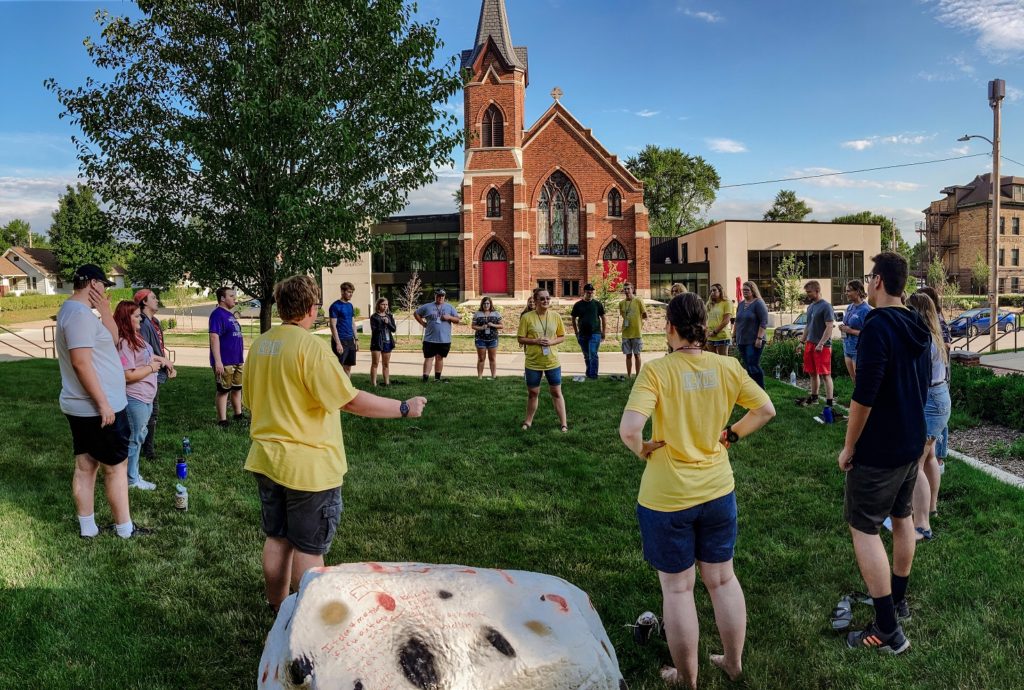
NEXUS is a vocational discernment institute rooted in Lutheran theology hosted by Grandview University in Des Moines, Iowa, and it is a week full of blessings! High school students who are contemplating their vocation, what God’s call for their life is, come to NEXUS and experience fellowship with other young Christians who are going through similar journeys. Morning and evening worship, classes on the Old and New Testament taught by solid Lutheran professors, small group discussions led by college-age mentors, and lots of prayer are all part and parcel of what NEXUS is, learning where God’s call meets your life!

Hi, my name is Luke and here are some of my thoughts on NEXUS: NEXUS is a great organization, because God makes it one! I loved being able to be a college-age mentor and a leader for the high school participants at NEXUS. Furthermore, I also liked being able to learn about God at NEXUS with and through the high school students.

My favorite thing about NEXUS this year was getting to meet and talk to Christians I had never met before or only briefly. I was able to talk to pastors, professors, and other Christians about Christianity. For myself, who someday wants to do full-time ministry as my career, working at NEXUS let me have conversations with other college-age students and high school students who think their vocation is full-time ministry. I also was able to practice and learn skills that will someday help me when I am doing full time ministry because I was a college-age mentor at NEXUS. Such skills were helping lead a small group, writing/giving a devotion, talking about the Bible with other people, etc.

Hello all, my name is Ethan Zimmerman, and this is my perspective on NEXUS!

NEXUS is something truly special, something that I don’t think happens anywhere else. NEXUS is not just another church or bible camp; discipleship and vocational discernment happen, and bonds of Christian fellowship that will stand the test of time are forged. My time as a NEXUS mentor was truly a blessing, and as my fellow mentor Chris put it, good for my soul!

Ethan

The topic of discipleship is something that has been on my mind for quite some time. I have wondered how I can disciple the people around me while I am at college, and being at NEXUS showed me how! Even though we were only with the participants for a week, we lived life with each other, we worshiped together, learned together, ate, laughed, and cried with each other. God showed me that this was how discipleship happened, in the nitty gritty little things of life, right in the trenches with people as they go through things and think about what God has in store for their life. Are they to be pastors? Missionaries? Youth leaders? Being there with these young participants while they pondered these questions and sought to answer what the Lord has called them to was truly a blessing and an eye opener as to what discipleship could look like.


I left NEXUS feeling encouraged, not just because I saw what discipleship and vocational discernment looked like in the lives of young folk, high school students, but because of the friendships that I left with. From the late nights discussing theology with the other mentors, to the goofy laughs shared with the participants, I left encouraged that there are other young Christians out there yearning to pursue God and answer the call He has given them in their lives, and that not every young person is all about decadent hedonism, but faith is still alive amongst my generation. I praise God for NEXUS, for the lives changed by it, for the doors opened because of it, and for the continued ministry it will have in the future!

We both think that every high school student that is a strong Christian should pray and think about coming to NEXUS next summer. Every high school student should think about going to NEXUS, not just high school students who think or know their vocation is full time ministry. We want to thank Lutheran CORE for financially helping The NEXUS Institute. And last but greatest of all, we want to thank God the Father, Son, and Holy Spirit for NEXUS!