Scriptural Authority To Suffer Another ELCA Blow in 2019?

Editor’s Note: The article below by Pastor Steven K. Gjerde originally appeared in the Summer 2018 Newsletter.
Click here to read the article.
Editor’s Note: The article below by Pastor Steven K. Gjerde originally appeared in the Summer 2018 Newsletter.
Click here to read the article.

Lutheran CORE has sent a letter to ELCA Presiding Bishop Elizabeth Eaton asking her to take action in light of some of the keynote speakers at the recent youth gathering. Click here to read it.

ELCA LEADERS DO NOT HONOR COMMITMENTS, RESPECT BOUNDARIES, OR RECOGNIZE THEIR OWN INCONSISTENCIES
LETTER FROM THE DIRECTOR – JUNE 2018
Recent events in the ELCA blatantly reveal that ELCA leaders have no intent to honor the commitments that were made and the boundaries that were set as part of the decisions on human sexuality at the 2009 Churchwide Assembly.
The social statement, “Human Sexuality: Gift and Trust,” which was approved by that assembly, clearly states that there is not agreement within the ELCA and that there would be a place for a wide variety of views, including the traditional view, within the church. But many who hold to the traditional view feel that all of the actions and positions taken by the ELCA since then have favored those who agree with same sex marriage and even those who are advocating for all sorts of other sexual identities and expressions. Recent events at United Lutheran Seminary, formed by the merger of Philadelphia and Gettysburg Seminaries, show just how much disfavor there is even against someone who held a traditional view twenty years ago.
Members of the LGBTQIA+ community at United Lutheran Seminary have been complaining loudly about how hurt, wounded, traumatized, and unsafe they feel because of the choice that was made for the first president of that institution. Great effort has been expended by ELCA leaders to help them feel safe. A letter written by one ELCA bishop came across to me as groveling in front of that part of the student body. In our view recent events at the seminary should lead anyone who has ever held a traditional view on human sexuality to feel unsafe. I have read various reports on the reasons for the recent firing of the president, Dr. Theresa Latini. For me any of those reasons is problematic.
If Dr. Latini was fired because twenty years ago she held a traditional view, even though she fully embraces the LGBTQIA+ agenda today, that is problematic, because it shows that anyone who has ever held a traditional view is unacceptable and their employment is not safe.
Some of the reports say that she was fired because twenty years ago she was director of an organization that advocates for and practices reparative or conversion therapy. I have spoken with the president of the board of OnebyOne, the organization that she was director of back in the 1990’s. He emphatically stated that that organization has never been an advocate for and has never practiced reparative therapy. Instead they are an educational arm of the church, which speaks to groups about hope and healing in Jesus. So if once being director of an organization that advocates for and practices reparative therapy is the reason she was fired, that reason also is problematic, because it is based upon an untruth.
Some say that Dr. Latini was fired because she did not disclose to the interviewing committee her previous involvement with OnebyOne. If that is the reason, that also is problematic, because, as I understand it, she did disclose her previous involvement to the chairperson of the board, who felt that she did not need to further disclose her previous involvement.
So, if any of those three was the reason for her being fired, they are all problematic, and they definitely show that the person who should feel unsafe in the ELCA is not a member of the LGBTQIA+ community, but instead anyone who now holds or has ever held a traditional view on human sexuality.
The above is just one more example of how the ELCA is not honoring its commitments to provide a place of inclusion, value, safety, respect, and honor for the traditional view on human sexuality. Why would I say that the leaders of the ELCA are not respecting the boundaries that were set by the 2009 Churchwide Assembly?
One needs look no further than the list of keynote speakers for the ELCA’s National Youth Gathering, which will be held at the end of this month in Houston. One of the keynote speakers is a member of the “We Are Naked and Unashamed” movement, which arose out of the student body of the Lutheran School of Theology in Chicago and rejects marriage by any definition (whether same gender or opposite gender) as normative for sexuality activity. Another keynote speaker is a leader in the DeColonize Lutheranism movement, which feels that Lutheranism needs to be delivered from white, male, and northern European dominance and oppression. A third keynote speaker is a mother and her twelve-year-old son, who wants to be a girl, who will be advocating for transgender issues.
The 2009 ELCA Churchwide Assembly addressed a specific and narrowly defined subset of same-sex relationships, namely those that are publicly accountable, lifelong, and monogamous (PALMS). It never addressed bisexuality or the issue of transgender persons or any of the other forms of sexual identity and expression that are a part of the LGBTQIA+ movement. And yet what do we see the ELCA doing less than nine years later? Totally catering to the LGBTQIA+ community within seminary student bodies, doing nothing to renounce the “We Are Naked and Unashamed” movement, and inviting a transgender activist to speak to 30, 000 young people at the National Youth Gathering.
Pastor Mark Erson, Chair of the Commission for LGBTQIA+ People in the ELCA’s Metro New York Synod, recently sent out an email in which he stated, “Our commission, that was formed in 2000 to implement our RIC (Reconciled in Christ) practice, was called the Commission for Gay and Lesbian People, but now there are a lot more letters that are used to identify members of this community.” They know full well that what they are pushing for is going way beyond what was approved in 2009.
Where is the honesty – where is the integrity – when ELCA leaders are endorsing, promoting, and allowing something far beyond what was agreed to and approved at the 2009 Churchwide Assembly? How can the ELCA claim to be an advocate for justice when it acts so unjustly? How could anyone who holds to a traditional view on human sexuality feel included, valued, honored, respected, and safe?
The ELCA suffers from nothing less than a massive breach of trust because of the way in which the actions of the ELCA since 2009 have been so different from what was actually approved in 2009.
If those are examples of how ELCA leaders are neither honoring commitments nor respecting boundaries, what do I mean when I say that they are not recognizing their own inconsistencies?
One ELCA synod had as part of its recent assembly a service of worship that featured Native leaders and Native music. The invitation from the synod said, “Join us as we reflect on the respect we owe the original inhabitants of the lands that make up our synod, repent of the harm done to Native populations . . . and commit ourselves to new levels of respect and regard.”
I cannot imagine their reflecting on the respect they owe to the original, orthodox leaders of the Lutheran Church. I cannot imagine their repenting of the harm they have done when they have bullied, isolated, and marginalized those with a traditional view of the authority of the Bible, Lutheran theology, human sexuality, and the mission of the church. I cannot imagine their repenting of the harm they have done to so many congregations because of the relentless LGBTQIA+ agenda. I cannot imagine their committing themselves to new levels of respect and regard for the traditional, orthodox people who planted the churches, built and paid for the buildings, and started the social service agencies within the territory of that synod. It amazes me how a synod can balance its budget by selling buildings of closed congregations – buildings that were built and paid for by people whose theology, moral values, and mission priorities they reject.
What kind of a future does a church body have that is doing things like that?
Dennis D. Nelson
President of the Board and Director of Lutheran CORE

LETTER FROM THE DIRECTOR – APRIL 2018
REPORT FROM THE PASTORAL SUMMIT – PHASE TWO
My head and heart were full as I returned home from Chicago after the second phase of the pastoral summit on April 11, followed by an all-day, in-person meeting of the board of Lutheran CORE. At the summit we heard from six outstanding presenters, who are serving God in very different settings, each one of them being very effective in their own setting. The day certainly showed us that while certain principles remain the same, and the Gospel is good news for all people, the methods used need to be different, and the style, emphases, and giftedness of the leaders need to be different, for the church to be able to reach all sorts of different kinds of people.
The purpose of the summit was to hear from several different people who are doing something unique and effective to raise up leaders, including pastors, for the future. We began by hearing from Scott Grorud, pastor of an LCMC congregation in southwestern Minnesota. It was exciting to hear about what he is doing to raise up young people to do ministry and to provide leadership for ministry. He told of a very thorough program of faith formation, which begins with the very young. Fourth graders attend a weekly Bible study in addition to Sunday School, which is overseen by adults but is student led. Incoming eighth graders are invited to a leadership retreat, to prepare them to be role models for incoming seventh graders. A youth band helps lead worship, so that confirmation students see youth who are just a little bit older than they are in leadership roles. High school juniors and seniors gather very early in the morning one day a week to read and discuss theology. An outreach to college students helps them stay in contact with their home congregation and supports them in their faith in an increasingly hostile environment. Through a summer internship program college students are involved in children’s and youth ministries, read and discuss theology, receive leadership training, and are mentored.
We then heard by Skype from Jari Rankinen, director of the Theological Institute of Finland. This organization was started in 1987 by several orthodox mission societies to provide support and Biblical, confessional Lutheran training for orthodox seminarians, to supplement the education they are receiving from the state church seminary, which is a part of the state university system.
Every Monday morning about one hundred fifty students receive an email describing classes in Biblical studies and theology that will be offered during the upcoming week. Attendance at those classes ranges in number from five to twenty-five, and the classes are held in rooms in the center of Helsinki, so they are near the university and thus easy for the students to get to. Last year twenty-five different people taught the classes. Most of them have doctoral degrees in theology, and many of them are professors at the state church seminary. Students receive their degree from the university rather than the institute. There are about two thousand people who support the institute with their prayers and financially. We were very grateful for current day technology as we were able to hear from and engage in conversation with someone in a time zone eight hours ahead of us.
Both Scott and Jari are very effective in their own particular setting, and yet how different their settings are. Scott described his church in southwestern Minnesota as being in the heart of deep, dark Lutheranism, so it is only to be expected that certain methods will work there that will not work elsewhere. Jari lives in a country that is traditionally Lutheran and where a strong majority of the people are members of the Lutheran church, but only about one percent of the population there attend church on any one given Sunday. A very different approach is needed – one that supports orthodoxy in a setting that is very indifferent if not hostile towards orthodoxy.
Another very different approach in a very different kind of setting was described by our third presenter, Brian Hughes, pastor of an ELCA congregation in Maryland. 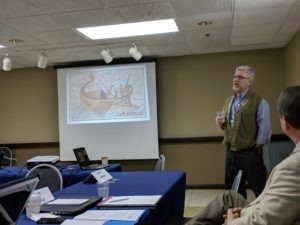 Brian describes his county as 90% unchurched, which is very different from deep, dark Lutheranism. He said, “The church culture has been bled out.”
Brian began by asking what it must have been like for the early fifth century Christians in Britain when they saw the Roman church leaders sailing down the Thames River, leaving Britain to return to Rome. What were the Christians in Britain going to do now? Christian communities were isolated and surrounded by nonbelievers, so they had to form small groups of people who would learn and practice the faith without the “structural church” headquartered in Rome. He then compared their situation with the position of Christians today. Christians today are surrounded by nonbelievers, and church structures and methods that have worked in the past do not work any longer – at least not in most settings. They have sailed down the Thames. What are we going to do now? After describing what happened in the development of Celtic Christianity – a lay led, monastic movement that kept the faith alive – Brian then told of how he is working to develop a similar network of equipped and empowered lay ministers. He quoted from the words of Jesus, who said, “The one who believes in Me will also do the works that I do and, in fact, will do greater works than these, because I am going to the Father” (John 14: 12). Brian told some amazing stories of lay people in his congregation doing amazing ministry, and then asked whether pastors today are willing to let go of ministry roles and to release, equip, and empower lay people to do ministry – even “greater things” kinds of ministry.
After lunch we heard from three more presenters. First, we heard from Gary Pecuch, director of youth ministries at an NALC congregation in Ohio. Gary and his wife are a blessing to the larger church as they lead their faith webinar seminars for the NALC as well as for the Southern Ohio Synod of the ELCA. One of the things that Gary emphasized most strongly is that faith formation must begin at a very early age. A congregation needs to “major in little people ministry.” He told of how a person’s interests and identity are solidified by the age of twelve, so we need to immerse young people in the life of the church well before that age. He spoke of the concept of “early and often.” Confirmation ministry needs to be the sharpest, best ministry in the church. If a church does confirmation well, chances are that young people will stick with the church or return to it later. Gary mentioned that many churches want to start with ministry to high schoolers, because theirs are the parents who are panicking. But the strength of a congregation’s high school ministry will never rise higher than the strength of that congregation’s early elementary ministry. Gary also spoke of the need for the digital church. He said that churches who do not embrace technology are either dead or dying. Finally, he talked about the importance of children and youth having quality relationships with every age group within the church. He identifies the relational voids that young people have in their lives, and then works to connect young people with the people in the congregation who will help fill that relational void.
Our fifth presenter was Julie Smith, pastor of an LCMC congregation in Minnesota, member of the LCMC board of trustees, and dean of students at St. Paul Seminary. Julie talked about the original vision that led to the founding of the seminary – that of training preachers of the Gospel, producing pastors who are deeply grounded in Lutheran theology to serve God in the church and in the world. Their program is one of contextually based education – learning in place. The concepts students learn they immediately live out in some fashion in their own ministry setting. She spoke of one criticism of residential education – it removes people from the real church and replaces it with an idealized church that does not exist. Pastors can end up hating the real church because it is not their ideal. The faculty and staff are also all embedded in congregations, which keeps their teaching real. Mentoring is central to this kind of education. Not only are the students learning and doing simultaneously, they are also constantly being fed by mentoring pastors. And the mentors themselves are constantly encouraged to learn, refresh, and deepen what they know, which experience reinvigorates their own ministry. Congregations invest in theological education in more ways than just sending a check. They see the development of the person right in their midst, from student to pastor. This approach also creates transparency in what the professors are teaching, because it is so “immediately there” for congregations. One significant challenge in this approach is the loss of community and collegiality. Students need to find other ways to connect with one another. The seminary holds an annual theological conference, which they encourage all students and faculty to attend.
Our final presenter was Jeff Christopherson, vice president of Send Network, which is a ministry of the Home Mission Board of the Southern Baptist Church. We were grateful that we could have conversation with and learn from not only our fellow Lutherans of different church body affiliations here in the United States, but also from a Lutheran from another part of the world and even from a non-Lutheran. This conversation also was by Skype. Again we were very grateful for the wonders of modern day technology.
Jeff began by sharing how the Southern Baptist Church planted seven hundred new mission starts last year, but then lost at least the same number of churches, so that even while planting that many, they are not able to keep up. He said that what is needed in our post-Christian world is not addition – not just the planting of new churches – but multiplication – planting new churches that then will go out and plant more new churches. What is needed is not inadequately fueling all church plants, but instead jet-fueling those who will be the most effective. His organization has developed a system for assessing the skills and preparedness of potential church planters and reviewing various locations and situations in order to reserve most of the resources for the most unchurched urban areas here in the United States. They carefully assess whether potential church planters have a vibrant relationship with Jesus, patience, tenacity, perseverance, and ability to endure pain. They then participate in a three-year program of intense training. Jeff shared that the goal is that four percent of the churches will be truly “multiplying” churches, and that ten percent will be more classic “reproducing/additive” churches. Together that percentage of churches can produce a “tipping point,” where there will be sufficient energy and resources to succeed. He concluded by sharing that a church planter needs to have a clear sense of call to this work, a high value for personal evangelism, and the ability to figure out not only how to win people for Jesus Christ, but then also how to develop these people into disciples who will win others for the Lord.
Summaries of these presentations can be found as part of the phase two section under the pastoral formation tab on our website, www.lutherancore.org. Audio recordings of the presentations will soon be available on our website.
As you can imagine, our minds were swirling by the end of the day. The next day the Lutheran CORE board met all day to process what we had heard and to begin to think through what happens next.
One thing that came to the top was this. For a long time we have been hearing about how many of the ministries that used to be “feeder programs” that would encourage young people to go to seminary and consider becoming a pastor no longer exist, or are not encouraging young people to become the kind of orthodox, outreach-oriented pastor that orthodox, outreach-oriented churches are looking for. We have also been hearing about how the first place where future pastors are formed is within the Christian home and within the local congregation. And yet what we are also hearing about is pastors who are not encouraging young people to become pastors because they themselves are not happy about being pastors. They are not encouraging young people to prepare for ministry because they themselves are burned out and/or are cynical about ministry. And many parents are not encouraging their children to become pastors because of the bad experiences that they themselves have had in church and because they want their children to be more financially successful.
I am reminded of how the apostle Paul ends his letter to the Ephesians by saying, “Grace be with you all who have an undying love for our Lord Jesus Christ” (Ephesians 6: 24). But then about one generation later the author of the book of Revelation writes to the church in Ephesus, “I know your works, your toil, and your patient endurance. You have tested those who claim to be apostles but are not. You are bearing up for the sake of my name. You have not grown weary.” But then he says, “But I have this against you, that you have abandoned the love you had at first” (Revelation 2: 2-4). What the church at Ephesus was commended for during one generation had been lost by the next generation.
Those who are involved with Lutheran CORE, LCMC, the NALC, and all others who have been a part of the renewal movement within the Lutheran Church have worked hard, have patiently endured, have not tolerated false teaching, are bearing up, and have not grown weary. But is there any way in which we have abandoned our first love? If we are going to have pastors in the future who fervently believe that the Bible is the Word of God and who are passionately committed to fulfilling the Great Commission, do we who are pastors, or retired pastors, or other workers or leaders in the church, need to rekindle our first love – our love for Christ, our love for the Church as the Body of Christ, and our love for ministry, the work of Christ in the world?
Blessings in Christ as we rekindle our first love,
Dennis D. Nelson
President of the Board and Director of Lutheran CORE

LETTER FROM THE DIRECTOR
FEBRUARY 2018
UPDATE ON PHASE TWO OF THE PASTORAL FORMATION PROJECT
Thank you for your prayers as we prepare for the second phase of our pastoral summit. The first phase was held at Grand View University in Des Moines last June. For that phase we gathered a number of leaders from four different Lutheran church bodies – ELCA, Missouri Synod, LCMC, and NALC – to discuss what can be done to raise up a whole new generation of Lutheran pastors who believe that the Bible is the Word of God and who are passionately committed to reaching people for Jesus Christ. A list of some of the main topics that were covered, as well as written copies and audio recordings of several of the presentations, can be found under the pastoral formation tab on the home page of our website, www.lutherancore.org.
The second phase will be held at a hotel near Chicago’s O’Hare airport on April 11. For this second phase we are gathering a number of leaders who are doing something unique and/or particularly effective to raise up leaders, including future pastors, in their ministry context. Four will be present in person, while two others will be presenting by skype.
The four who will be presenting in person are –
Scott Grorud, pastor of Faith Lutheran Church in Hutchinson, Minnesota (LCMC). Scott will tell about what he is doing to raise up leaders within his ministry context, including what he is doing to raise up young people to be future leaders.
Brian Hughes, pastor of St. John Lutheran Church in Columbia, Maryland (ELCA). Brian will describe what it means to be a multi-ethnic, multi-cultural, and multi-denominational church, and how he is raising up leaders in his ministry setting.
Gary Pecuch, director of youth ministries at St. John’s Evangelical Lutheran Church in Grove City, Ohio (NALC). Along with his wife, Gary leads the Faith Webinar seminars for the NALC and offers similar seminars for the ELCA’s Southern Ohio Synod. Gary will describe what the future church will look like (and not look like) for millennials and centennials; what the role of pastor will be in the future; what seminary education might look like in the future; and the kind of training he is offering young people and people who work with young people, in light of the above.
Julie Smith, pastor of St. John’s Lutheran Church in Springfield, Minnesota (LCMC); member of the LCMC board of trustees; and dean of students of Saint Paul Lutheran Seminary. Julie will tell about the vision that led to the founding of the seminary and also about their various programs – their more traditional programs as well as the ways in which they are making theological education more affordable, accessible, and available.
The two who will be presenting by skype are –
Jeff Christopherson, vice president of the Send Network, which is part of the North American Mission Board of the Southern Baptist Convention. Jeff will tell about his work of identifying, training, supporting, equipping, and sending out church planters who will focus on new believers, disciple-making, community transformation, and multiplication.
Jari Rankinen, general secretary of the Theological Institute of Finland. This institute gives support to orthodox seminarians and provides orthodox Lutheran teaching as a supplement to the education seminarians are receiving through the state university system. One of the presenters at the first phase of the pastoral summit, Gene Veith, told us about the mission societies in Scandinavia, who are keeping orthodoxy alive in an environment that is very hostile to orthodoxy. We are very grateful to Gene for putting us in touch with the leader of one of these institutions, so that we can learn more.
Also as part of our pastoral formation project, we are featuring in our bi-monthly newsletter, CORE Voice, different organizations that are training the next generation of Lutheran pastors. We are also working on putting together a workshop that could be presented at different church gatherings and convocations, involving the people who would be attending those events. A long-term goal is to be able to put together an event that would be open to all, would be inspirational in nature, and would be based upon the words of Jesus in Matthew 9 – “Pray to the Lord of the harvest to raise up laborers for His harvest.”
We are very grateful to all of our friends for their prayers for our pastoral formation project. We also want to say “Thank you” to all who have given a gift in support of these efforts to raise up pastors and other church leaders for the future.
Please continue to pray with us and for us as we continue to work with others to raise up the next generation of Lutheran pastors.
Blessings in Christ,
Dennis D. Nelson
President of the Board and Director of Lutheran CORE
dennisdnelsonaz@yahoo.com

A funny thing happened on my way to the 2018 March for Life–I almost talked myself out of going. I was already in DC, having attended the 8:30 prayer service at DAR Hall, although technically it was the 24th National Memorial for the Preborn and their Mothers and Fathers. At any rate, my car was in two-hour parking and I had broken away from the group (of mainly pastors), in search of a parking garage to prevent my car from being ticketed. It would have been easy to just keep driving as I needed to get to Richmond that night. But then I received an email from Dennis Nelson, President of the Board and Director of Lutheran CORE, which said, “Thank you for your bold witness as you participate in the March for Life today. Your presence and involvement help communicate the fact that we as Lutheran Christians believe that life, including the life of the unborn, is a precious gift from God.” Okay then—the timing of that was incredible and I believe in God, not coincidence–better find the others.
Four minutes later, my bus arrived and within an hour, by bus and by foot, I arrived at 12th Street and Constitution Ave where I was told to look for a large Lutherans For Life banner on the sunny side of the street. 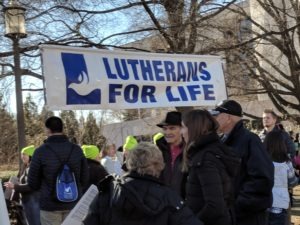 For the next two hours, Lutherans of all stripes gathered there to assemble their banners, grab lunch from the food trucks, and prepare for the march. There was unity of purpose, music, and joy in the air as introductions were made and photos were taken.
For us, the March began about 2 pm and we very slowly walked 1.3 miles to the United States Supreme Court building in about an hour and a half. Along the way, we saw a multitude of Catholic priests, nuns and lay people—an amazing witness to other Christians. 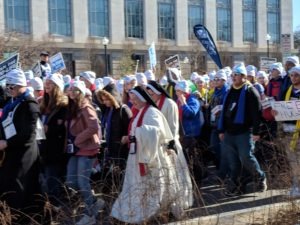 There were also a number of evangelicals from independent and traditional churches. We saw Lutherans holding signs and singing along to the hymns printed on the back of the signs. I will admit, I don’t trust myself to walk and read at the same time, so it was good that the hymns were familiar.
At the prayer service I noticed a lot of young people in the seats, in sharp contrast to the seniority of some of the clergy on the stage, but during the march we saw huge crowds of high school students, often dressed in brightly colored hats, scarves or shirts, as well as babies and young children. There was even an ELCA law student who attended with his NALC mother. His mom later told me, “It was great for him to see so many young adults his age marching for the cause of life.” Another young man approached us because he saw the banner we took turns carrying. He had come in from Iowa, one of only two Protestants on the bus, and he was happy to see other Protestants present. Now, 45 years after that fateful court case was decided, there seems to be hope for the future based on the youth present. This is not a battle that is going away anytime soon. I was heartened to hear that the President addressed the March for Life at the Rose Garden, but I did not witness that.
At the prayer service, I sat two seats away from an older teenager who seemed uncomfortable in her own skin and remarked that she wasn’t even religious. Near the end of the service, the Benham twins, David and Jason, spoke and much of what they had to say was directed at the youth. It turns out that their father, a pastor, used to talk to Miss Norma nearly every day because his office was located right next to the abortion clinic where she worked. Yes, the Norma McCorvey, from the Roe v. Wade court case, that led to legalized abortion in the United States. The Benhams continuously sent her cookies and invited her to dinner at their house until, over time, she became a Christian and pro-life. It is a much more complicated story than that, but I’m glad I got up early enough to hear it. If nothing else, a seed has been planted in that teenager, and I will always wonder if that day was life changing for her.
I don’t usually think of Washington, DC as a friendly place, but I met nice people at every turn all day long. Not just the marchers, but the bus drivers, the parking attendant, random people I stopped to ask for directions, and the Metro subway workers. I made it safely back to my car, parked somewhere near the intersection of Vermont and L streets, because the Metro workers knew I needed to get off the subway at McPherson Square. That was very important to know because my phone had died by that point and I didn’t have a map. Next time I will bring a bottle of water, my cell phone wall charger plus a map and SmarTrip subway card. When I finally got to my room in Richmond, VA that night, I had walked 13,725 steps and I fell asleep instantly.
To give you a feel for just how big this event was, watch this timelapse of the 2018 March for Life. 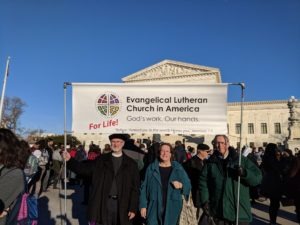
In its most recent newsletter, Lutheran CORE’s Steven Gjerde noted that ELCA Presiding Bp. Elizabeth Eaton had stated that, “Life is precious and beautiful and, even in its painfulness, something fiercely to be protected.” Next year, please join Lutheran CORE members, supporting members and partners, from a multitude of Lutheran church bodies, who will participate in the 2019 March for Life. Invite a friend, bring your kids and their friends, in order to show them that they are not alone and that “… we as Lutheran Christians believe that life, including the life of the unborn, is a precious gift from God.”
Kim Smith
Member of the Board of Lutheran CORE


