September 2023 Newsletter


Editor’s Note: Rev. Dr. Douglas Schoelles joined the board of Lutheran CORE earlier this year. Rev. Jeffray Greene has been writing devotions for us for a long time. We are grateful to them both for their valuable contributions to Lutheran CORE.
Lutheran CORE’s readers have been faithfully absorbing Rev. Greene’s daily devotions for many years. Some read them via the website and others view them on Twitter or on our Facebook page.
But it’s nice to have options. Pastor Schoelles enables you to watch a video or listen to audio in the car. He records The Daily Plunge in which he encourages “a quick swim in the day’s scripture reading.” Pr. Schoelles says he works his way through books of the Bible in bite-sized pieces. And by bite-sized he means videos in the 4–5-minute range. Definitely digestible!
Dr. Schoelles recently asked Lutheran CORE if we would like to link to his devotionals from our website. The answer was yes, thank you! And so now we can listen, watch or follow along by 1) listening to the audio, 2) watching via YouTube, or 3) following along on his Facebook page. Click here to open our new Daily Plunge Bible Study page where you can choose the option which best suits you. Also, click here to see Dr. Schoelles’ playlists arranged by books of the Bible.
Currently, Rev. Greene is about halfway through the book of Revelation while Dr. Schoelles is wading through 1 Corinthians. Please join us!
Both sets of devotions are available each day. Check here to see our new Devotions page. The Daily Devotions page and the new Daily Plunge Bible Study page are subpages under it but can also be accessed via the Devotions page.
Click here to see our revised web map reflecting these changes.


Editor’s Note: River’s Edge Ministry (REM), of Mt. Airy, MD, traveled to Pine Island, FL in January as part of Cross Country Mission (CCM) 2023. Pine Island was devastated by Hurricane Ian in late September 2022. Mary Bates, NALC Disaster Response Coordinator, did the necessary groundwork to find the work sites that matched our team’s skillsets. Lutheran CORE’s board provided funding that enabled REM to reduce the cost of the trip for the crew. Previous articles about Cross Country Mission and City Mission can be found The Potency of Missional Engagement, Igniting Renewal Through Mission and How City Mission Was Born, Part 1: Katrina, the Unwelcomed Reformer.
Intergenerational mission has been part of CCM’s DNA from the beginning. But I didn’t fully understand what that meant until we arrived and were working together at various job sites. Certainly, the crew that travelled to Pine Island in late January ranged in age from 15 to the early 70s, so I mentally checked “intergenerational” off my expectations list. But there was far more to it than that.
When I filled out the volunteer skills assessment, I reluctantly marked most of the construction areas with “Unskilled, no desire to try”. There’s no doubt that my foot is injured, and that I am well past my roofing days. And my everyday skills weren’t applicable to the construction projects critical to the trip. Sure, I could clean up (if that meant dishes), paint (as long as I didn’t have to climb ladders or get on the floor). Cooking, check! Then I got down to Spreading the love of Christ, Conversational Ministry and Prayer Ministry. Regrettably I consider myself a work in progress at spreading the love of Christ, so I marked that one as “unskilled, but willing to try.” For Conversational Ministry, I chose, “Can do a good job by myself.” For Prayer Ministry, I selected, “Have done, but need help.” But I fully expected that I’d be in the kitchen most of the time.
River’s Edge Ministries sent this message to team members ahead of time, “[T]here will be a need for more pastoral care for the home owners and the people around the neighborhoods. Be prepared to stop and listen to their stories, and pray for them if and when the Spirit leads. Remember we are serving these people. Our goal is less to ‘finish a job’ than it is to minister to the people who have experienced this devastation. Be ready to share the love of Christ to all we meet. If you feel called to this especially, there will certainly be opportunity to serve in this way.”
Each morning our job assignments were written on a white board under the pavilion where we met for meals and most anything that didn’t involve cooking, showering, or sleeping. Pastor K. Craig Moorman knows that we (especially those new to this kind of mission work) need to hear “Expect the unexpected!” repeatedly. Otherwise … we might have been flabbergasted to find that the church where we stayed was itself under major construction—including the kitchen!
Each day, I was paired with Doreen, a retired nurse practitioner, on the Conversational Ministry team. And at first I found it difficult to shake the mindset that I was doing “nothing” while everyone around us was sweating from their hard labor.
Doreen and I mostly listened to the homeowners, their neighbor, and CCM team members talk. Our homeowners immediately began sharing their lives’ sorrows with us and those stories will stick with us. They talked about how they faced death and were able to survive the storm surge that swept over the entire island because their neighbor left them the keys to his two-story house when he evacuated. They told us just how bad it was when they returned to their property. It didn’t take long before it became crystal clear that conversational ministry was important to the body of Christ too.
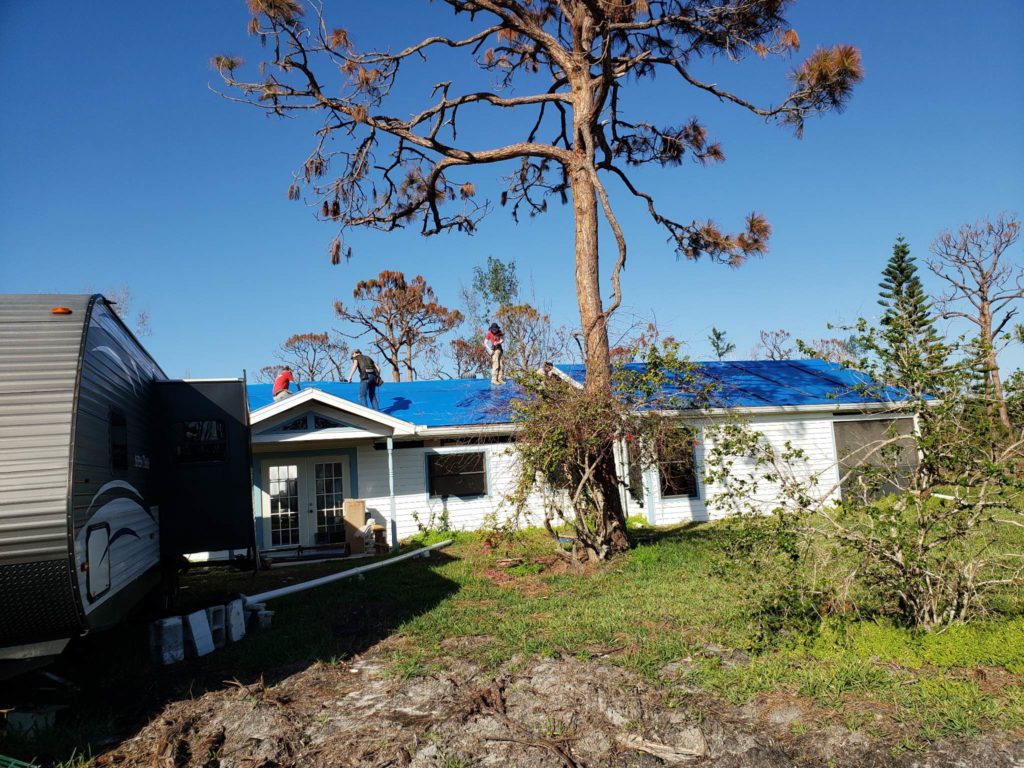
At some point I thought about how much faith it took for the homeowners to let a team come into their partially reconstructed home and tear down its professionally installed blue tarp. Mary Bates, the NALC’s disaster response coordinator, had begged them to let us help, but how do you let people you don’t know come in and rip the roof off of your home without wondering if they will really be back the next day? Could we be trusted to keep our promises?


In the end, the homeowners, neighbors, and the entire team witnessed His Church operating as Jesus intended. Team members hailed from all kinds of churches, but functioned as one joyful body in Christ.
At the close of the first full day, we met in a large prayer circle on the sandy driveway. Doreen told me earlier in the day that she felt like we needed to pray with and for the homeowners and their neighbor … and she led that prayer—teaching some of us how it’s done.
I later realized how much we learned from each other on that trip. It needed to be multigenerational. The guys on the roof were mostly 15-35ish. It is not work that most older people can still do. But inside the home, the skilled were teaching the unskilled how to cut, fit, and install insulation and drywall. Then they were teaching them how to mud and use paper tape on the seams. A couple of the younger women were working “upstairs” that last day too—during that final push to finish the roof on the original part of the house—as promised.
I remember hearing the story of a Jewish man who learned to pray by standing next to his father as he prayed. That’s what we witnessed on Pine Island. People that knew how, did and taught, and the rest of us observed and learned. We did not leave the mission field unchanged; it changed us. It’s no wonder, as Pastor Craig wrote in Igniting Renewal Through Mission, that “exposing [his children] to the mission field” resulted in all five of his [now adult] children having a “deep and abiding relationship with Jesus Christ.” And it’s no wonder that his two youngest sons, Jacob and Caleb, and their friends were able to lead that group as if they’d been taught to do so.


CORRECTION: The Global Lutheran House of Study is located at United Theological Seminary.


